













60's Space Food Looks Gross, Probably Tastes Gross

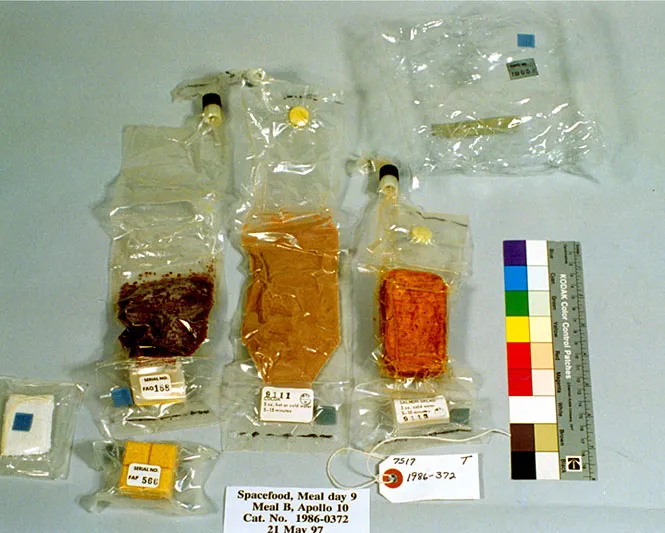
Being on one of the Apollo missions sounds like a blast, but in the end, you still gotta eat. Shown in this image is John Young's extra space lunch from the Apollo 10 mission. It contains cocoa, salmon salad, sugar cookie cubes, grape punch and hand wipes.
The Smithsonian's National Air and Space Museum released the image today, May 18, to correspond with the anniversary of the Apollo 10 mission.
The Apollo 10 spacecraft launched from Cape Kennedy at 12:49 p.m. EST with commander Thomas Stafford, command module pilot Young and lunar module pilot Gene Cernan. This liftoff marked the fourth Apollo launch in seven months. Its purpose was to serve as a complete dry run for the Apollo 11 mission, the first mission to land humans on the Moon.
Each crew member was supplied with three meals per day, which provided approximately 2,800 calories. This photo shows Young’s Meal B lunch for mission Day 9.
And, no, it's not still around because he went on a hunger strike until NASA invented better space food. The astronauts were provided with extra food in case their mission had to be extended. Because the mission only lasted eight days he didn't eat this "delicious" food (obviously).
Meals were sorted by day and designated for each astronaut with a corresponding piece of Velcro — white for mission commander, blue for command module pilot and red for lunar module pilot. You can see the blue Velcro marking this meal as Young's in this images.
This meal shows the special packaging and food processing required for eating in the reduced gravity of space.
Get the world’s most fascinating discoveries delivered straight to your inbox.
