 Live Science Plus






Divers Exploring WWII 'Graveyard of the Atlantic'
You are now subscribed
Your newsletter sign-up was successful
Want to add more newsletters?

Delivered Daily
Daily Newsletter
Sign up for the latest discoveries, groundbreaking research and fascinating breakthroughs that impact you and the wider world direct to your inbox.

Once a week
Life's Little Mysteries
Feed your curiosity with an exclusive mystery every week, solved with science and delivered direct to your inbox before it's seen anywhere else.

Once a week
How It Works
Sign up to our free science & technology newsletter for your weekly fix of fascinating articles, quick quizzes, amazing images, and more
Delivered daily
Space.com Newsletter
Breaking space news, the latest updates on rocket launches, skywatching events and more!

Once a month
Watch This Space
Sign up to our monthly entertainment newsletter to keep up with all our coverage of the latest sci-fi and space movies, tv shows, games and books.

Once a week
Night Sky This Week
Discover this week's must-see night sky events, moon phases, and stunning astrophotos. Sign up for our skywatching newsletter and explore the universe with us!
Join the club
Get full access to premium articles, exclusive features and a growing list of member rewards.
The seas off the North Carolina coast are known to be filled with World War II shipwrecks. But this battleground hasn't been thoroughly studied — until now.
These waters are known as the Graveyard of the Atlantic and Torpedo Junction. Here, dozens of ships — mostly merchant vessels — were sunk by German U-boats.

"They sank ships at will," said study team member Eva Kovacs of the Woods Hole Oceanographic Institution (WHOI) in Massachusetts. Kovacs is part of a 10-day mission to provide NOAA with the first 3-D optical survey of the undersea wrecks off the North Carolina coast.
"We hope to get a full 3-D picture of several sites so that NOAA can go back and assess the wrecks' condition and the impact of the ships on the marine environment," Kovacs said. "We're breaking new ground."

The Battle of the Atlantic mission is the first study of a maritime battleground off the coast of North Carolina, according to NOAA officials.
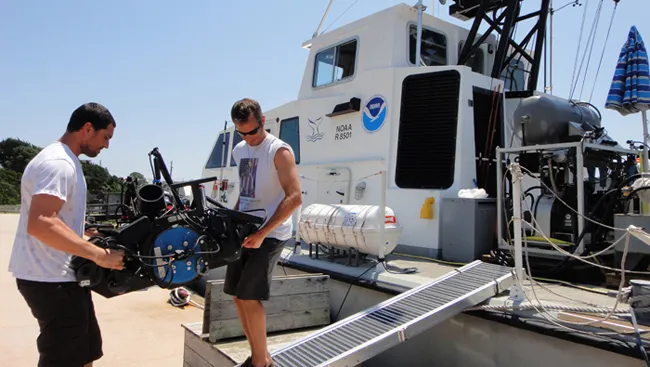
The mission, currently in progress aboard the NOAA vessel SRVx, employs a remotely operated vehicle (ROV) outfitted with several underwater 3-D and high-definition camera systems developed by the mission scientists. The team expects to survey wrecks as deep as 600 feet (183 meters).
WHOI hopes to provide dramatic still and video images, which will be the detailed data needed to fashion the large, two- and three-dimensional mosaic maps of the shipwreck sites. The maps will help the researchers monitor changes in the vessels over the years.
The dive team will be on the lookout for one of the last of the known German U-boats, which has yet to be found.
On the other side of the United States, a separate research mission recently finished exploring World War II shipwrecks of the coast of Hawaii.

