













Sumatra, Japan, Chile: Are Earthquakes Getting Worse?

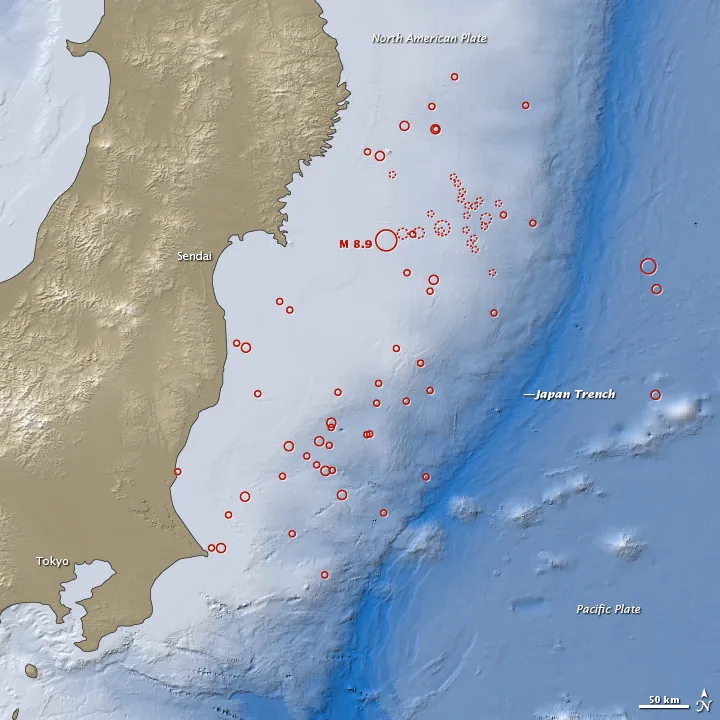
The 8.9-magnitude earthquake that rumbled through Japan today (March 11), triggering a devastating tsunami, was the strongest felt in that country since seismic monitoring was invented. It's also comparable in scale to a few other recent temblors, including last year's 8.8-magnitude quake in Chile and 2004's 9.1-magnitude undersea rupture off Indonesia that caused a tsunami that killed more than 200,000 people.
But researchers say these catastrophes shouldn't be taken as evidence of a larger trend. According to the United States Geological Survey, the number of earthquakes with magnitudes greater than 7 has remained constant in the last century. And the occurrence of a few big quakes in a few years is most likely a statistical anomaly. (The upcoming "supermoon," by the way, also did not cause the Japanese earthquake.)
"Statistics are way too small to say that this just couldn't happen randomly," Henry Pollack, a professor of geological sciences at the University of Michigan, told LiveScience.
However, increasing populations in earthquake-prone areas mean that smaller quakes can put more people at risk than in the past, researchers say.
A more wobbly future?
Earthquakes with magnitudes in the upper 8s and 9s are rare; even magnitude-8 quakes occur, on average, just once a year. So the chance of having two big quakes in one year is statistically not that much different than having one in a year, Pollack said, just as raising your chances of winning the lottery from one in a million to two in a million is negligible.
The top six quakes ever recorded do seem to cluster into two time periods: a 12-year span between 1952 and 1964, when the first, second and fourth-largest quakes ever hit Chile, Alaska and the Kamchatka Peninsula, respectively; and the seven-year span between the 2004 Indian Ocean quake (number three on record) and today's Japanese quake, which bumped last year's 8.8-magnitude Chile quake out of the top five. That clustering is very likely random chance, said Terry Tullis, a professor emeritus of geological sciences at Brown University. But it should provide a sense of relief to anyone worrying that the current spate of quakes has doomed us to a more unstable future: After all, Tullis said, things quieted down quite a bit after 1964, at least in terms of large quakes.
Get the world’s most fascinating discoveries delivered straight to your inbox.
"I don't think it's anything to get alarmed about, in terms of 'Are we having more and more and more?'" Tullis told LiveScience. "There is no reason to suppose that we're going to have quite a few more big ones quite soon — which is not to say they couldn't happen, but I think there is no reason to be concerned based on the limited information we do have."
Same quakes, more casualties
There may be little evidence that quakes themselves are getting worse, but populations in quake-prone areas are increasing, according to the USGS. That means relatively small quakes can cause big casualties. The losses are even greater in areas without earthquake-resistant building standards. The 2010 Haiti quake was a magnitude 7, but because the epicenter was a densely populated area full of shoddy buildings, the death toll was between 92,000 and 316,000. In comparison, the 2010 8.8-magnitude Chilean quake happened off the coast of a better-built city. The death toll of that quake was about 500 people.
"One thing we'll learn [from this quake] is how much insight the Japanese had into earthquake construction methods, because an event like this really puts buildings to the test," Pollack said.
You can follow LiveScience Senior Writer Stephanie Pappas on Twitter @sipappas.

Stephanie Pappas is a contributing writer for Live Science, covering topics ranging from geoscience to archaeology to the human brain and behavior. She was previously a senior writer for Live Science but is now a freelancer based in Denver, Colorado, and regularly contributes to Scientific American and The Monitor, the monthly magazine of the American Psychological Association. Stephanie received a bachelor's degree in psychology from the University of South Carolina and a graduate certificate in science communication from the University of California, Santa Cruz.