













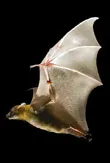
Their motions might seem erratic and graceless, but bats are more efficient flyers than birds, thanks to an airlift mechanism that is unique among aerial creatures, new wind-tunnel tests show.
Previous studies that compared oxygen consumption among birds, insects and bats of similar sizes—a hummingbird, a small bat and a large moth, for example—found that bats [image] use less energy to fly, but “no one’s really had an explanation for this phenomenon,” said study team member Sharon Swartz, an associate professor in ecology and evolutionary biology at Brown University.
The wind tunnel tests suggest the secret to efficient bat flight lies in the furry creature’s flexible skin membrane and its many-jointed wings, which together creates a shape-shifting structure that provides more lift, less drag and greater maneuverability.
Like human hands
Unlike insects and birds, which have relatively rigid wings that can move in only a few directions, a bat’s wing contains more than two dozen joints that are overlaid by a thin elastic membrane that can stretch to catch air and generate lift in many different ways [video].
This gives bats an extraordinary amount of control over the three-dimensional shape their wings take during flight, Swartz explained.
“Insects can move the joint at the insect equivalent of a shoulder, but that’s the only place where they can exert force and control movement,” she said. Birds have many more joints in their wings, but it’s nothing compared to bats.
Get the world’s most fascinating discoveries delivered straight to your inbox.
“Bats are operating with the same skeleton that we have. Every joint in the human hand is there in the bat’s wing and actually a couple more,” Swartz told LiveScience. “Think about the degree of control that we have over the shape of our hands—bats are able to extend that to make fine scale adjustments during flight.”
It was once thought that despite having so many wing joints, it was more efficient for bats to stabilize their wings and wave them up and down like relatively rigid paddles the way birds do.
“What we see when we look more closely is that in fact, it’s not what they’re doing,” Swartz said in a telephone interview. “It suggests that they’re able to take advantage of this highly jointed system to make subtle adjustments to the wing shape during flight.”
Stretchy wings
The other key to a bat’s efficient flight lies in its highly elastic wing. Videos from the wind tunnel tests show that a bat’s wing is mostly extended for the down stroke during straightforward flight. But because the membrane can curve and stretch much more than a bird’s wing can, bats can generate greater lift for less energy.
By blowing non-toxic smoke over the bats [video] as they were flying, the researchers were also able to create a video that revealed how air flows around the creatures as they flap their wings.
The data showed that during the down stroke, the air vortex—which generates much of the lift in flapping-wing flight—closely tracks the animals’ wingtips. But in the upstroke, the vortex appears to come from another location entirely, perhaps the wrist joint.
The researchers think this unusual pattern helps to make bat flight more efficient and credit it to the tremendous flexibility and articulation of the wing.
Model for flying machines
The findings, detailed in the Dec. 2006 issue of the journal Bioinspiration and Biomimetics, suggest the furry fliers might make good templates for flying machines.
“Bats have unique capabilities, but the goal is not to build something that looks like a bat,” said study team member Kenny Breuer, also of Brown University. “We want to understand bat flight and be able to incorporate some of the features of bat flight into an engineered vehicle.”
The complexity of bat’s wings also challenges some current theories that say bats evolved from some kind of flying squirrel-type creature.
“That might still be true, but what we know today is that although gliding appears to have evolved seven times in mammals,” Swartz said, “not a single one of those groups is closely related to bats.”