













Triceraaatooops, I Am Your Faaather

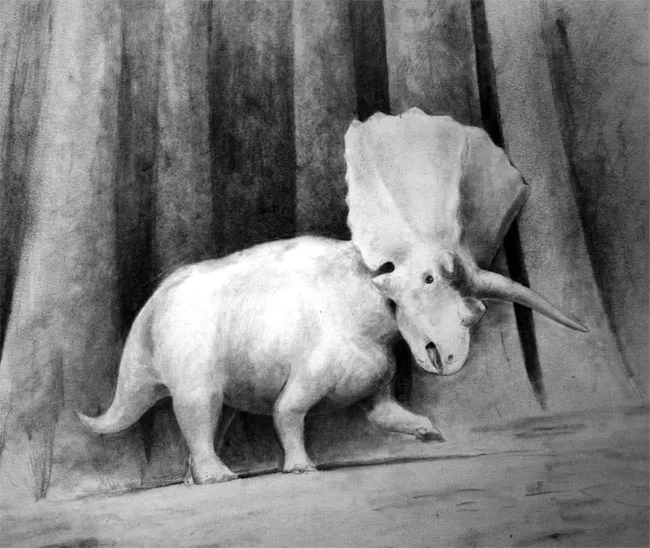
An enormous horned dinosaur, weighing as much as an African elephant with a skull extending about 8 feet (2.4 meters), was recently discovered by a paleontologist — within the pages of a scientific journal article.
The dinosaur, dubbed Titanoceratops ouranos, lived in the American southwest during the late Cretaceous period around 74 million years ago. The horned dinosaur represents the earliest member of the Triceratops lineage, called the Triceratopsini, suggesting the group evolved its large size more than 5 million years earlier than previously thought, according to Yale University paleontologist Nicholas Longrich, who made the discovery, which will be detailed in an upcoming issue of the journal Cretaceous Research.
Until now, the oldest known member of the Triceratopsini was the 68-million-year-old Eotriceratops xerinsularis found in Alberta.
Longrich made the discovery while searching through scientific papers. He came across a description of a partial skeleton of a dinosaur discovered in New Mexico in 1941, which went untouched until 1995 when it was identified as Pentaceratops sternbergi. When the missing part of its frill, a signature feature of the horned dinosaurs, was reconstructed for display in the Sam Noble Oklahoma Museum of Natural History, it was modeled after Pentaceratops.
"When I looked at the skeleton more closely, I realized it was just too different from the other known Pentaceratops to be a member of the species," Longrich said, adding that the specimen's size indicated it likely weighed about twice as much as an adult Pentaceratops.
The new species is very similar to Triceratops, but with a thinner frill, longer nose and slightly bigger horns, Longrich said.
Longrich thinks Titanoceratops is the ancestor of both Triceratops and Torosaurus, and that the latter two split several millions years after Titanoceratops evolved. "This skeleton is exactly what you would expect their ancestor to look like," Longrich said.
Get the world’s most fascinating discoveries delivered straight to your inbox.
Next, Longrich hopes other paleontologists will find fossil skeletons of Titanoceratops that include intact frills to help confirm the differences between Titanoceratops and Pentaceratops.
You can follow LiveScience Managing Editor Jeanna Bryner on Twitter @jeannabryner.
