 Live Science Plus





You are now subscribed
Your newsletter sign-up was successful
Want to add more newsletters?

Delivered Daily
Daily Newsletter
Sign up for the latest discoveries, groundbreaking research and fascinating breakthroughs that impact you and the wider world direct to your inbox.

Once a week
Life's Little Mysteries
Feed your curiosity with an exclusive mystery every week, solved with science and delivered direct to your inbox before it's seen anywhere else.

Once a week
How It Works
Sign up to our free science & technology newsletter for your weekly fix of fascinating articles, quick quizzes, amazing images, and more

Delivered daily
Space.com Newsletter
Breaking space news, the latest updates on rocket launches, skywatching events and more!

Once a month
Watch This Space
Sign up to our monthly entertainment newsletter to keep up with all our coverage of the latest sci-fi and space movies, tv shows, games and books.

Once a week
Night Sky This Week
Discover this week's must-see night sky events, moon phases, and stunning astrophotos. Sign up for our skywatching newsletter and explore the universe with us!
Join the club
Get full access to premium articles, exclusive features and a growing list of member rewards.
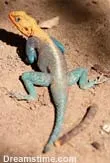
The rainbow-splashed tails of lizards fade with age, a costume change that is a consequence of different feeding behaviors in juveniles versus adults, new research suggests.
Juvenile lizards actively search for food, exposing themselves frequently to danger from lurking predators. By flashing an eye-catching tail, the lizards can deflect attacks to this appendage, which can re-grow if severed. Later in life when the lizard switches to less active food finding, the dazzling decoy becomes unnecessary.
The lizard's main predator at the study site was a carnivorous bird, the great grey shrike, which hunts from perches and has excellent color vision.
To survive an ambush the juvenile lizards in the study used two tail displays—a fast, delicate vibration and a slower undulation—more frequently than when they matured. Since juveniles are so active there is a greater probability of encountering predators, and they are less likely to spot the unexpected enemy. So the tail displays can be lifesavers.
At about three weeks old, the lizards became less active and relied on the safer sit-and-wait method of finding food. While stationary, the adults are more likely to spot a predator in time to escape.
"The ultimate experiment to explore our hypothesis further would be to manipulate tail color and to examine survival consequences when lizards use either of the two foraging modes," the authors stated in their research paper, published in the November/December issue of the journal Behavioral Ecology.
Researchers said that while they can't directly apply the results to other species, it could hold true for other lizards that experience the color change.
- Three Lizards, Three Behaviors
- Snakes, Frogs and Lizards: The Best of Your Images
- Fickle Female Fish Force Males to be Flashy
- Images: World's Ugliest Animals
