















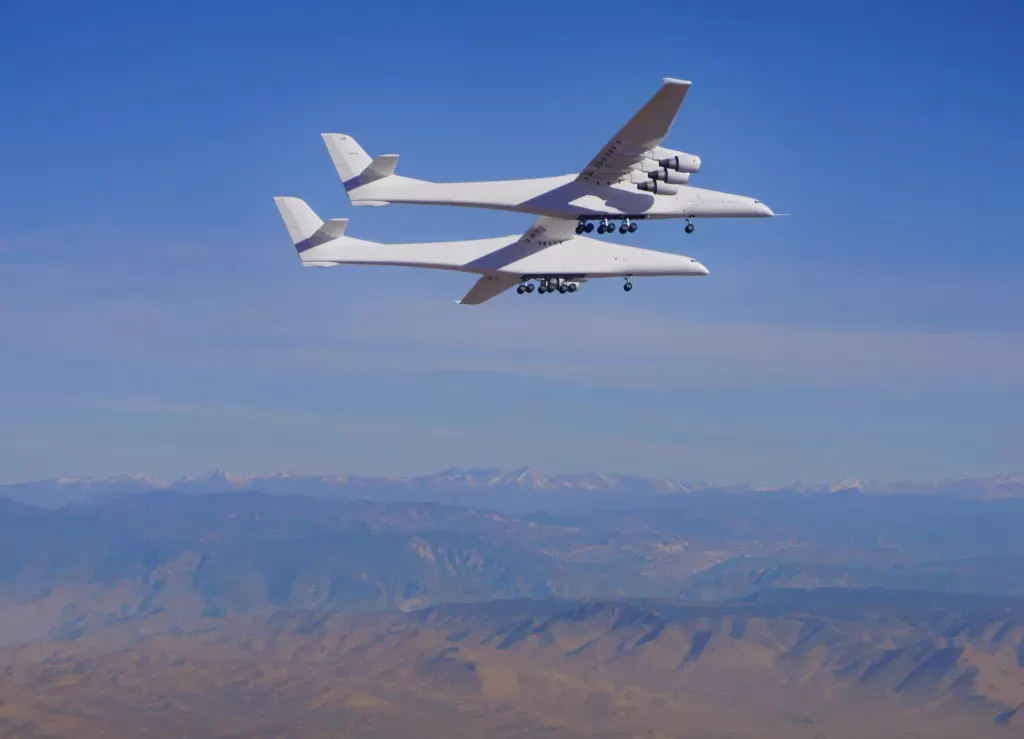
The biggest airplane ever built now has two flights under its belt.
Stratolaunch's Roc carrier plane, which is being groomed to haul hypersonic vehicles aloft, conducted its second-ever test flight Thursday morning (April 29).
The giant aircraft, which features a wingspan of 385 feet (117 meters), took off from Mojave Air and Space Port in southeastern California at 10:28 a.m. EDT (1428 GMT; 7:28 local California time) on a data-gathering shakeout cruise that lasted three hours and 14 minutes.
Related: Stratolaunch test photos — The world's largest plane in action

Roc, which Stratolaunch will use to air-launch hypersonic vehicles, stayed aloft for more than three hours on the April 29 flight.
Roc reached a maximum altitude of 14,000 feet (4,267 m) and a top speed of 199 mph (320 km/h) during Thursday's test flight, which Stratolaunch deemed a success.
"We're very pleased with how the Stratolaunch aircraft performed today, and we are equally excited about how much closer the aircraft is to launching its first hypersonic vehicle," Stratolaunch chief operating officer Zachary Krevor said during a postflight news conference today.
Microsoft co-founder Paul Allen established Stratolaunch in 2011 with the idea that Roc would be used to launch satellites in midair. But Allen died in October 2018 without seeing that vision become reality, or even seeing the twin-fuselage Roc get off the ground. The plane didn't make its first — and, until today, only — test flight until April 2019.
Get the world’s most fascinating discoveries delivered straight to your inbox.
The company was sold in October 2019 to its current owners, who recast Roc's role. The plane will now serve as a mobile launch platform for hypersonic vehicles, maneuverable craft that travel at least five times faster than the speed of sound.
Stratolaunch is developing its own family of hypersonic vehicles, including a reusable 28-foot-long (8.5 m) craft called Talon-A, which will be the first to fly with Roc. But that won't happen for a while yet; Roc needs to make a number of additional solo flights first, company representatives said today.
If all goes according to plan, the first drop tests with Roc and a Talon-A test article will occur early next year. An expendable version of Talon-A will reach hypersonic speeds later in 2022, and the first flight with the reusable Talon-A variant will follow in 2023, said Stratolaunch chief technology officer Daniel Millman.
The data gathered during Talon-A flights might be of interest to the U.S. military, which has been developing its own hypersonic vehicles for years now, though none are operational yet. (Hypersonic vehicles are good weapon-delivery systems, because their maneuverability makes them tougher to counteract than traditional ballistic missiles.)
"One of the areas that we're looking at is, how can we help the Department of Defense in mitigating risks for a lot of their expensive flight testing?" Millman said. "Our testbed has the ability to carry payloads. It has the ability to test materials. It has the ability to fly a variety of profiles that are of interest to folks across the spectrum both offensively and defensively in terms of hypersonics."
Mike Wall is the author of "Out There" (Grand Central Publishing, 2018; illustrated by Karl Tate), a book about the search for alien life. Follow him on Twitter @michaeldwall. Follow us on Twitter @Spacedotcom or Facebook.
