Get the world’s most fascinating discoveries delivered straight to your inbox.
You are now subscribed
Your newsletter sign-up was successful
Want to add more newsletters?
Join the club
Get full access to premium articles, exclusive features and a growing list of member rewards.
An account already exists for this email address, please log in.
Invisible 'flickering' on the sun could predict potentially dangerous solar flares hours in advance
Images captured by NASA's Solar Dynamics Observatory have revealed that "coronal loops" give off subtle flashes of ultraviolet light before a solar flare, which could act as an early warning system for dangerous space weather.
Shining loops of plasma on the surface of the sun "flicker" hours before they unleash potentially dangerous solar flares, a new study shows. The new findings could help create more reliable space weather forecasts, researchers say.
Solar flares are violent outbursts of electromagnetic radiation that shoot from the sun when invisible magnetic field lines at the sun's surface get twisted up until they eventually snap. These outbursts most commonly occur around sunspots — dark patches where magnetic field lines poke through our home star's surface — and often pull up plasma from the sun's surface into shimmering horseshoe shapes, known as coronal loops, before they blow their top.
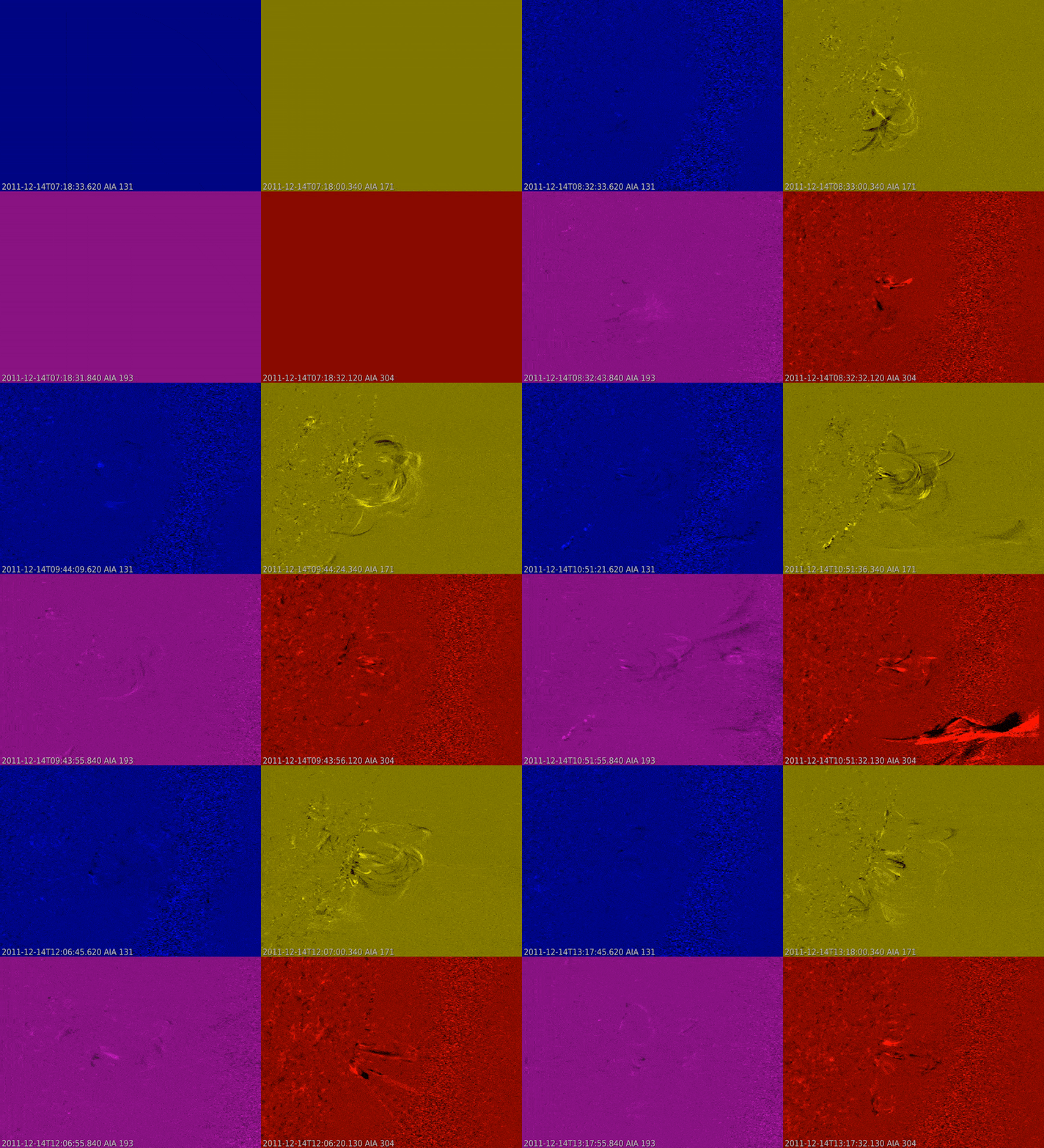
In the new study, published Dec. 6, 2024 in the Astrophysical Journal Letters and presented Jan. 15 at the 245th meeting of the American Astronomical Society in Maryland, researchers analyzed multi-wavelength images of coronal loops preceding 50 solar flares, filmed by NASA's Solar Dynamics Observatory (SDO). This revealed that the loops emitted small flashes of invisible ultraviolet light at specific wavelengths shortly before the flares were unleashed.
"The results are really important for understanding flares and may improve our ability to predict dangerous space weather," study co-author Emily Mason, a researcher at Predictive Science Inc. in San Diego, said in a statement.
Researchers analyzed SDO footage of the coronal loops preceding 50 solar flares. This video shows the flickering in a loop from 2011 in four different wavelengths of ultraviolet.
The researchers noted that this flickering could "signal oncoming flares two to six hours ahead of time with 60 to 80 percent accuracy," which is a significant improvement over current methods. The intensity of the flickering also correlates with the power of the incoming flares, they added.
Sign up for the Live Science daily newsletter now
Get the world’s most fascinating discoveries delivered straight to your inbox.
"However, the [study] team says more observations are needed to confirm this link," NASA representatives wrote in the statement.
Currently, the sun is spitting out solar flares like there's no tomorrow thanks to the ongoing solar maximum — the peak in the sun's roughly 11-year cycle of activity — so there will be no shortage of data for follow-up studies.
Predicting space weather
Forecasting solar activity is extremely challenging, and scientists can still get predictions wrong. For example, the ongoing solar maximum arrived earlier and has been more active than scientists initially expected.
Being able to more accurately predict space weather would also give aurora chasers a better chance of seeing the northern lights.
But most of the current methods of forecasting space weather, such as measuring magnetic field strength and analyzing sunspots, do not give accurate estimates for when specific flares will occur.
"A lot of the predictive schemes that have been developed are still predicting the likelihood of flares in a given time period and not necessarily exact timing," study co-author Seth Garland, a researcher at the Air Force Institute of Technology in Ohio, said in the statement.
However, the new method of predicting solar flares could provide more advanced warning by taking into account the individuality of each potential solar outburst.
"Each solar flare is like a snowflake — every single flare is unique," study lead author Kara Kniezewski, a graduate student at the Air Force Institute of Technology, said in the statement.
Harry is a U.K.-based senior staff writer at Live Science. He studied marine biology at the University of Exeter before training to become a journalist. He covers a wide range of topics including space exploration, planetary science, space weather, climate change, animal behavior and paleontology. His recent work on the solar maximum won "best space submission" at the 2024 Aerospace Media Awards and was shortlisted in the "top scoop" category at the NCTJ Awards for Excellence in 2023. He also writes Live Science's weekly Earth from space series.