India's moon rover, Chandrayaan-3, has for the first time detected sulfur near the moon's south pole, the country's space agency announced earlier this week. The sought-after element is usually found near volcanoes on Earth, so its appearance on the moon hints at our satellite's volcanic history as well as past atmospheric conditions, scientists say.
And reserves of the element could be key for building infrastructure on the moon.
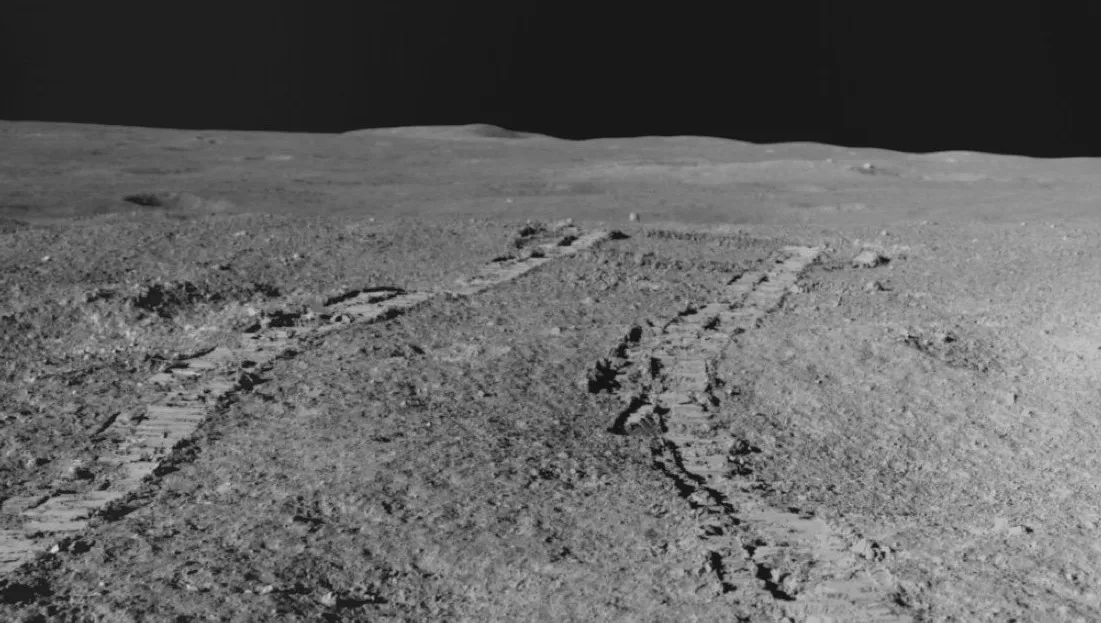
The detection comes less than a week after India's spacecraft aced its touchdown about 70 degrees from the lunar south pole. Less than a day later, the solar-powered Pragyan rover began its quest for frozen water in its new home.
While that discovery is yet to come Pragyan has "unambiguously" detected sulfur in lunar soil by conducting first-ever local measurements on the moon, the Indian Space Research Organization (ISRO) said in a statement published Monday (Aug. 28). The rover is equipped with a chemical analysis tool — not unlike the ones onboard Mars rovers Curiosity and China's now-defunct Zhurong — which can beam a laser onto the lunar surface and zap soil particles into a plume of plasma. Sulfur was then detected in the plume by the unique wavelength at which it emits light, ISRO noted.
India's Chandrayaan-3 spacecraft snapped this photo while entering orbit around the moon on Aug. 5, 2023.
(Image credit: ISRO)
Using the same method, Pragyan also spotted a host of other elements in lunar soil: Aluminum, calcium, chromium, iron, manganese, oxygen, silicon and titanium. While these elements and their abundance can unveil more details about how the moon evolved geologically, sulfur's presence specifically has intrigued scientists since the 1970s.
A recent analysis into the 382 kilograms (842 pounds) worth of moon rocks brought home by the Apollo missions in early 1970s did find sulfur, but those samples were picked up from near the moon's equator. This is the first time the element has also been detected near the south pole, which is a region of immense interest for many crewed and uncrewed missions alike, largely due to its apparent reservoir of frozen water.
Sign up for the Live Science daily newsletter now
Get the world’s most fascinating discoveries delivered straight to your inbox.
Past research shows that astronomers can use lunar sulfur in storage batteries and for construction purposes. Sulfur could even replace moon water while building infrastructure or habitats, thanks to the fact that it is best used as a hot element around 248 degrees Fahrenheit (120 degrees Celsius), which is just a tad higher than the moon's daytime temperatures of 224 degrees Fahrenheit (106 degrees Celsius).
Although the moon is circled by several spacecraft, detecting sulfur was "something that was not feasible by the instruments onboard the orbiters," ISRO said in the same statement.
The space agency's two-week long Chandrayaan-3 mission reached its halfway point yesterday (Aug. 30).
Meanwhile, the rover Pragyan avoided a close call with a hazardous crater after it was rerouted onto a new path. Not long after, it snapped the first full picture of the Vikram lunar lander on the moon.
Pragyan is still on the hunt for hydrogen, which scientists hope can be mined to produce water and rocket fuel.
Sharmila Kuthunur is an independent space journalist based in Bengaluru, India. Her work has also appeared in Scientific American, Science, Astronomy and Space.com, among other publications. She holds a master's degree in journalism from Northeastern University in Boston. Follow her on BlueSky @skuthunur.bsky.social