













Giant 'kidney beans' spotted in Mars satellite images could point to signs of water and life
A NASA satellite has spotted frozen "kidney beans" on Mars' sand dunes trapped in place until springtime. Photographing them can help us determine if there was ever enough water on Mars to sustain life.

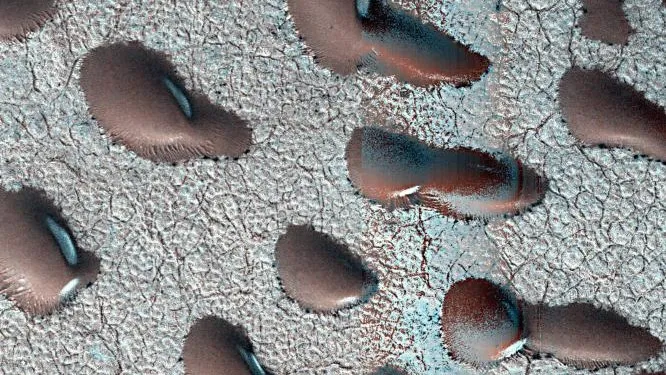
These Martian "kidney beans" aren't safe to eat: they're actually frozen sand dunes in Mars' northern hemisphere. A recently released photo by NASA's Mars Reconnaissance Orbiter (MRO) shows a top-down view of the frosty legume lookalikes, taken to help scientists determine if conditions on the Red Planet could have sustained life a long time ago.
In the photo, taken in Sept. 2022 and publicly released in Dec. 2024, the dunes appear surprisingly motionless. Dunes on both Mars and Earth usually migrate as wind picks up grains of sand from one side of a dune and drops them off at another, making deserts look like slow-motion seas. However, the dunes in the photo are covered in a layer of carbon dioxide frost during the northern hemisphere winter on Mars. The frost stops wind from scooping up sand, preventing the dunes from migrating until the spring thaw comes.
Traces of ancient water?
Pictures of frost-covered dunes help scientists learn whether water ever existed on the planet's surface for long enough for life to evolve and survive on Mars Even though the frost is made from carbon dioxide, not water, it still influences the odds that Mars had water for long periods in the past.
Related: Hundreds of black 'spiders' spotted in mysterious 'Inca City' on Mars in new satellite photos
related stories
The amount of carbon dioxide on Mars varies depending on how the planet is angled relative to the sun. Earth wobbles just a bit as it spins on a slightly-tilted axis, and this gives us different seasons. But Mars' axial tilt wobbles a lot over the course of millions of years, drastically changing its seasons. When Mars is tilted far enough, carbon dioxide ice turns into gas on a large scale — enough to give the whole planet a thicker atmosphere. This thicker atmosphere might have been enough to support liquid water over long periods.
With a better understanding of how carbon dioxide frost comes and goes under current conditions on Mars, scientists can make better predictions of the past climate on Mars. Studying how the frost changes with the seasons can also help scientists recognize geologic formations caused by carbon dioxide, revealing more details about the planet’s shifting climate. If there were periods of time when the climate supported stable liquid water, there's a big possibility that Mars could have supported microbial life — and it might even still be hiding somewhere.
Get the world’s most fascinating discoveries delivered straight to your inbox.

Damien Pine (he/him) is a freelance writer, artist, and former NASA engineer. He writes about science, physics, tech, art, and other topics with a focus on making complicated ideas accessible. He has a degree in mechanical engineering from the University of Connecticut, and he gets really excited every time he sees a cat.