Get the world’s most fascinating discoveries delivered straight to your inbox.
You are now subscribed
Your newsletter sign-up was successful
Want to add more newsletters?
Join the club
Get full access to premium articles, exclusive features and a growing list of member rewards.
An account already exists for this email address, please log in.
James Webb telescope uncovers 1st-ever 'Einstein zig-zag' hiding in plain sight — and it could help save cosmology
A new JWST study has revealed the true origins of a luminous quasar that has been duplicated six times as its light "zig-zags" through space-time via a phenomenon first predicted by Albert Einstein. The unusual light show could help tackle one of cosmology's biggest problems, experts claim.
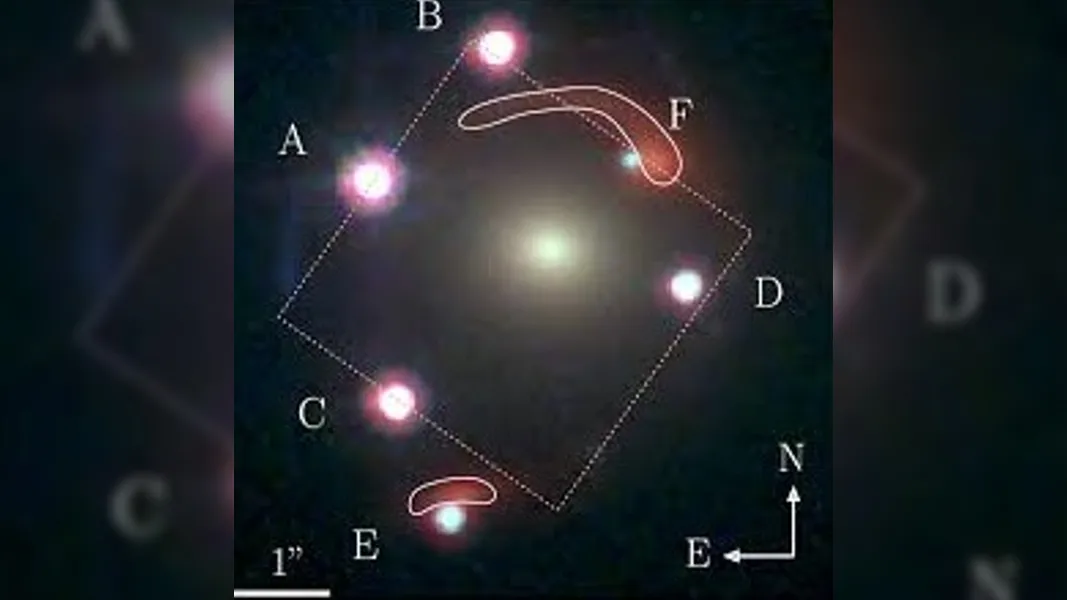
Researchers discovered the "Einstein zig-zag" phenomenon while analyzing six mirror images of a single gravitationally lensed quasar in the distant cosmos.
For the first time, researchers have used data from the James Webb Space Telescope (JWST) to uncover an example of a previously hypothetical phenomenon known as an "Einstein zig-zag" — where light from an object in the distant cosmos passes through two different regions of warped space-time. The newly confirmed effect, which was discovered among six identical copies of a luminous quasar, could shed light on an issue that is beginning to plague cosmology, experts say.
In 2018, astronomers discovered a quartet of identical bright points billions of light-years from Earth, later named J1721+8842. Initially, the scientists assumed that the four lights were mirror images of a single quasar — a luminous galactic core powered by a feeding black hole — that had been duplicated through a phenomenon known as "gravitational lensing."
Gravitational lensing happens when light from a distant object appears to get bent as it passes through warped space-time that has been pulled out of shape by the immense gravity of a lensing object — usually a massive galaxy or cluster of galaxies — located between the distant object and the observer. This warping effect can either duplicate the initial light source, as the light takes different routes around the lensing object, or stretch out the light into luminous halos, known as Einstein rings after Albert Einstein, who first predicted gravitational lensing with his theory of general relativity in 1915.
But in a 2022 study, researchers discovered that J1721+8842 had two additional points of light alongside the original quartet, as well as a faint red Einstein ring. The newly discovered points were slightly fainter than the other four points, which led researchers to suspect that the light show showed a pair of adjacent quasars, known as a binary quasar, that had been duplicated three times (rather than a single quasar that had been copied six times).
Light from Einstein rings and other gravitationally lensed objects appears to bend around their lensing objects. But in reality, the light is travelling in a straight line through warped space-time.
(Image credit: NASA)
However, in a new study, uploaded Nov. 8 to the preprint server arXiv, researchers reanalyzed J1721+8842 using new data from JWST and found that all six points of light are actually from a single quasar after all. The team also found that newly unveiled bright spots have been lensed around a second massive object farther away from the first, which is also responsible for the faint Einstein ring seen in more recent images. (The study has not yet been peer-reviewed but has been submitted for publication in the journal Astronomy & Astrophysics.)
After observing the light curves of each bright spot over two years, researchers showed that there is a slight delay in the time it takes the two faintest duplicate images to reach us, which suggests that the light in these copies has to travel farther than the other four bright spots. This is likely because the light in these images passes around the opposite sides of each lensing object (i.e. around the left side of the first lens and right side of the second lens).
Sign up for the Live Science daily newsletter now
Get the world’s most fascinating discoveries delivered straight to your inbox.
The study team has dubbed this "extremely rare lensing configuration" an Einstein zig-zag because light from some of the double-lensed bright spots has swerved back and forth as it passed around both lensing galaxies, the researchers wrote.
Saving cosmology
Gravitationally lensed objects, such as Einstein rings, are treasured by astronomers and cosmologists because the warped light can help reveal the mass of the galaxies that lensed them. This, in turn, can help reveal secrets of the universe such as the secret identity of dark matter and how dark energy drives cosmic expansion.
However, researchers believe that the newly confirmed Einstein zig-zag could help to smooth out this tension because its unique configuration will allow astronomers to precisely measure both the Hubble constant — the rate at which cosmic expansion is accelerating — and the amount of dark energy — the invisible force driving the universe's expansion — in this region of space. Normally, scientists can only determine exact figures for one or the other but detailed knowledge of both is needed to truly understand cosmic expansion, the researchers wrote.
Thomas Collett, an astrophysicist at the University of Portsmouth in the U.K. who was not involved in the study, told Science magazine that studying the zig-zag will "shine a light on whether the expansion rate of the universe is consistent with the cosmological model or not." However, it could take researchers more than a year to resolve the figures they need from the tangled images, he added. "So we might have to wait a while [for an answer]."
Harry is a U.K.-based senior staff writer at Live Science. He studied marine biology at the University of Exeter before training to become a journalist. He covers a wide range of topics including space exploration, planetary science, space weather, climate change, animal behavior and paleontology. His recent work on the solar maximum won "best space submission" at the 2024 Aerospace Media Awards and was shortlisted in the "top scoop" category at the NCTJ Awards for Excellence in 2023. He also writes Live Science's weekly Earth from space series.