















'An ancient, complex, and very serious game is going on': The weird ways creatures feed in the open ocean
"In an environment where food is scarce, where there is nowhere to hide, and where the predators are probably faster than you are, most animals must find new ways to protect themselves."


In this excerpt from "Into the Great Wide Ocean: Life in the Least Known Habitat on Earth" (Princeton University Press, 2024), author Sönke Johnsen looks at dinner in the deep, where creatures living in the open ocean have evolved weird ways to feed — and to avoid getting eaten in an ecosystem where there is nowhere to hide.
As the marine biologist Peter Herring said, we catch "only the slow, the stupid, the greedy, and the indestructible."
But beneath the surface, an ancient, complex, and very serious game is going on. The difficulties of finding food have led to some novel feeding strategies. Many pelagic animals hunt their prey and eat them, much like you'd imagine a lion would: chasing down an animal and biting it until it dies. But I'd like to focus on the animals that do things differently from those on land.
Imagine a world where the only food is the dust that sparkles in the morning sunbeams of your house. This dust is in fact nutritious, some of it being flakes of your own dead skin, but you'd go crazy trying to pick it out of the air with your hands or mouth. What you could do, though, is get a large square of fine window screen and walk through your house, holding it in front of you. You'd have to be careful about the mesh. If it's too coarse, the skin flakes would go through. If it's too fine, not enough air will go through, and the skin flakes will bounce away. But if you get it right, you eventually get a nice coating of dust on your screen that you could then lick off.
This is essentially what many pelagic animals do. They create a screen and use it to trap tiny particles out of the water. The animals on the seafloor, such as the relatives of starfish called "feather stars" and a delightful group of animals known as "feather duster worms," do this as well and often have the advantage of being stationary in a current.
Given the empty nature of much of the oceanic water column, it's perhaps not surprising that certain animals have evolved to eat ever-smaller things, since smaller things tend to be more abundant. Particularly fascinating are the larvae of eels — which, contrary to popular depiction, don't look anything like the adults. Instead, they look like long transparent leaves: extremely flat, with tiny heads. How do they catch food? Upon investigation of their digestive tracts, some researchers believe they actually absorb nutrients through their skin. They later use the energy they store to fuel their metamorphosis into grown glass eels.
Another fascinating but unusual feeding method can be found in the gymosomes. Although from the outside these animals are cute little slugs with wings, often with evocative names like "sea angels," inside their head is a Swiss-army-knife set of contraptions that are adapted to get their favorite prey out of its shell. Clione limacina, for example, first grabs the Limacina snail with a pair of soft tentacles. It uses these tentacles to maneuver the snail into just the right position. Then, long, sharp hooks are squeezed out of sacs on its head (this is known as "eversion"). These hooks — much like cocktail forks — can reach far enough into the shell of the Limacina to pull the soft body out.
Get the world’s most fascinating discoveries delivered straight to your inbox.
RELATED STORIES
As hard as it can be to find and capture food in the open ocean, it is just as hard to avoid becoming food. In an environment where food is scarce, where there is nowhere to hide, and where the predators are probably faster than you are, most animals must find new ways to protect themselves.
One can, of course, evolve to become larger, and it's possible to imagine a dinosaur-like evolutionary arms race where oceanic animals get bigger and faster. But this is not common. Yes, there are whales, sharks, and some large and powerful fish and squid, but the majority of species in the open ocean do not appear to be evolving to increase in size.
Some animals protect themselves by being toxic or venomous, or simply tasting awful. But if you can't run, you can't fight, and you're tasty, all that is left to do is hide. This includes hiding in the dark or hiding in plain sight by looking like water. The best way to do that: be transparent and let the background light pass through you as if you weren't there. The animals in the pelagic realm are playing a serious game.
Adapted from Into the Great Wide Ocean: Life in the Least Known Habitat on Earth. Copyright © 2013 by Sönke Johnsen. Reprinted by permission of Princeton University Press.
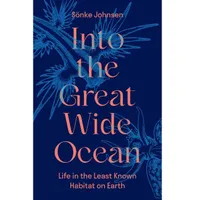
Into the Great Wide Ocean: Life in the Least Known Habitat on Earth
Sönke Johnsen vividly describes how life in the water column of the open sea contends with a host of environmental challenges, such as gravity, movement, the absence of light, pressure that could crush a truck, catching food while not becoming food, finding a mate, raising young, and forming communities. He interweaves stories about the joys and hardships of the scientists who explore this beautiful and mysterious realm, which is under threat from human activity and rapidly changing before our eyes.

Sönke Johnsen is professor of biology at Duke University. He is the author of "The Optics of Life: A Biologist’s Guide to Light in Nature" and the coauthor of "Visual Ecology."