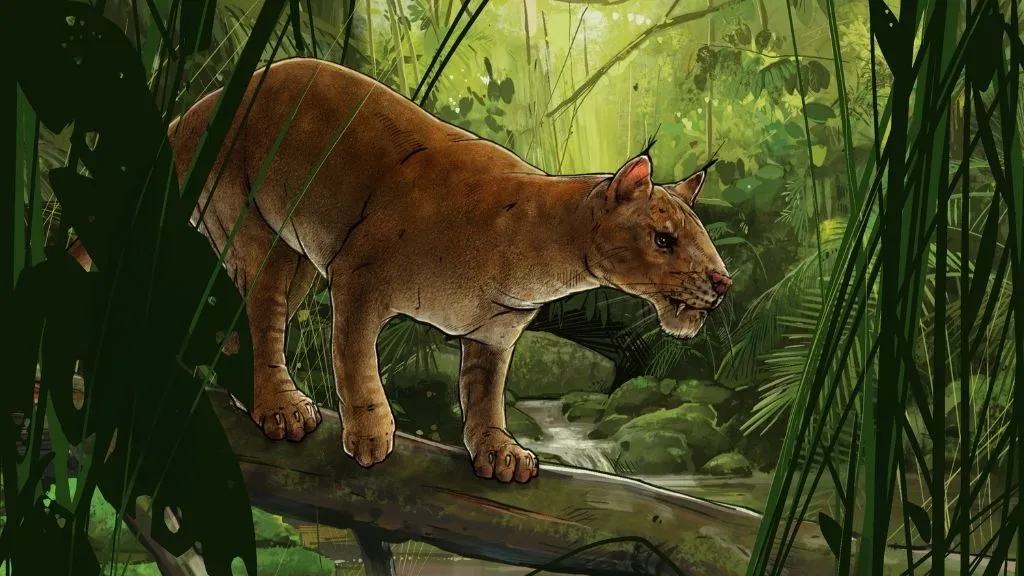
An unidentified fossil collected more than three decades ago was actually a mysterious species of saber-toothed carnivore that once stalked prey through the ancient rainforests of Southern California.
The fossil includes a near-complete lower jawbone and a set of well-preserved teeth, according to a new study, published Tuesday (March 15) in the journal PeerJ. Paleontologists at the San Diego Natural History Museum (The Nat) originally collected the specimen in 1988 from a site known as the Santiago Formation in Oceanside, a city in San Diego County, California. The geological formation is estimated to be about 42 million years old, so fossils from the site date back to the Eocene epoch (55.8 million to 33.9 million years ago), according to the American Museum of Natural History.
When the fossilized jawbone was initially discovered, "it had been very properly identified as a meat-eating animal," said study co-author Ashley Poust, a postdoctoral researcher in vertebrate paleontology at the Nat. The specimen bears "big, slicing, scissoring teeth" that are ideally suited for shredding fresh meat, rather than for crunching through nuts or gnawing on bones, for instance, Poust said.
The museum paleontologists originally thought these formidable teeth might belong to a nimravid, a type of cat-like hypercarnivore, an animal whose diet consisted mostly of meat. The nimravids are often called "false saber-toothed cats," as they resemble the famous felines but don't belong to the Felidae family as true cats do, Live Science previously reported.
This fossil has been in The Nat’s collection since 1988. It was recovered in Oceanside by the museum’s PaleoServices team.
(Image credit: San Diego Natural History Museum (CC 4.0))
However, study co-author Hugh Wagner, a paleontologist at the Nat, later suggested that the jawbone might belong to a more mysterious group of hypercarnivores with scant representation in the fossil record: the machaeroidines. Remains of these strange beasts have been uncovered only at select sites in Asia and North America, and prior to the new study, only 14 specimens had ever been found, according to the PeerJ report. The now-extinct group includes the earliest known saber-toothed mammalian carnivores, which are not closely related to any living carnivores.
Two of these specimens — a partial skeleton and a jawbone — were discovered in Wyoming and Utah and described in priorpapers by the study's co-first author Shawn Zack, an assistant professor at the University of Arizona College of Medicine and an expert in ancient carnivores. For the new paper, Zack, Poust and Wagner teamed up to reexamine the perplexing carnivore jawbone in the Nat's collection and determine, once and for all, whether it belonged to a machaeroidine.
Sign up for the Live Science daily newsletter now
Get the world’s most fascinating discoveries delivered straight to your inbox.
The team snapped photos of the fossil from many angles in order to construct a detailed 3D model of the bone and teeth, and after a thorough examination, they confirmed that the specimen was not only a machaeroidine, but a never-before-seen genus and species of machaeroidine.
They named the newfound creature Diegoaelurus vanvalkenburghae in honor of San Diego County, where the specimen was found, and scientist Blaire Van Valkenburgh, a past president of the Society of Vertebrate Paleontology whose work greatly influenced scientists' understanding of carnivore evolution.
"Finding this particular group was pretty surprising," because no other machaeroidine specimens in the U.S. had been found west of the Rocky Mountains, Poust told Live Science. "We didn't know that these occurred out here at all."
Based on the size of the jawbone, the researchers determined that D. vanvalkenburghae was about the size of a bobcat, according to the study. The animal carried blade-like, slicing teeth in the back of its mouth and had "sort of reduced teeth in the front — it's totally lost the first [tooth] behind its lower canine," Poust said. Modern cats also have this gap behind their lower canines, to make space for their large upper canines to bite down, he noted. In addition to this gap, D. vanvalkenburghae had a downturned, bony chin that also would have helped to accommodate its impressive saber teeth.
Study author Ashley Poust holds the recently named D. vanvalkenburghae fossil in front of the skull of a saber-toothed cat, a much larger carnivore that emerged millions of years after D. vanvalkenburghae.
(Image credit: San Diego Natural History Museum (CC 4.0))
About 42 million years ago, D. vanvalkenburghae would have lived in a very different environment than can be found in San Diego County today, Poust noted.
The Eocene kicked off with a period of extensive warming, which fueled the growth of hot, humid rainforests around the world, according to the American Museum of Natural History. Fossils recovered from Santiago Formation suggest that the lush rainforests of ancient Southern California were once home to lemur-like primates, marsupials, boar-size tapirs and tiny rhinos. In theory, D. vanvalkenburghae may have preyed on these animals, although the predator's exact diet is unknown, Poust said.
The new species helps fill out the sparse machaeroidine fossil record, but it also raises new questions about the cat-like predators, Poust said.
For example, did D. vanvalkenburghae ever coexist and compete for prey with nimravids? The oldest nimravid remains found in the U.S. are roughly 5 million years younger than the newly identified D. vanvalkenburghae fossil, so it would partially depend on when the machaeroidine went extinct. The exact timing and reason for this extinction also remain mysterious, although it's clear that machaeroidines died out many millions of years before the emergence of true saber-toothed cats (Smilodon), Poust noted.
Nicoletta Lanese is the health channel editor at Live Science and was previously a news editor and staff writer at the site. She is a recipient of the 2026 AHCJ International Health Study Fellowship, with a project focused on antibiotic stewardship practices in Japan and the U.S. They hold a graduate certificate in science communication from UC Santa Cruz and degrees in neuroscience and dance from the University of Florida. Beyond Live Science, Lanese's work has appeared in The Scientist, Science News, the Mercury News, Mongabay and Stanford Medicine Magazine, among other outlets. Based in NYC, she also remains involved in dance and performs in local choreographers' work.