













'First complete models' of a human embryo made in the lab

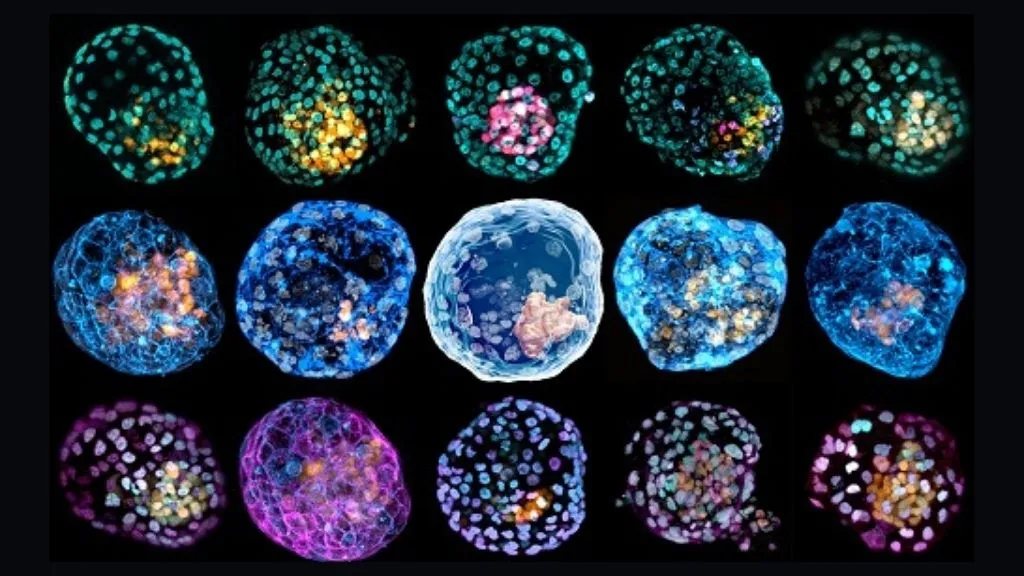
Scientists have created hollow spheres of cells that resemble human embryos in their earliest stages of development. The artificial embryos, called "blastoids," could allow scientists to study early human development, infertility and pregnancy loss without experimenting on actual embryos.
Two separate research groups created these model embryos using different methods, and each published their results March 17 in the journal Nature Portfolio.
One research group started with adult human skin cells, which they genetically reprogrammed to resemble embryonic cells, according to a statement. The researchers then grew these modified cells over a 3D scaffold that guided them into a spherical shape. The resulting structure closely mimicked a human blastocyst, a structure that typically contains a few hundred cells and forms roughly four days after a sperm cell fertilizes an egg and later implants in the uterine wall, Nature News reported.
The second research group began with human stem cells, including both embryonic stem cells and stem cells derived from adult skin tissue, known as "induced pluripotent stem cells," Nature News reported. The team treated the stem cells with specific chemicals known as growth factors to coax them into the shape of a blastocyst.
Related: Inside life science: Once upon a stem cell
Both teams demonstrated that their homemade blastocysts behaved similarly to real ones, in that they formed as hollow spheres and contained three distinct cell types that eventually form different parts of the body, as blastocysts do, Nature reported. Additionally, the spheres could "implant" into a plastic sheet, which stood in for the human uterine wall.
Despite these similarities, neither model perfectly recreates a human embryo, and based on evidence from similar mouse models, the spheres likely cannot develop beyond the blastocyst stage. Evidence suggests that, when implanted in a mouse uterus, mouse blastoids fail to properly differentiate into additional cell types, potentially because of how their gene expression differs from true blastocysts, according to a 2019 report in the journal Developmental Cell.
Get the world’s most fascinating discoveries delivered straight to your inbox.
"I would consider this as a major advance in the field," Jianping Fu, a professor of mechanical engineering at the University of Michigan, Ann Arbor, told NPR. "This is really the first complete model of a human embryo."
"With this technique, we can make hundreds of these structures. So this will allow us to scale up our understanding of very early human development," José Polo, a developmental biologist at Monash University in Australia and the senior author of the first study, told NPR. "We think this will be very important."
However, the experiments do raise some serious ethical questions.
"I'm sure it makes anyone who is morally serious nervous when people start creating structures in a petri dish that are this close to being early human beings," Daniel Sulmasy, a bioethicist at Georgetown University, told NPR. "The more they press the envelope, the more nervous I think anybody would get that people are trying to sort of create human beings in a test tube."
Related Content
As of now, the International Society for Stem Cell Research (ISSCR) has a guideline that places time limits on human embryo experiments in the lab, capping them at 14 days, Nature reported. This cap is intended to stop the embryo from maturing past a point where its cells begin differentiating into complex structures; in human pregnancy, the implanted blastocyst would form a "primitive streak" by Day 14, which is a mark that signals a shift to this differentiation. Both research teams abided by this rule in the new blastoid experiments.
The ISSCR plans to issue updated guidelines on embryo-like structures, such as these blastoids, in May 2021, according to Nature.
In a report published in February 2020, the society stated that such models "would have great potential benefits for understanding early human development, for biomedical science, and for reducing the use of animals and human embryos in research. However, guidelines for the ethical conduct of this line of work are at present not well defined," according to the Monash University statement.
Meanwhile, the U.S. National Institutes of Health (NIH) "will continue to consider applications on a case-by-case basis," according to a statement posted March 11 by Carrie Wolinetz, the NIH director of science policy.
Originally published on Live Science.

Nicoletta Lanese is the health channel editor at Live Science and was previously a news editor and staff writer at the site. She is a recipient of the 2026 AHCJ International Health Study Fellowship, with a project focused on antibiotic stewardship practices in Japan and the U.S. They hold a graduate certificate in science communication from UC Santa Cruz and degrees in neuroscience and dance from the University of Florida. Beyond Live Science, Lanese's work has appeared in The Scientist, Science News, the Mercury News, Mongabay and Stanford Medicine Magazine, among other outlets. Based in NYC, she also remains involved in dance and performs in local choreographers' work.