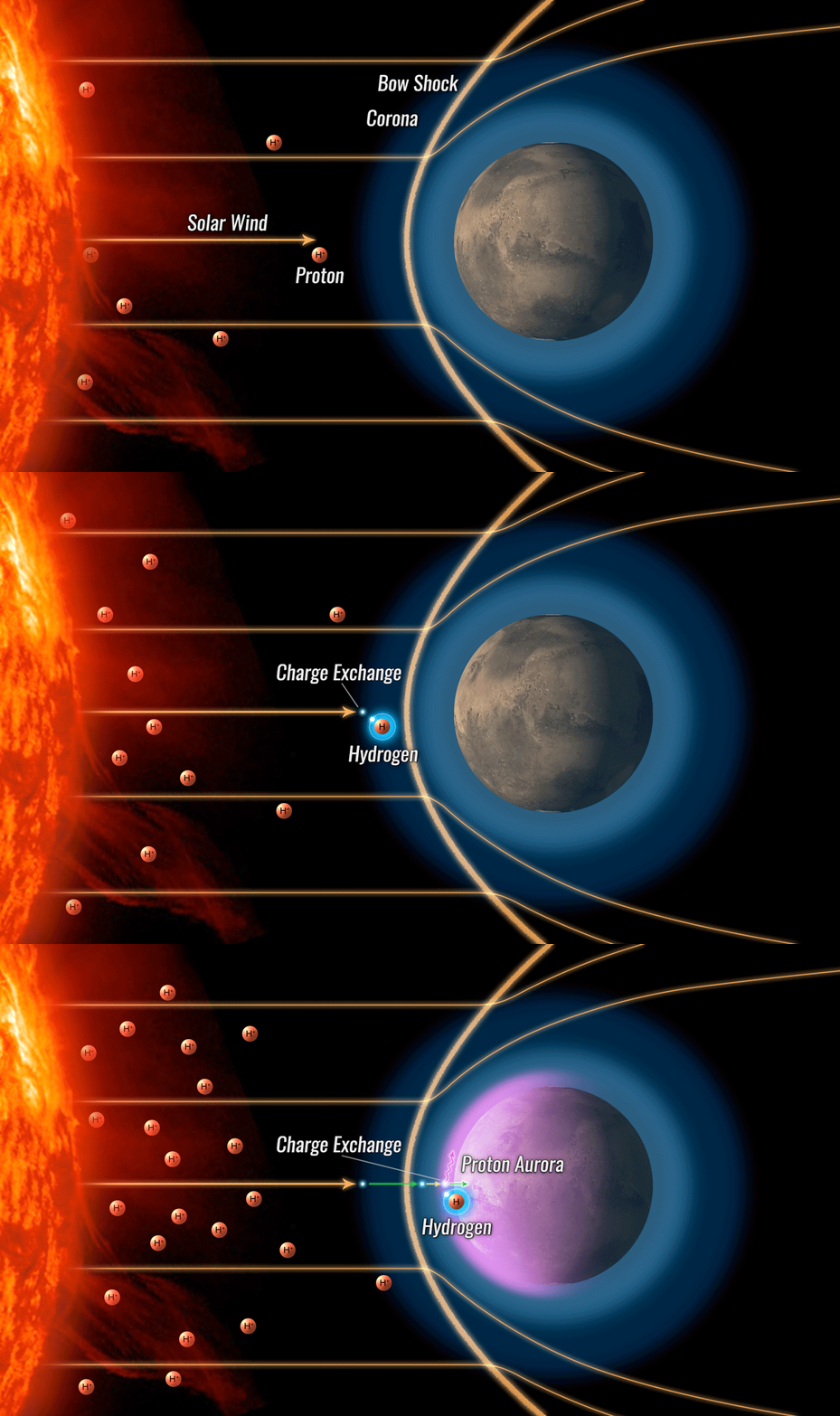
A solar wind proton approaches Mars at high speed; it steals an electron from an escaped Martian hydrogen atom and passes through a magnetic field surrounding Mars. The now-neutral atom then enters the planet's atmosphere and collides with gas molecules, which causes the atom to emit ultraviolet light.
(Image credit: NASA/MAVEN/Goddard Space Flight Center/Dan Gallagher)
SAN FRANCISCO — Auroras unfurling in Martian skies are stunning displays, and they also offer important clues about how the Red Planet's water escapes into its atmosphere, scientists reported on Dec. 12 here at the annual meeting of the American Geophysical Union (AGU).
A type of aurora called a proton aurora was first identified on Mars in 2016, using data from the Mars Atmosphere and Volatile Evolution (MAVEN) spacecraft. This aurora, which occurs during daytime and produces ultraviolet light, is invisible to the naked eye, but was spotted by MAVEN's Imaging UltraViolet Spectrograph (IUVS) instrument.
Recently, researchers took a closer look at Martian proton auroras, analyzing data accumulated over years of observations and describing their findings in a new study. They found that these auroras aren't as rare as originally thought. In fact, they are Mars' most common aurora and they are astonishingly frequent, "with almost 100% occurrence rate on the day side of the planet in southern summer," said lead study author Andréa Hughes, a doctoral candidate in engineering physics at Embry-Riddle Aeronautical University in Daytona Beach, Florida.
"To think that the probability of seeing proton aurora during southern summer on the day side approaches 100%!" Hughes told Live Science. "That, I think, was most surprising to me and, I think, to most members of the team as well."
Auroras on Earth typically appear when streams of charged particles from the sun — also known as solar winds, traveling at approximately 1 million mph (1.6 million km/h) — slam into our planet's magnetic field. The high-energy collisions between solar particles and atmospheric gas particles create sky glows such as the northern and southern lights.
Mars' proton auroras also start with solar winds. But in this case, charged protons collide with a cloud of hydrogen surrounding Mars. There, they slurp electrons away from hydrogen atoms, which neutralizes the protons. When those energetic neutral atoms enter the lower atmosphere of Mars, their collisions with molecules produce ultraviolet glows — proton auroras, Hughes explained at AGU.
Sign up for the Live Science daily newsletter now
Get the world’s most fascinating discoveries delivered straight to your inbox.
Why are these auroras so common during the Martian southern summer? "We have known for several years now about seasonal variation in the hydrogen corona" — the cloud of hydrogen surrounding Mars — which is at its highest altitude around the summer solstice, Hughes said. In other words, summer months are when Mars' hydrogen cloud is perfectly positioned to interact frequently with solar winds and produce near-constant proton auroras.
And that's not all the researchers discovered. As temperatures climb during summer months, rising dust clouds carry water vapor away from the Martian surface. "That causes hydrogen to break apart into hydrogen and oxygen, and that causes it to escape," Hughes said. "Because of that — and because of the connection between solar wind protons interacting with the hydrogen in Mars' atmosphere — we know that when we're seeing proton aurora, the source of that is not only the solar wind but also this water that's breaking apart and being lost to space."
At this point, you might be wondering if you'd be able to witness a proton aurora if you were standing on Mars — but you wouldn't, unfortunately.
"It's not something that could be observed from the surface, because we're looking at this in ultraviolet light, and ultraviolet is absorbed in the atmosphere. So by the time it gets to the surface, you wouldn't see it," Hughes said.
However, let's say you were a space traveler arriving at Mars on the daytime side during summer in the southern hemisphere. If you were to don ultraviolet goggles during your spacecraft's approach, "then yes, you would absolutely be able to see this beautiful emission enhancement — and perhaps proton aurora dancing around in the atmosphere," Hughes said.
But as human spaceflight to Mars is still a distant dream, it could be a while before people experience that awe-inspiring sight firsthand.
The findings were published online Dec. 12 in the journal JGR Space Physics.
Mindy Weisberger is a science journalist and author of "Rise of the Zombie Bugs: The Surprising Science of Parasitic Mind-Control" (Hopkins Press). She formerly edited for Scholastic and was a channel editor and senior writer for Live Science. She has reported on general science, covering climate change, paleontology, biology and space. Mindy studied film at Columbia University; prior to LS, she produced, wrote and directed media for the American Museum of Natural History in NYC. Her videos about dinosaurs, astrophysics, biodiversity and evolution appear in museums and science centers worldwide, earning awards such as the CINE Golden Eagle and the Communicator Award of Excellence. Her writing has also appeared in Scientific American, The Washington Post, How It Works Magazine and CNN.