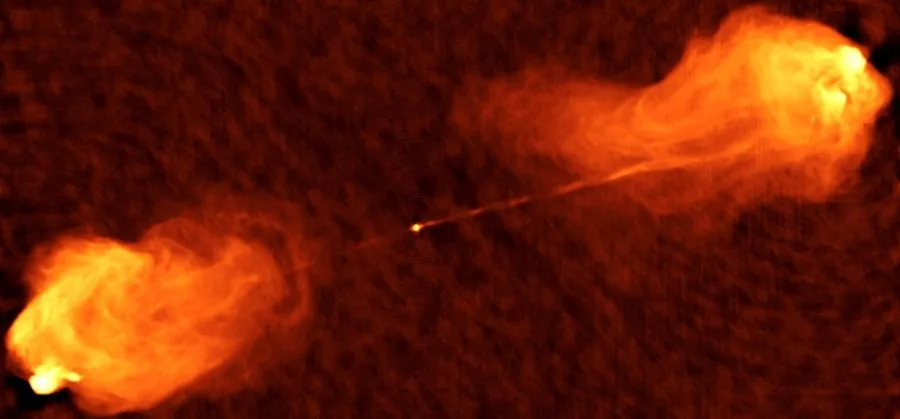
Nine hundred million years after the Big Bang, in the epoch of our universe's earliest galaxies, there was already a black hole 1 billion times the size of our sun. That black hole sucked in huge quantities of ionized gas, forming a galactic engine — known as a blazar — that blasted a superhot jet of bright matter into space. On Earth, we can still detect the light from that explosion more than 12 billion years later.
Astronomers had previously discovered evidence of primeval supermassive black holes in slightly younger "radio-loud active galactic nuclei," or RL AGNs. RL AGNs are galaxies with cores that look extra-bright to radio telescopes, which is considered evidence that they contain supermassive black holes. Blazars are a unique type of RL AGN that spit out two narrow jets of "relativistic" (near-light-speed) matter in opposite directions. Those jets emit narrow beams of light at many different wavelengths and have to be pointed right at Earth for us to detect them across such vast distances. This new blazar discovery moves the date of the oldest confirmed supermassive black hole to within the first billion years of the universe's history and suggests there were other, similar black holes in that era that we haven't detected.
"Thanks to our discovery, we are able to say that in the first billion years of life of the universe, there existed a large number of very massive black holes emitting powerful relativistic jets," Silvia Belladitta, a doctoral student at the Italian National Institute for Astrophysics (INAF) in Milan and co-author of a new paper on the blazar, said in a statement.
Latest Videos FromLive Science
Related: Twisted physics: 7 mind-blowing findings
The discovery by Belladitta and her co-authors confirms that blazars existed during an epoch of our universe's history known as "reionization" — a period after a long, post-Big Bang dark age when the first stars and galaxies began to form.
And discovering one blazar strongly suggests there were many others, the authors wrote. If only one blazar existed in this early phase of the universe, it would be an extraordinarily lucky break for it to have pointed its narrow, visible beam at Earth. It's much more likely that there were many such blazars pointing in all sorts of directions, and that one of them happened to throw its light our way.
These blazars, the authors wrote, were the seeds of the supermassive black holes that dominate the cores of large galaxies across our universe today — including Sagittarius A*, the relatively quiet supermassive black hole at the center of our Milky Way.
"Observing a blazar is extremely important. For every discovered source of this type, we know that there must be 100 similar, but most are oriented differently, and are therefore too weak to be seen directly," Belladitta said.
That information helps astrophysicists reconstruct the story of how and when these monster black holes formed.
Originally published on Live Science.