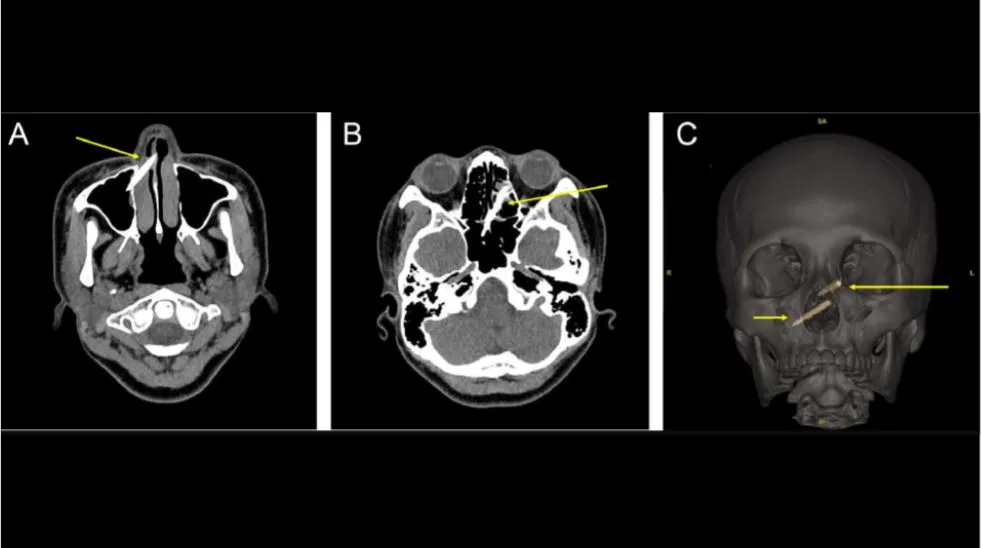
A CT scan showing chopstick fragments penetrating the woman's sinuses (A,B). A 3D reconstruction of the woman's skull showing the positions of the chopstick pieces (C).
(Image credit: Reprinted with permission of Elsevier (2021).)
A woman in Taiwan unknowingly had two chopstick fragments lodged in her sinuses for a week after a violent fight with her sister, according to a new report.
The 29-year-old woman went to the emergency room after she was "attacked by her sister with plastic-wood chopsticks while at the dinner table," according to the report, published June 24 in The Journal of Emergency Medicine. The woman said she had experienced a mild nosebleed and swelling in her left eye after the attack. Doctors saw that she had two small cuts under her eye and on her nose. But an X-ray did not show anything unusual.
After the woman was attacked by her sister, doctors observed two small wounds under her eye and on her nose.
(Image credit: Reprinted with permission of Elsevier (2021).)
However, one week later, the woman began to suspect that her injury was more serious than it appeared. She noticed that "some parts of the chopsticks used in the attack were missing," according to the report authors, from Hualien Tzu Chi Hospital in Taiwan. And when she looked in the mirror, she thought she could see a gray object in her nose.
A doctor then examined the inside of her nose and saw pieces of chopstick penetrating her nasal septum, or the wall dividing the two nasal passages, the report said. A CT scan showed two chopstick pieces in her sinuses, with one embedded more deeply than the other.
The chopstick fragments after they were removed from the woman's sinuses.
(Image credit: Reprinted with permission of Elsevier (2021).)
The route that the chopsticks followed to enter the woman's skull was the same as the route doctors use when performing surgery on the ethmoid sinuses — which are located between the corner of your eye and the bridge of your nose — to treat sinus infections.
The woman needed surgery to remove the fragments, which were about 1.4 inches (3.5 centimeters) and 2 inches (5 cm) long, respectively, according to the report. She experienced no surgical complications.
Sign up for the Live Science daily newsletter now
Get the world’s most fascinating discoveries delivered straight to your inbox.
Emergency room doctors should be aware that foreign bodies entering the skull the way these chopsticks did "could present only as tiny laceration wounds and may be asymptomatic," the authors wrote. If doctors suspect a foreign body lodged near the nose, it's important they perform an examination of the ears, nose and throat, as well as a CT scan to identify it as soon as possible, they said.
Rachael is a Live Science contributor, and was a former channel editor and senior writer for Live Science between 2010 and 2022. She has a master's degree in journalism from New York University's Science, Health and Environmental Reporting Program. She also holds a B.S. in molecular biology and an M.S. in biology from the University of California, San Diego. Her work has appeared in Scienceline, The Washington Post and Scientific American.