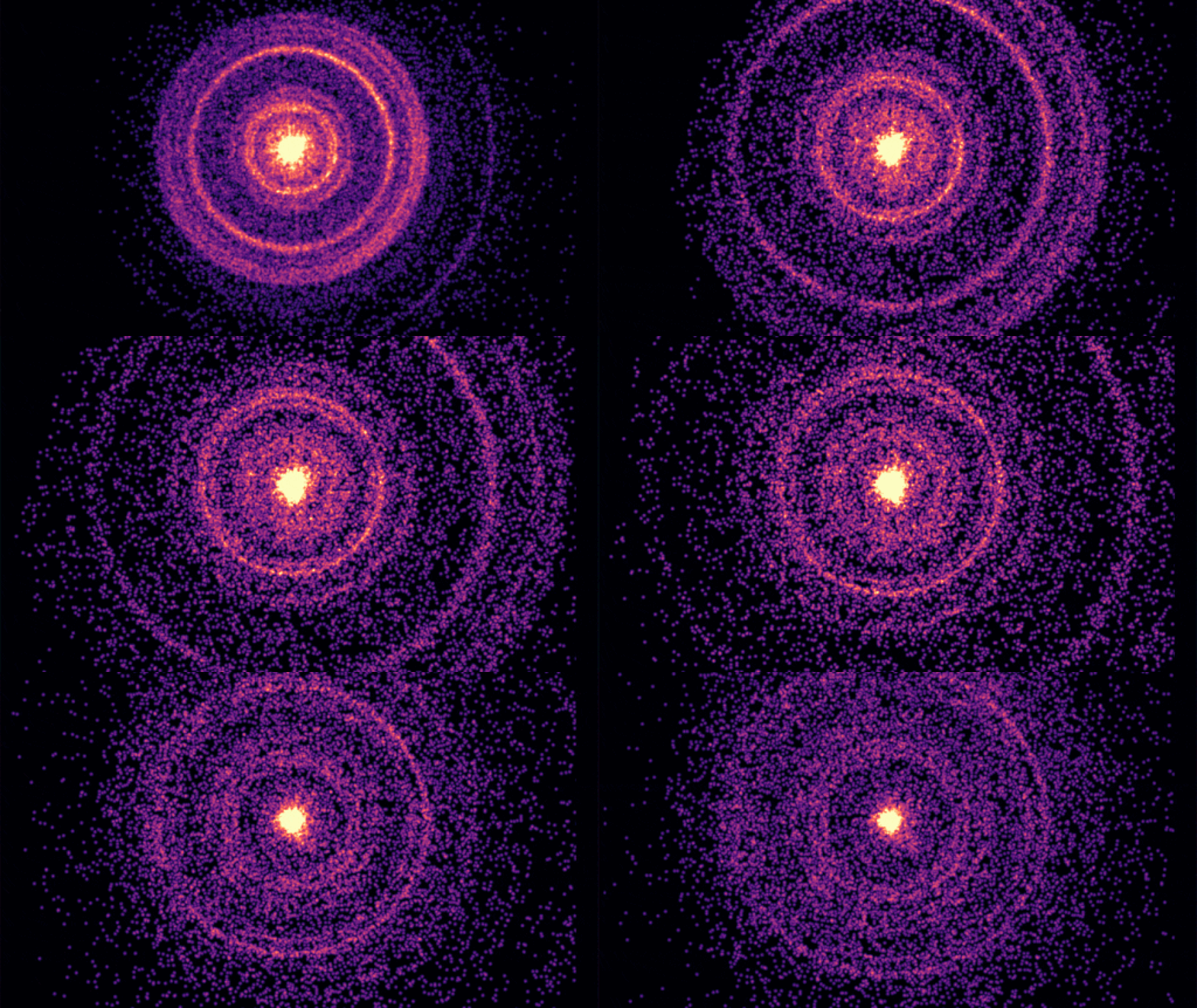
Scientists are taking a closer look at the afterglow left by the brightest gamma-ray burst ever recorded, and what they see doesn't fit with any theoretical models.
A time-lapse animation made with NASA's Neil Gehrels Swift Observatory shows the brightest gamma-ray burst ever recorded as it evolved over 12 days in October 2022.
(Image credit: NASA/Swift/A. Beardmore (University of Leicester ))
The brightest gamma-ray burst ever detected is revealing new mysteries as scientists study it in greater detail.
In two new papers – one published today in The Astrophysical Journal Letters, and another published on the preprint server arXiv and submitted for publication in the journal Nature Astronomy – astronomers found that the evolution of the radio waves released by an enormous stellar explosion seen in 2022 was slower than models predicted, raising questions about how the release of energy evolves during ultra-powerful gamma-ray bursts.
"[I]t is very difficult for existing models to replicate the slow evolution of the energy peaks that we observed," James Leung, a doctoral student at the University of Sydney who co-authored the Nature Astronomy paper, said in a statement. "This means we have to refine and develop new theoretical models to understand these most extreme explosions in the Universe."
Gamma-ray bursts (GRBs) are brief, bright flashes of gamma-ray light that are thought to be the most powerful explosions in our universe since the Big Bang. GRBs are released during extreme stellar explosions or supernovas, when a dying star runs out of fuel and collapses into a neutron star or even a black hole. The brightest burst ever seen, known as GRB 221009A, was first detected on Oct. 9, 2022 by gamma-ray and X-ray telescopes. The likely supernova that caused the burst was 2.4 billion light-years away from Earth.
A NASA illustration showing the typical evolution of a long gamma-ray burst — the most common type of GRB.
(Image credit: NASA's Goddard Spa ce Flight Center)
While the burst itself lasted just a few seconds, it left behind an "afterglow" of emissions across the light spectrum that may persist for years, Tara Murphy, an astrophysicist at the University of Sydney and co-author of the arXiv study, said in the statement. Initially, there is a bright forward shock caused by the materials ejected by the gamma-ray burst, Leung added, followed by a reverse shock back into the cloud of ejecta. Both shocks contribute to the afterglow.
Researchers began gathering data from this afterglow within three hours of spotting the initial gamma-ray burst, finding that the burst was 70 times brighter than any burst ever detected. It's likely that a gamma-ray burst of this size is a 1 in 10,000-year event, according to researchers at the University of Sydney.
Astronomers have not yet detected any sign of the supernova that spurred the gamma-ray burst, but they suspect that the stellar explosion resulted in the creation of a brand-new black hole.
Sign up for the Live Science daily newsletter now
Get the world’s most fascinating discoveries delivered straight to your inbox.
The far-off location of the burst, which is in the direction of the constellation Sagitta, or the Arrow, went behind the sun, from Earth's perspective, in December 2022 and only re-emerged in mid-February. The clear line of sight will again enable astronomers to measure the remaining afterglow from the burst.
Stephanie Pappas is a contributing writer for Live Science, covering topics ranging from geoscience to archaeology to the human brain and behavior. She was previously a senior writer for Live Science but is now a freelancer based in Denver, Colorado, and regularly contributes to Scientific American and The Monitor, the monthly magazine of the American Psychological Association. Stephanie received a bachelor's degree in psychology from the University of South Carolina and a graduate certificate in science communication from the University of California, Santa Cruz.