













Sticky orange coating on a 6,000-year-old Yukon dart came from a beaver's anal sac
As alpine ice melts, hundreds of ancient artifacts have been recovered from the southern Yukon.

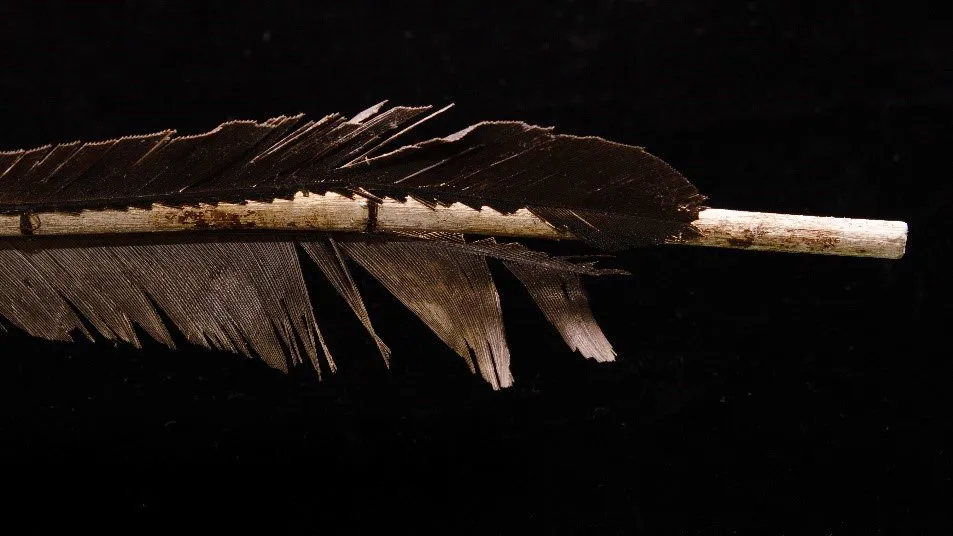
A 6,000-year-old feathered dart recently discovered in the Canadian Yukon was smeared with castoreum, a sticky, orange secretion produced in the anal sacs of beavers.
This is the first time that castoreum has been chemically identified in the archaeological record, and the dart is the earliest evidence of the substance's use on an ancient weapon, scientists recently reported. The researchers aren't sure why the anal secretion was applied to the dart, though it could have been as a way to preserve it, decorate it or even reinforce it, they said.
Related: In photos: Life in the Arctic region of the Americas
The dart, which measured about 6.6 feet (2 meters) long, is known as an atlatl, a segmented throwing weapon made of three sections of birchwood bound together with animal sinews and fletched with feathers. Reddish-orange residue coated the dart in two places near the weapon's joints, researchers wrote in the June 2021 issue of the Journal of Archaeological Science: Reports.
First Nations peoples likely created and used the dart prior to the seventh century A.D., the researchers said. The dart was found in 2018 in an alpine region of Canada's southern Yukon, in an ice patch where traditional territories of the Carcross/Tagish First Nation and the Kwanlin Dün First Nation Indigenous groups overlap.
Since 1997, melt from climate change has led to the recovery of more than 380 artifacts of First Nations people in this part of the Yukon, in a collaborative effort led by First Nations representatives and councils, as well as officials with the Yukon government. For millennia, ice patches here drew seasonal visits from sheep and caribou, and the area has served as a favored hunting ground for First Nations people for over 9,300 years, according to the study.
When the ice encasing these fragile objects melts, it leaves them vulnerable to rapid disintegration. There is therefore "an urgent need to collect, preserve and study them," the authors wrote.
Get the world’s most fascinating discoveries delivered straight to your inbox.
RELATED CONTENT
At first, scientists thought that the residue on the dart might be red ochre — a natural clay pigment — or adhesive colored by ochre, as ochre-tinted spruce resin was previously identified in other artifacts from this Yukon region. Using surgical tools, the researchers carefully removed small samples of the residue for chemical analysis, and found that the residue came from beavers' back ends.
Beavers' castor sacs lie between the base of the tail and the pelvis; they are located internally near the cloaca, and beavers secrete paste from these glands for scent marking, the researchers reported. When fresh, "castoreum is a sticky, semi-liquid paste and becomes solid with a waxy to resinous texture as it dries," according to the study.
Together with prior evidence of ochre and resin use in ancient weapons from the Yukon, this discovery of castoreum on a throwing dart demonstrates that thousands of years ago, Indigenous people habitually incorporated a range of resources from their local ecosystems into their tool use.
"Walking hand in hand with the land, water and wildlife is the history of our people," Lynda Dickson, Carcross/Tagish First Nation Haa Shaa du Hen (chief), said in a statement. "Their resourcefulness and ingenuity continue to impress and teach us."
Originally published on Live Science.

Mindy Weisberger is a science journalist and author of "Rise of the Zombie Bugs: The Surprising Science of Parasitic Mind-Control" (Hopkins Press). She formerly edited for Scholastic and was a channel editor and senior writer for Live Science. She has reported on general science, covering climate change, paleontology, biology and space. Mindy studied film at Columbia University; prior to LS, she produced, wrote and directed media for the American Museum of Natural History in NYC. Her videos about dinosaurs, astrophysics, biodiversity and evolution appear in museums and science centers worldwide, earning awards such as the CINE Golden Eagle and the Communicator Award of Excellence. Her writing has also appeared in Scientific American, The Washington Post, How It Works Magazine and CNN.