













Lasers reveal Roman-era circus in Spain where 5,000 spectators watched horse-drawn chariot races
Researchers used lidar technology to map Iruña Veleia, a Roman-era city in Spain.
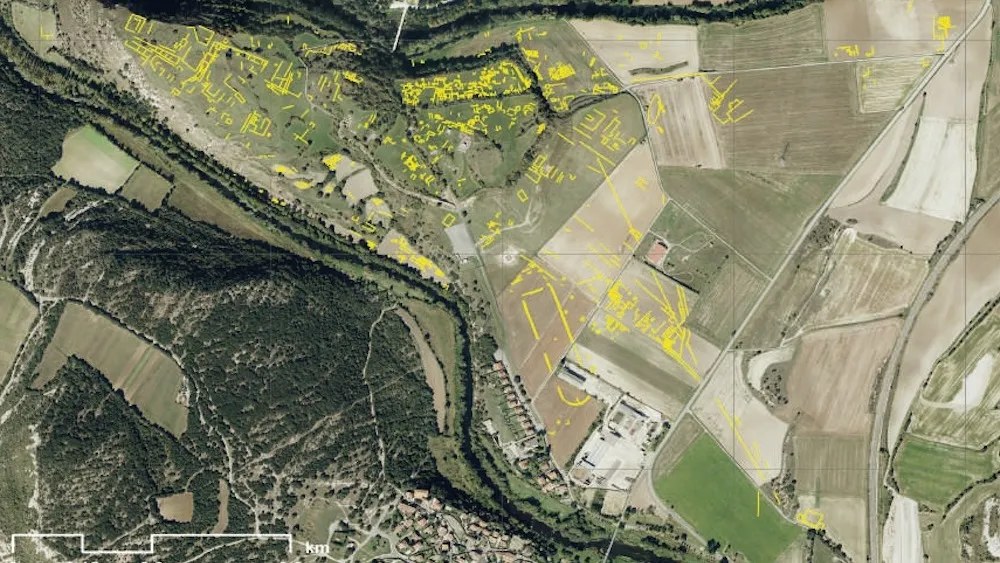
Laser beams have revealed unknown structures, including the remains of a circus that hosted horse-drawn chariot races, that were once part of a sprawling Roman city hidden in what is now northern Spain.
Archaeologists announced their findings, which were part of a new pilot program, July 17, at a news conference. The researchers mapped the site of Iruña Veleia in what is now Álava, a province in the Basque Country, using lidar (light detection and ranging), in which laser pulses are beamed at the landscape from above and measured when they bounce back in order to image the terrain's surface, according to a translated statement from the Provincial Council of Álava.
The new aerial map reveals several structures spread out across the 620-acre (251 hectares) site, including a 919-foot-long (280 meters) by 236-foot-wide (72 m) Roman "circus" arena that seated 5,000 spectators and hosted horse-drawn chariot races. This is only the third known Roman circus site in the Iberian Peninsula.
Chariot racing was a popular pastime in ancient Rome. In fact, there was an entire industry focused on it. And much like avid sports fans of today, enthusiasts aligned with their favorite stables of horses and charioteers and would travel from near and far to cheer them on, according to the World History Encyclopedia.
Related: Ancient language found on 2,100-year-old bronze hand may be related to Basque
In addition to the arena, Lidar also revealed arcade-lined streets, housing districts, meeting spaces for worship and buildings used for urban sanitation and water supply.
RELATED STORIES
The urban center is "a jewel that is yet to be discovered," according to the statement.
Get the world’s most fascinating discoveries delivered straight to your inbox.
"The discovery is very important, and once again confirms that Iruña Veleia is a large ancient site, with great archaeological and historical research potential," Ana del Val, deputy of Spain's Department of Culture and Sports, said in the statement.
The researchers said they hope the site "receive[s] the attention it deserves, to protect it, to study it, to give it value and to create wealth for the whole territory."
Jennifer Nalewicki is former Live Science staff writer and Salt Lake City-based journalist whose work has been featured in The New York Times, Smithsonian Magazine, Scientific American, Popular Mechanics and more. She covers several science topics from planet Earth to paleontology and archaeology to health and culture. Prior to freelancing, Jennifer held an Editor role at Time Inc. Jennifer has a bachelor's degree in Journalism from The University of Texas at Austin.