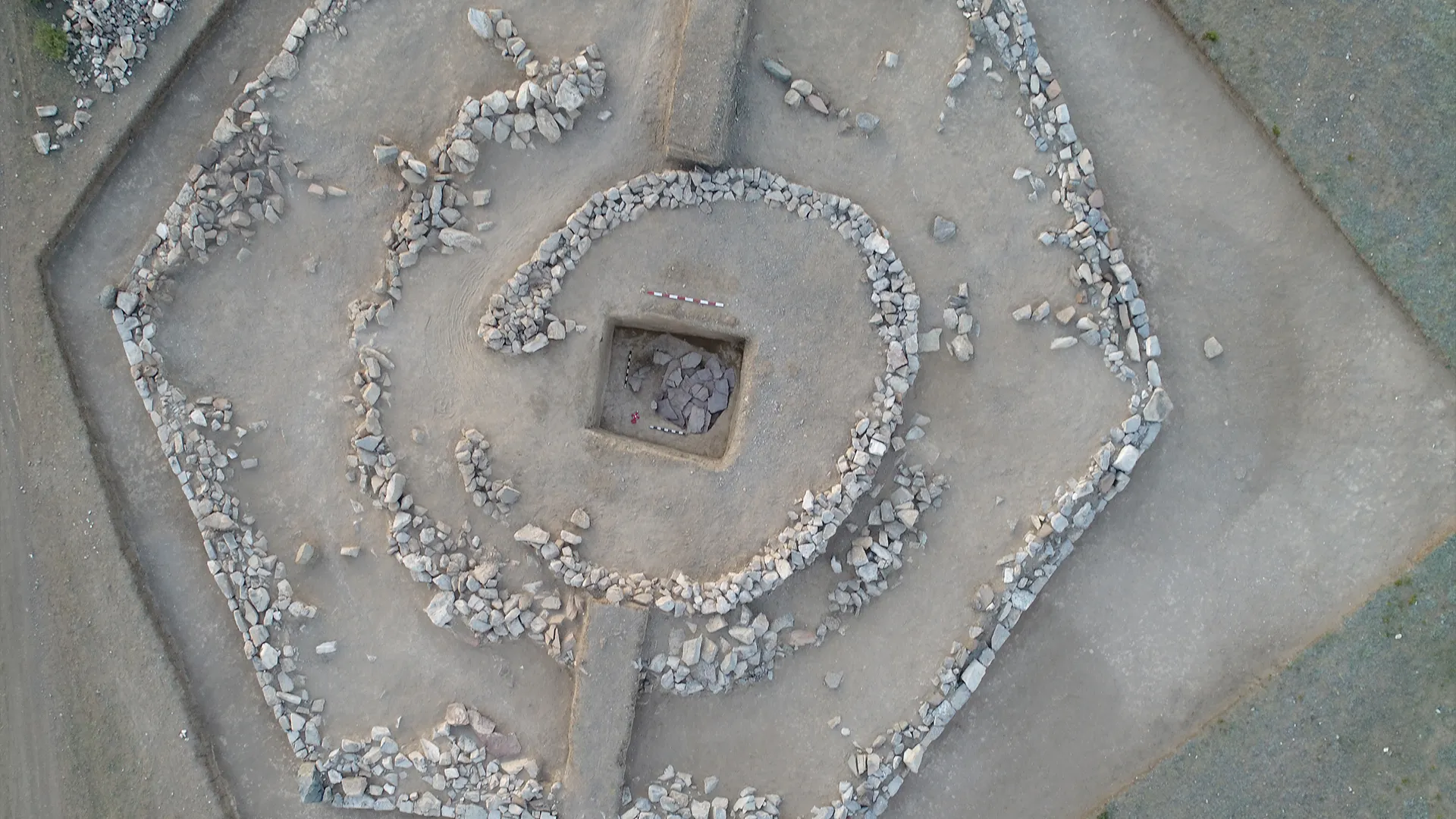
An aerial view of the hexagonal-shaped pyramid in Kazakhstan. Notice how the inner stone walls form a maze-like path that leads toward the burial site at its center.
Archaeologists in Kazakhstan have discovered a 3,800-year-old hexagon-shaped structure that they describe as a "pyramid." The maze-like structure is not as tall as Egypt's monuments, but currently stands about 10 feet (3 meters) high and likely served as an elite burial site.
The discovery is not like anything "found before in the Eurasian steppe," according to a statement from Eurasian National University in Kazakhstan.
"This pyramid on the territory of Eastern Kazakhstan was found this year," Ulan Umitkaliyev, the head of Eurasian National University's archaeology and ethnology department who is leading excavations at the site, told Live Science in an email. "It is hexagonal in shape, with megaliths weighing up to 1 ton [0.9 metric tons] placed in each corner."
While archaeologists use the term "pyramid" or "step pyramid" to describe it, the Bronze Age monument is unlike the pyramids found in Egypt. Its outer stone walls form a hexagon, the structure's inner walls look like a maze that leads to a grave at its heart. Parts of it were once covered by an earthen mound, Umitkaliyev added. It's not clear if there was ever a roof over part of the structure or whether it was entirely open air.
The people who lived in this region at the time built many graves and stone monuments and engaged in metal working and making jewelry. Their economy may have been partly pastoral — herding large numbers of animals across the Eurasian steppes.
A close-up of the burial site at the center of the pyramid.
(Image credit: Ulan Umitkaliyev)
The exterior walls of the pyramid are decorated with petroglyphs, or rock art of various animals, including camels and a multitude of horses, according to the statement. Horse bones were discovered just outside the pyramid and a horse cult likely flourished in the area at the time.
Sign up for the Live Science daily newsletter now
Get the world’s most fascinating discoveries delivered straight to your inbox.
Radiocarbon dating of the pyramid's organic remains indicate that the structure was built during the 19th century B.C., Umitkaliyev said. "Similar monuments are found on the territory of Kazakhstan, especially in Central Kazakhstan," Umitkaliyev said.
Excavations at the site and analysis of its remains are ongoing, but so far archaeologists have found ceramics, a woman's gold earrings and other pieces of jewelry, the statement said. It is not clear if any human remains are still present.
The stone-lined burial at the center of the pyramid.
Archaeologists are eager to learn more about the finding, but more information is needed before it can be scientifically evaluated, Karen Rubinson, a research associate with the Institute for the Study of the Ancient World at New York University, told Live Science in an email. Rubinson was not involved in the finding, but is an expert on the archaeology of the region.
For instance, scientific records and photographs of the artifacts and petroglyphs need to be published in order for scholars not involved with the excavation to properly analyze the monument, Rubinson said.
The newly discovered pyramid is located in Kyrykungir, an area that contains a number of ancient graves and monuments. It is located near Toktamys village, an area scientists at Eurasian National University have been excavating since 2014, the statement said.
Owen Jarus is a regular contributor to Live Science who writes about archaeology and humans' past. He has also written for The Independent (UK), The Canadian Press (CP) and The Associated Press (AP), among others. Owen has a bachelor of arts degree from the University of Toronto and a journalism degree from Ryerson University.