













'If you can bench press a car, you are good to go': Inside the incredible bite-force of crocodiles
In this extract from "Bite: An Incisive History of Teeth, from Hagfish to Humans," Bill Schutt looks at the creatures with the strongest bite forces in the world.


In this adapted extract from "Bite: An Incisive History of Teeth, from Hagfish to Humans" (Algonquin Books, 2024), author and vertebrates zoologist Bill Schutt investigates the extraordinary bite force of living crocodilians, as well as their formidable predecessors, Deinosuchus and Sarcosuchus — the "most forceful biters in history."
"There are no 'pretty good' crocodilian researchers, Gregory Erickson quipped. “In my business, if you're not very good, you're missing an arm or something." Erickson, a professor of anatomy and vertebrate paleobiology at Florida State University, also emphasized that it takes a team of experienced handlers to secure the larger specimens. "We always have four or five people who really know their stuff."
Though Erickson has a range of research interests, I’d contacted him because of his research into the biting behavior of alligators, crocodiles and their relatives,
Once strapped down, a tap on the snout usually causes the test subject to open its mouth, after which the bite bar is placed onto the rear teeth. That's because the laws of physics dictate that a measurement taken closest to the jaw joint will provide the greatest bite force.
This placement also stimulates something akin to the knee-jerk reaction you might have experienced while being examined by a rubber-mallet-wielding physician. Here, though, the reflexive response by the crocodilian is to chomp down on the bite bar with full force. Although Erickson's first experiments centered on alligators (which makes perfect sense, given his Florida location), eventually he and his coworkers were able to obtain bite-force data on all 23 species of extant crocodilians, a group that includes crocodiles, alligators, caimans (alligator relatives from Central and South America), and gharials (narrow-snouted piscivores).
"We try to do three to five [individuals] of each species," Erickson said, emphasizing that this practice increased the chances of obtaining a true indication of the bite forces for that species. Ultimately, the largest animals they measured were several 17-foot (5.2 meters) saltwater crocodiles (Crocodylus porosus), which, along with the Nile crocodile (Crocodylus niloticus), happen to be the species involved in the greatest number of fatal and nonfatal attacks on humans.

Researchers have found bite forces among crocodiles is solely dependent on body size.
Erickson and his fellow researchers were interested in determining how bite forces varied between species. Before their study, there had been several hypotheses predicting that bite forces in crocodilians would vary depending on factors like tooth shape, or the length or width of the jaw — variables that were readily observable traits commonly used to identify the species in question.
Get the world’s most fascinating discoveries delivered straight to your inbox.
In something of a surprise, though, Erickson and his colleagues found that bite force was solely dependent on body size. "We got the same regression lines pound for pound," he told me. In other words, if you had a crocodile, alligator and caiman, each weighing 100 pounds (45 kilograms), their bite forces would be the same.
All the smaller species had smaller bite forces. The 17-foot saltwater crocodiles generated a bite force of 3,700 pounds (1,680 kg), but when those numbers were scaled up to the historically recorded 23-footers (7 m), Erickson said, "7,700 pounds [3,500 kg] is not infeasible."

Gharials are the exception to the rule for crocodilian bites, being far below their relatives in terms of force.
There were, however, two exceptions to the size/bite force correlation: the two species of gharials (Gavialis gangeticus and Tomistoma schlegelii), whose long, skinny snouts look oddly out of place attached to a body that can reach 12 to 15 feet (3.7 to 4.7 m) in length or more and weigh in at up to 2,000 pounds (900 kg).
Their extremely elongated jaws are equipped with 110 interlocking, needle-like teeth, and the whole setup is wonderfully well adapted for slashing through the water with little resistance. But their bite force is significantly below expected values for critters of that size. Erickson believes the gharials' specialized fishing tackle is the cause, and that it resulted in an evolutionary trade-off in which greater bite force was sacrificed for the sake of rapid fish-snatching ability, made possible by an extremely long set of toothy jaws.
Unfortunately, the two living species of gharials are critically endangered. Within the gharials' riverine habitats on the northern Indian subcontinent, their numbers may have fallen to levels measured in the hundreds of individuals. Except for the narrow-nozzled gharials, all crocodilians, no matter their size, come equipped with some seriously powerful jaws.
Erickson hypothesizes that this adaptation evolved in ancestral crocodilians during the age of dinosaurs, enabling them to carve out an ecological niche along the water's edge that they've successfully held for over 100 million years. He compared crocodilian diversity to starting out with a big, powerful engine, then tweaking the attachments you could add to that megaforce-generating machine — tweaks that would include variation in the length, width and shape of the "stuff out in front of the eyes" (Erickson's term for the jaws and teeth). These attachments helped the different crocodilians become better adapted to prey on a variety of creatures, from mollusks to fish, and from birds to big game.
When considering the bite of a crocodilian, Erickson stressed the fact that just as important as the total force a crocodilian jaw might produce is the surface area where that force is being applied — in other words, the force per unit area, or pressure. That's because this measurement not only factors in the forces generated but also the shape of the tooth.
Erickson compared a pointy tooth like a crocodile canine to a shoe with a stiletto heel, which he described as more capable of damaging a wooden floor than a shoe with a flat sole. The force applied to the ground by the high-heel wearer is distributed across a smaller unit of area (the tip of the high heel) than it would be across the broad, flat sole of a sneaker. In pointy canine teeth, the bite force is distributed over a small surface area at the tooth tip, making them effective for piercing a prey's skin or hide.
Conversely, flat teeth, like premolars and molars, distribute bite forces over a greater surface area, making them ideal for turning large chunks of food into smaller chunks.

Sarcosuchuns was a 40 foot long crocodile-like creature that lived about 120 million years ago.
Of course, I was interested in the greatest bite force ever generated by an animal, extinct or extant, so I asked Erickson. He told me that was a tough question (presumably in part due to the scarcity of researchers during the age of dinosaurs) but that data points to a pair of prehistoric apex predators.
The first is Deinosuchus, a now-extinct crocodilian relative of modern alligators. Deinosuchus lived around 82 million to 75 million years ago in what is now the United States, where it reached lengths of almost 33 feet (10 m). "I don't think that any animal that has ever lived could have broken the grip of Deinosuchus," Erickson told me.
"So, what about escaping the grasp of an adult American alligator (Alligator mississippiensis) nowadays?" I wondered. "How hard would that be?"
"The bite force of a very large alligator is about 3,000 pounds [1,360 kg], about the weight of a small car," Erickson said. "So if you can bench press a car, you are good to go … If not, you're lunch."
RELATED STORIES
The second contestant in the Greatest Bite Force of All Time Contest is Sarcosuchus. With a body length of about 40 feet (12 m), this behemoth lived in what is now South America and Africa 133 million to 112 million years ago. Sarcosuchus is classified as a crocodyliform (a "crocodile-like" creature). This means that although it certainly had the look of a card-carrying crocodilian, Sarcosuchus is not believed to be an ancestor of modern crocodiles and their relatives.
Still, Erickson believes that, like Deinosuchus, Sarcosuchus was generating a bite force of 20,000 pounds (9,000 kg), a number that his team estimated by scaling up the data from extant crocodilians. "I think they were right up there with the most forceful biters in history," he told me.
There are apparently limits, though, on the amount of bite force that can be generated. These relate to how much stress can be placed on the enamel covering of a tooth before it shatters. But, Erickson reminded me, this type of creature has a safeguard against that potential disaster. "Crocodilians all break their teeth," he said. "But they have one advantage over mammals — they can replace their teeth throughout their lives."
From "Bite: An Incisive History of Teeth, from Hagfish to Humans" by Bill Schutt. Used with permission of the publisher, Algonquin Books. Copyright © 2024 by Bill Schutt. This excerpt has been edited for space and clarity.
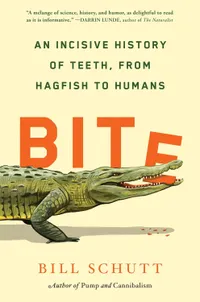
Bite: An Incisive History of Teeth, from Hagfish to Humans - $31 at Amazon
From three-inch fang blennies to thirty-foot prehistoric crocodiles, from gaboon vipers to Neanderthals, Bite is a fascinating journey through the natural, scientific, and cultural history of something right in front of—or in—our faces: teeth.
In Bite, zoologist Bill Schutt makes a surprising case: it is teeth that are responsible for the long-term success of vertebrates. The appearance of teeth, roughly half a billion years ago, was an adaptation that allowed animals with backbones, such as fish, amphibians, reptiles, birds, dinosaurs and mammals—including us—to chow down in pretty much every conceivable environment.

Bill Schutt is a vertebrate zoologist and author of six nonfiction and fiction books, including Pump: A Natural History of the Heart and the New York Times Editor’s Choice, Cannibalism: A Perfectly Natural History. Recently retired from his post as professor of biology at LIU Post, he is a research associate at the American Museum of Natural History, where he has studied bats all over the world. His research has been featured in Natural History magazine as well as in the New York Times, Newsday, the Economist, and Discover.