 Live Science Plus





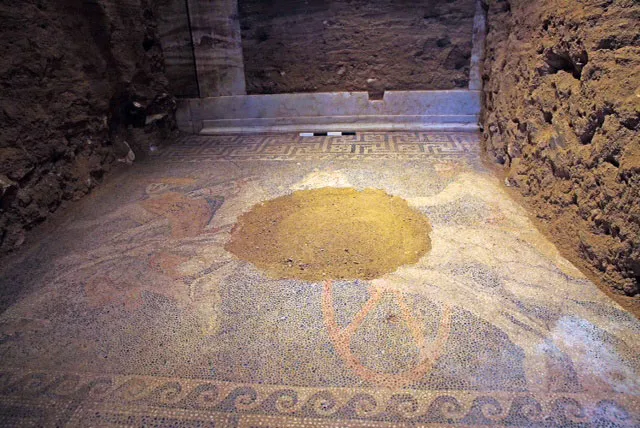
An elaborate and colorful mosaic showing the Greek god Hermes leading a man to the underworld has been uncovered in a vast tomb from the era of Alexander the Great, Greek archaeologists announced.
The figurative artwork spans the surface of an antechamber at the Kasta Hill burial complex in Amphipolis, an ancient city in the Central Macedonia region of Greece. Appropriately for a tomb, the mosaic depicts a horse-drawn chariot led by Hermes as "psychopomp," or spiritual guide to souls in the afterlife, according to the Greek Ministry of Culture.
The mosaic covers an area of about 14.7 feet by 8.9 feet (4.5 meters by 3 meters). It was discovered as archaeologists cleared soil from a room behind a doorway that is supported by a pair of larger-than-life caryatids, or female statues that take the place of pillars or columns. [See Photos of the Alexander-Era Tomb's Excavation]
Article continues belowOngoing archaeological excavations rarely attract so much attention. But the tomb at Amphipolis is remarkable for its enormous proportions — it is enclosed by a marble wall 1,600 feet (490 m) in perimeter — and its mysterious contents. Archaeologists still don't know who might be buried inside if the tomb turns out to be intact.
The dig has sparked great excitement since August, when Greek Prime Minister Antonis Samaras toured the site and declared it an "extremely important discovery." At that time, archaeologists had just unearthed a pair of headless sphinxes standing guard at the sealed entrance of the tomb. As the excavators have probed deeper inside over the past two months, they've revealed additional rooms with impressive architectural elements, such as the delicately carved caryatids and traces of paint on the walls.
The freshly revealed mosaic is composed of small pebbles that are white, black, gray, blue, red and yellow in color. The artwork isn't completely intact; a circular area about 2.5 feet (0.8 m) in diameter in the middle of the composition has been lost. But the figurative scene is still clear: Hermes heads the chariot, which is pulled by two white horses. Hermes and the horses are leading a bearded man with a laurel wreath on his head shown in profile. That main scene has a border decorated with waves and a meander pattern.
The team of excavators, led by Greek archaeologist Katerina Peristeri, believes the tomb dates back to the fourth century B.C. and bears the architectural fingerprints of Dinocrates, Alexander the Great's chief designer. The team doesn't expect to find Alexander himself if they do find a corpse (or corpses) in the burial complex; Alexander died in Babylon and is believed to have been buried in Egypt, though his grave has never been found.
Follow Megan Gannon on Twitter and Google+. Follow us @livescience, Facebook & Google+. Original article on LiveScience.

