















Michelangelo Artfully Hid a Brain Stem in God's Throat

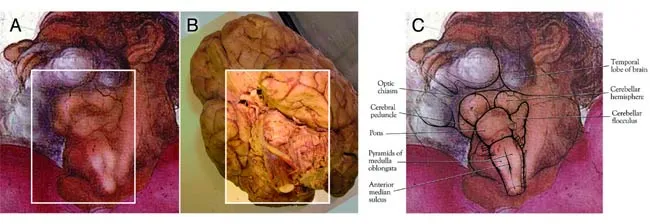
Michelangelo's depiction of God's throat in one panel of his Sistine Chapel fresco is awkward, which is odd for an artist so devoted to the study of anatomy. Now researchers have a theory to explain why: Michelangelo embedded an image of a human brain stem in God’s throat, they find.
The Renaissance artist is known to have studied human anatomy by dissecting cadavers when he was a young man, and continued until late in his 89 years. This practice informed his powerful depictions of the human and the divine.
But one panel of his Sistine Chapel frescoes contains an oddly lit and awkward image of God's neck and head as seen from below. The light illuminating the neck was different from that of the rest of the painting. Also, God's beard is foreshortened and appears to roll up along the sides of his jaw, and his bulbous neck has prompted speculation that Michelangelo intended to portray God with a goiter, or abnormally enlarged thyroid gland.
Two researchers – one a neurosurgeon, the other a medical illustrator – writing in the May issue of the journal Neurosurgery have another, more flattering theory. In this panel, which portrays the Separation of Light from Darkness, from the Book of Genesis, Michelangelo embedded a ventral view of the brainstem, they wrote. [Image of hidden brain stem]
Using a digital analysis, they compared the shadows outlining the features of God’s neck and a photograph of a model of this section of the brain, which connects with the spinal cord, and found a close correspondence.
This is not the first anatomical image found hidden in the frescoes of the Sistine Chapel. In an article published in 1990, Frank Lynn Meshberger, a gynecologist, identified an outline of the human brain in the Creation of Adam. Among other details, he noted that the shroud surrounding God had the shape of the cerebrum, or the upper part of the brain. A decade later, another researcher pointed out a kidney motif.
"We speculated that having used the brain motif successfully in the Creation of Adam almost a year earlier, Michelangelo wanted to once again associate the figure of God with a brain motif in the iconographically critical Separation of Light from Darkness," wrote authors Ian Suk, a medical illustrator, and neurosurgeon Rafael Tamargo, both of the Johns Hopkins School of Medicine.
Get the world’s most fascinating discoveries delivered straight to your inbox.
They do point out "the perils of overinterpreting a masterpiece," saying that not all art historians and other viewers will agree with their conclusions. Even so, they say their analysis, along with historical records, backs the interpretation.
