













Sharks' Killer Strategy Revealed
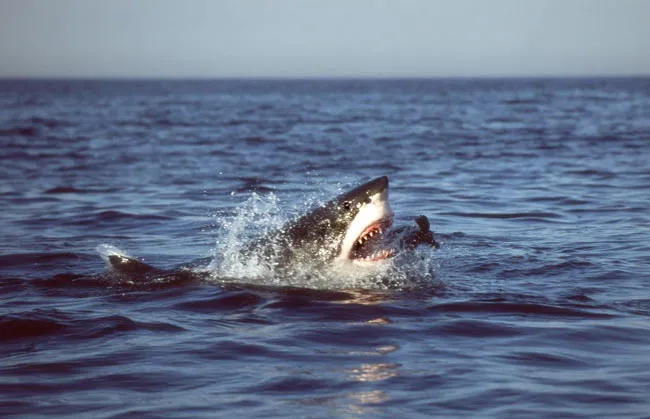
Killers tend to strike where they will be most successful, often near home, detectives say. The same is true for great white sharks, according to a new study.
Researchers used geographic profiling – a tool originally developed to catch serial criminals – to study how sharks hunt so-called Cap fur seals at Seal Island in False Bay, South Africa, a location famous for spectacular shark attacks at the water's surface.
The tool revealed that great white sharks use a strategic hunting approach and establish a "center of gravity" to focus their search for food instead of simply lurking in shallow water to ambush prey. In much of the wild, shark hunting-patterns are a mystery, so any insight into their habits can help protect the species, whose numbers are declining globally.
"In order to protect the sharks you have to protect the area where they hunt," said Neil Hammerschlag, a Ph.D. candidate in marine biology at the University of Miami. "You have to keep the system in balance."
Hammerschlag and a team of researchers observed 340 shark attacks while stationed on two ships at opposite ends of Seal Island. Once a shark was spotted flying out of the water to bite a seal, a ship would race to the bloody spot of attack to see if the kill was a success, document the coordinates and measure the shark's size.
The researchers pinpointed the sharks' base of operations, around 330 feet (100 meters) away from the seals' main entrance to the island. The location supports previous research that found that sharks' success in capturing seals actually decreases as they move closer to the island.
The scientists propose that this spot represents a balance among prey detection, capture rates and competition, all important factors in a predator-prey system. Larger white sharks were more likely to stay near the packs' "center of gravity," either due to refined hunting skills or dominance over smaller sharks, which tend to hunt over a wider area.
Get the world’s most fascinating discoveries delivered straight to your inbox.
"Sharks hunt in a certain area, much like criminals operating from a house, like with gang activity," said Kim Rossmo, a criminal justice professor at Texas State University-San Marcos who was involved with the geographic profiling in the study.
Geographic profiling involves a complex mathematical algorithm originally developed to identify a criminal's base by analyzing the locations of their previous crimes (the researchers got the idea to use this technique while reading a crime novel). Unlike a lone criminal killing near his home, sharks are constantly mobile, and were found to be constantly swimming around their base "like planets revolving around the sun," Hammerschlag told LiveScience.
In the animal world, geographic profiling is still a novel approach and has only been used briefly to characterize the foraging behavior of pipistrelle bats and bumblebees, but it has never before been used to study a marine environment or to study sharks.
The study was published in the June 22 issue of the Journal of Zoology.
- Gallery – Great White Sharks
- Video - Whale Shark Rave: Thriving Population
- Top 10 – Deadliest Animals