













High-Tech Effort Underway to Protect Magna Carta

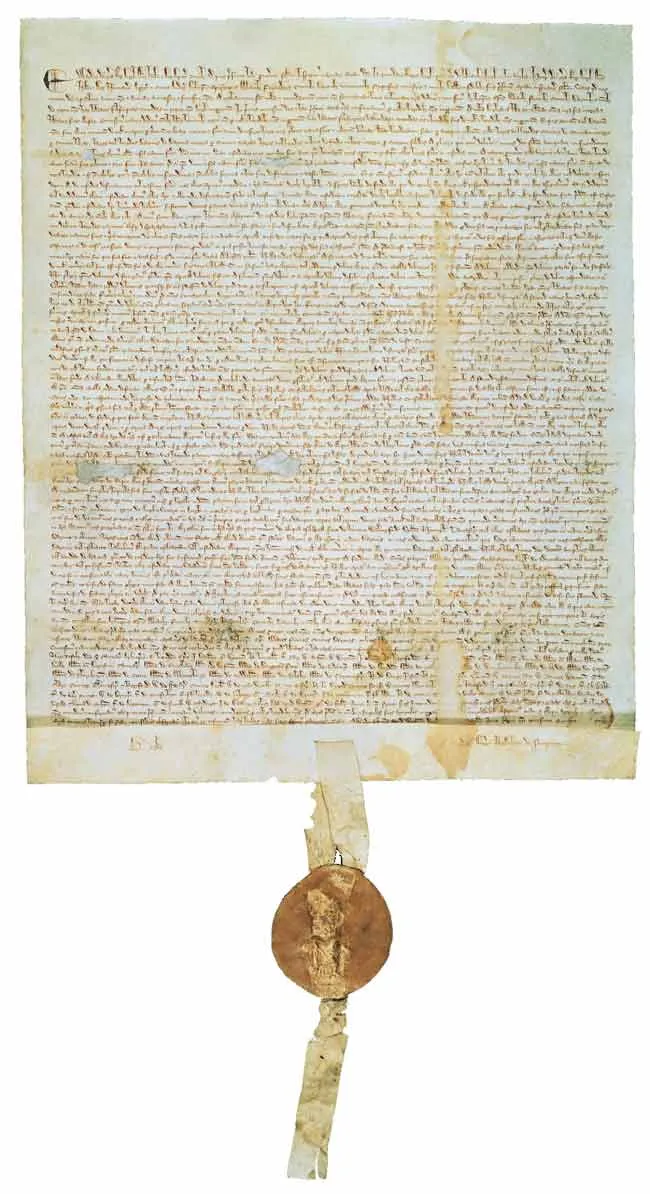
The Magna Carta helped form the foundation for modern English and U.S. law. Now one of two copies known to exist outside England is headed for a special new case to preserve it.
The very first Magna Carta dates to 1215, when English barons forced King John to write down the traditional rights and liberties of the country's free persons. A copy of the Magna Carta signed by King Edward I in 1297 currently resides within a helium-filled casement at the National Archives Building in Washington. But the medieval document is scheduled for a temporary removal in 2011 so it can be re-measured for a new case filled with argon.
Researchers worried that helium atoms, which are relatively small, could escape from the case holding the Magna Carta, leaving the 713-year-old animal skin parchment susceptible to degradation. Those fears proved unfounded, but the National Archives has chosen to preserve the parchment in another inert gas, argon, whose larger atoms have proven easier to contain.
"Argon is used to displace oxygen and any moisture that may be remaining in the encasement area, to preserve the document and minimize degradation," said Mark Luce, an engineer at the National Institute of Standards and Technology.
Catherine Nicholson, supervisory conservator at the National Archives and Record Administration, said the use of helium for preservation dates back to when the "U.S. government had a monopoly on helium and was interested in finding ways to use it."
Multiple Magna Cartas
Five centuries after the Magna Carta was written, American colonists who broke off from England emphasized similar liberties in the Bill of Rights and other documents. One such passage in the Bill of Rights states: "No person shall ... be deprived of life, liberty, or property, without due process of law."
Get the world’s most fascinating discoveries delivered straight to your inbox.
There were several Magna Cartas, because the English lords required each king following King John to sign a new copy of the document. In addition, each lord wanted his own personally signed copy.
Each copy of the Magna Carta was handwritten on animal skin parchment rather than paper, Nicholson said. Each copy also carried a wax seal that hung down from the document like a pendant on a ribbon.
The copies "look different because they were made by different people," Nicholson told LiveScience. "They didn't get the same one out and say 'Okay, you sign this one, too.'"
Just four original copies of the 1297 Magna Carta remain; two are in England and one is in Australia.
Building a case
The National Archives joined with the National Institute of Standards and Technology in the 1990s to create new encasements for the "charters of freedom," including the Declaration of Independence, the Constitution of the United States and the Bill of Rights.
Those documents' encasements use glass and metal, and not the rubber O-rings found in the older encasement that currently protects the 1297 Magna Carta. But the Magna Carta will get its own upgraded protection after taking a year off from the display case to get fitted.
"With an O-ring design, you have to replace the rubber O-rings every seven or 10 years," Luce explained in a phone interview. "Whereas a glass and metal seal – depending on whether the encasement is disassembled – has no specific timeline for replacement."
- History's Most Overlooked Mysteries
- Trove of Unknown Ben Franklin Letters Found
- 10 Events That Changed History
