













Dinosaur Sported Colorful Feathers
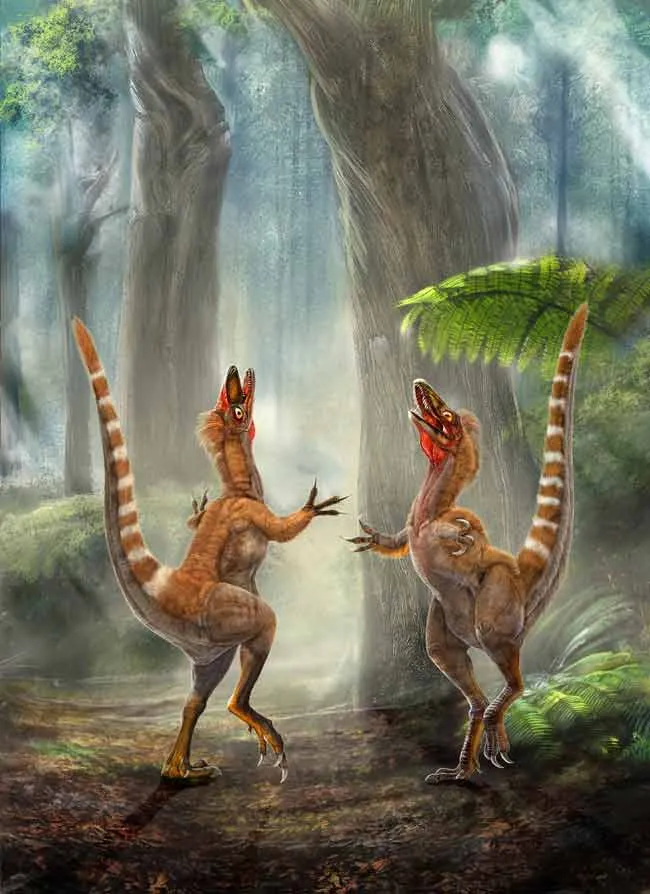
Our image of what dinosaurs looked like has just been colorized, thanks to fossilized feather remains showing one meat-eating beast sported a striped tail of white and gingery bands.
Not only do the results paint a jazzier picture of the ancient giants, they also confirm the presence of real feathers, not just "feather-like" or bristly structures, in some meat-eating dinosaurs called theropods, the scientists say. The finding has implications for understanding the origin of feathers, since scientists think birds evolved from a group of theropods called maniraptors, some 150 million years ago during the Jurassic period.
"Our research provides extraordinary insights into the origin of feathers," said Mike Benton, a professor of paleontology at the University of Bristol. "In particular, it helps to resolve a long-standing debate about the original function of feathers — whether they were used for flight, insulation, or display. We now know that feathers came before wings, so feathers did not originate as flight structures."
Rather, feathers were likely used for color display at first, he added.
Specifically, Benton and his colleagues found remains of melanosomes, which are tiny structures enclosing pigments that are embedded within the structure of feathers. Melanosomes are responsible, in part, for the colors exhibited by the feathers of some modern-day birds, such as zebra finch feathers.
The team looked at melanosomes from remains of theropods and primitive birds using a scanning electron microscope, finding melanosomes for reddish-brown to yellow pigment and those for black-grey pigment. While the remains didn't include actual pigments, the researchers matched the shapes of these melanosomes with those found in the feathers of today's birds to figure out the color.
The pattern of the melanosome structures suggested the theropod Sinosauropteryx had simple bristles with alternating white and ginger, or chestnut-colored rings down its tail. And the early bird Confuciusornis had patches of white, black and orange-brown coloring on parts of its body.
Get the world’s most fascinating discoveries delivered straight to your inbox.
"There's a very clear rim of feathers running down the top of the head kind of like a Mohican [Native American headdress] all the way down the back and along the tail," Benton said, referring to feathers on Sinosauropteryx, which lived some 120 million years ago.
In the past, some have suggested that what scientists assumed were fossilized feathers were actually bits of tissue.
"These bristles really are feathers," Benton said during a press briefing yesterday on the discovery. "If they were bits of skin or connective tissue or something else they would not contain melanosomes."
And since the researchers found the feathers only on certain areas of Sinosauropteryx's body, Benton said, the downy coat was likely not used for thermoregulation, or temperature adjustment, which had been suggested as another possible function of the first feathers.
- Secret of Bird Flight Revealed
- Ancient Bird's Feathers Had Iridescent Glow
- Avian Ancestors: Dinosaurs That Learned to Fly
Jeanna Bryner is managing editor of Scientific American. Previously she was editor in chief of Live Science and, prior to that, an editor at Scholastic's Science World magazine. Bryner has an English degree from Salisbury University, a master's degree in biogeochemistry and environmental sciences from the University of Maryland and a graduate science journalism degree from New York University. She has worked as a biologist in Florida, where she monitored wetlands and did field surveys for endangered species, including the gorgeous Florida Scrub Jay. She also received an ocean sciences journalism fellowship from the Woods Hole Oceanographic Institution. She is a firm believer that science is for everyone and that just about everything can be viewed through the lens of science.