













Nostrils Take Turns Smelling

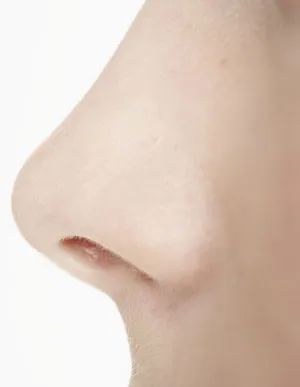
When two different scents waft up toward the nose, the nostrils take turns at sniffing the smells, a new study finds.
For the study, 12 volunteers sampled smells from two bottles containing distinctively different odors. One bottle had phenyl ethyl alcohol, which smells like a rose, and the other had n-butanol, which smells like a marker pen.
The bottles were fitted with nosepieces so that volunteers could smell both scents simultaneously — one through each nostril.
During 20 rounds of sampling, all 12 participants experienced switches between which smell came through the strongest — sometimes a participant mostly smelled rose, while other times they smelled marker pen.
Some experienced more frequent and drastic switches than others, but there was no predictable pattern of the switch across the whole group of volunteers or within individuals.
Study team member Denise Chen, of Rice University in Houston, said this "binaral rivalry" between the nostrils resembles the rivalry that occurs between other pairs of sensory organs. For example, when the eyes simultaneously view two different images — one for each eye — the two images are perceived in alternation, one at a time.
So the participants in the smelling study were perceiving an "olfactory illusion," Chen said. "Instead of perceiving a constant mixture of the two smells, they perceive one of the smells, followed by the other, in an alternating fashion, as if the nostrils were competing with one another. Although both smells are equally present, the brain attends to predominantly one of them at a time."
Get the world’s most fascinating discoveries delivered straight to your inbox.
This binaral rivalry involves adaptations to sensory neurons in the brain, Chen said. Future studies could teach us more about just how our noses actually detect smells and how our brains process them, she added.
The new findings were detailed in an online issue of the journal Current Biology.
