















There Once Was a Shark That Ate an Amphibian That Ate a Fish ...

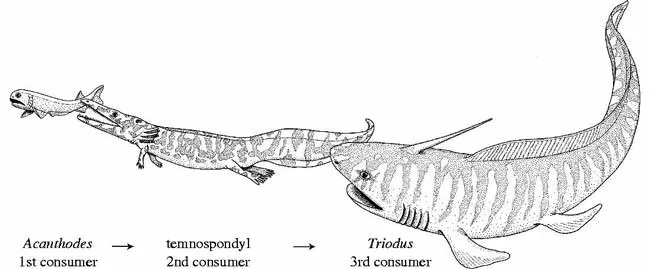
A fossilized shark that swallowed a crocodile-like amphibian that, in turn, had gobbled up a fish has now been unearthed.
This exceptional find marks the first time scientists have found direct evidence of such a complex, extinct food chain.
In the past, researchers had uncovered evidence of what past species ate based on the fossilized contents of their guts or droppings. For instance, fossilized dung, or "coprolites," have revealed some dinosaurs ate grass.
"Prey, especially in the gut or intestines of fossil organisms, are very rarely preserved," said paleobiologist Jurgen Kriwet at Humboldt University of Berlin in Germany. At most, only a single victim or perhaps several of the same species are preserved, he added.
By accident, Kriwet and his colleagues discovered the new shark fossil in a museum collection. These exceptionally preserved remains are roughly 290 million years old, pre-dating the emergence of the dinosaurs.
The freshwater shark, some 20 inches (50 centimeter) long, dates back to the late Permian period, when the Saar-Nahe Basin in southwest Germany was peppered with short-lived lakes. In the shark's gut were two young amphibians known as temnospondyls, each roughly 8 inches to 10 inches (20 to 25 centimeters) large.
"The temnospondyl was crocodile-like," Kriwet said. "The temnospondyls in the gut of the shark were larvae. Their adult equivalents grew very big up to one meter (three feet), maybe more, and they occupied the niche that is occupied today by crocodiles in lakes."
Get the world’s most fascinating discoveries delivered straight to your inbox.
"Crocodiles were not around in the Permian," he added. "They evolved much later." The disappearance of the temnospondyls appears linked with the rise of the crocodiles, Kriwet explained.
In turn, one of the amphibians possessed the remains of a digested bony fish that was about four inches (10 centimeters) long during life. Adults of this fish grew up to 20 inches (50 centimeters) or more.
The remarkable fossils shed welcome new light onto the ancient world. For instance, "no other extinct or modern, living shark is known to feed on amphibians," Kriwet told LiveScience. Future research could help reconstruct ancient food webs "and might shed light on how modern food webs in aquatic systems arose."
The findings were detailed online Oct. 30 in the journal Proceedings of the Royal Society B.
- Vote: Your Favorite Shark
- The Top 10 Deadliest Animals
- Gallery: Great White Sharks
