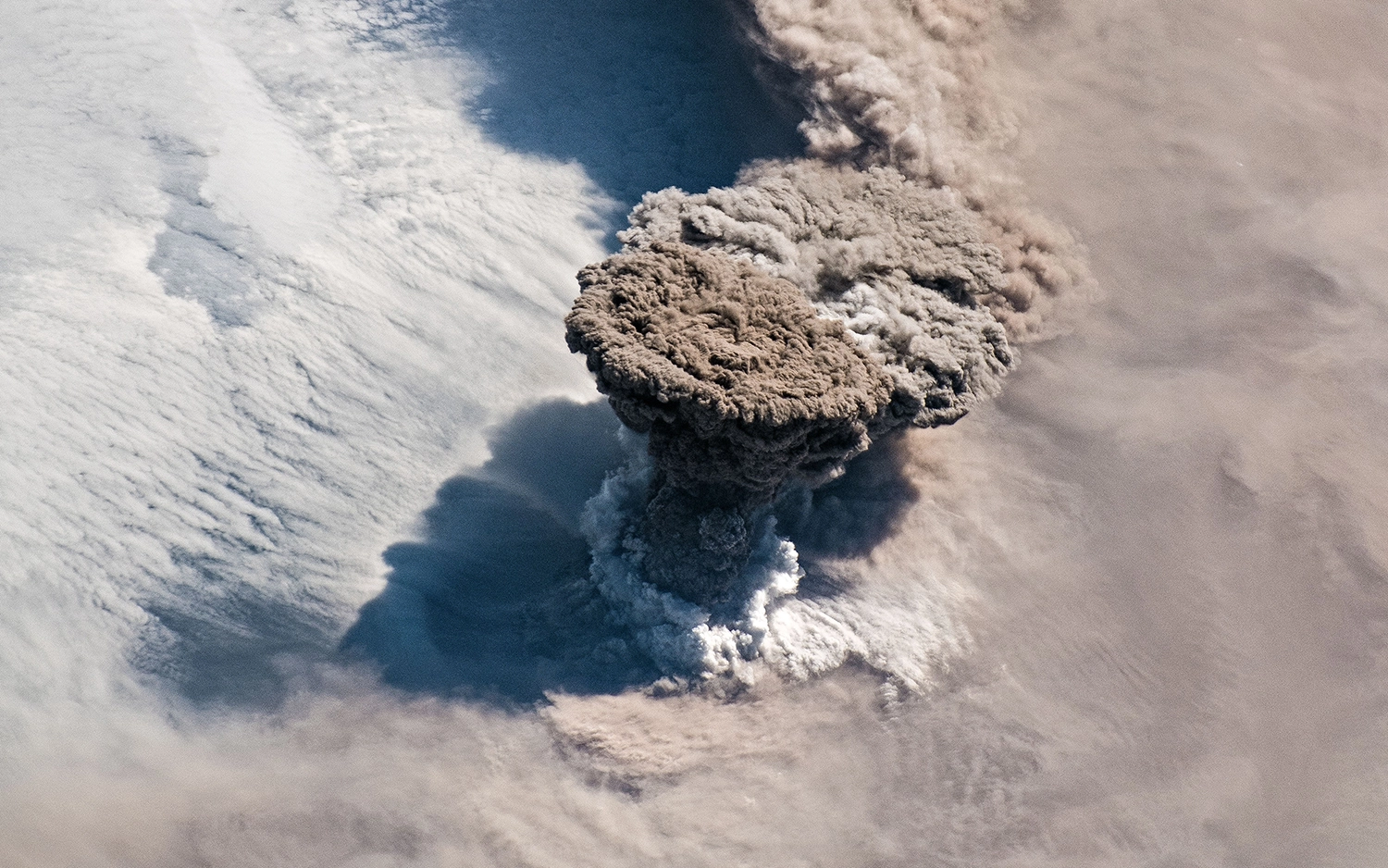
A towering mushroom-shaped cloud of ash and smoke recently rose from a volcano on an island in the Pacific Ocean, and an astronaut on board the International Space Station (ISS) captured a spectacular view of the eruption from high above.
The volcano Raikoke sits on the Kuril Islands, an archipelago of volcanic peaks that lies between Russia's Kamchatka Peninsula and Japan's Hokkaido Island. On June 22 at approximately 4 a.m. local time, Raikoke exploded for the first time since 1924, expelling a dense plume that could be seen from the ISS, NASA Earth Observatory reported.
The towering plume extended to an altitude of about 43,000 feet (13 kilometers); it rose from the volcano's crater and formed a spindly column that puffed out at the top. [The 11 Biggest Volcanic Eruptions in History]
In this highest zone of a volcanic plume, known as the umbrella region, the ash cloud's density equalizes with the density of the air around it, and the plume's rise slows and then stops, according to NASA. Circular gravity waves are visible in the plume's flattened top; they form as pulses of air from below push briefly above the plume's maximum height and then settle back down, an effect similar to the spreading ripples displaced by a stone dropped in water, according to the volcano-tracking website Volcano Discovery.
Because the ISS photo was taken at an angle and not directly above the volcano, the impressive height, girth and structure of the ash plume is visible, as is the shadow cast by the plume on the cloud cover far below. Clusters of bright white clouds ringing the bottom of the plume are likely water vapor condensation, "or it could be a rising plume from interaction between magma and seawater, because Raikoke is a small island and [magma] flows likely entered the water," Simon Carn, a volcanologist at Michigan Technical University, told NASA.
Storm winds in the Pacific pulled ash from the Raikoke eruption to the east.
(Image credit: NASA Earth Observatory)
Raikoke is a stratovolcano, which means its slopes are built up from numerous layers of hardened lava and ash. It reaches 1,808 feet (551 m) above sea level, and prior to Raikoke's 1924 explosion, the volcano's last recorded activity was in 1778, according to the National Museum of Natural History's Global Volcanism Program.
Another image captured by satellite on June 22 shows dense concentrations of ash on the western half of the plume, while circulating storm winds over the Pacific tug at the plume and draw it eastward. Along with the ash, Raikoke's eruption also discharged a plume of sulfur dioxide that winds stirred into the stratosphere, Carn said.
Sign up for the Live Science daily newsletter now
Get the world’s most fascinating discoveries delivered straight to your inbox.
Mindy Weisberger is a science journalist and author of "Rise of the Zombie Bugs: The Surprising Science of Parasitic Mind-Control" (Hopkins Press). She formerly edited for Scholastic and was a channel editor and senior writer for Live Science. She has reported on general science, covering climate change, paleontology, biology and space. Mindy studied film at Columbia University; prior to LS, she produced, wrote and directed media for the American Museum of Natural History in NYC. Her videos about dinosaurs, astrophysics, biodiversity and evolution appear in museums and science centers worldwide, earning awards such as the CINE Golden Eagle and the Communicator Award of Excellence. Her writing has also appeared in Scientific American, The Washington Post, How It Works Magazine and CNN.