













Stunning New Map of the Milky Way Shows 800 Million Stars, Galaxies and Near-Earth Asteroids

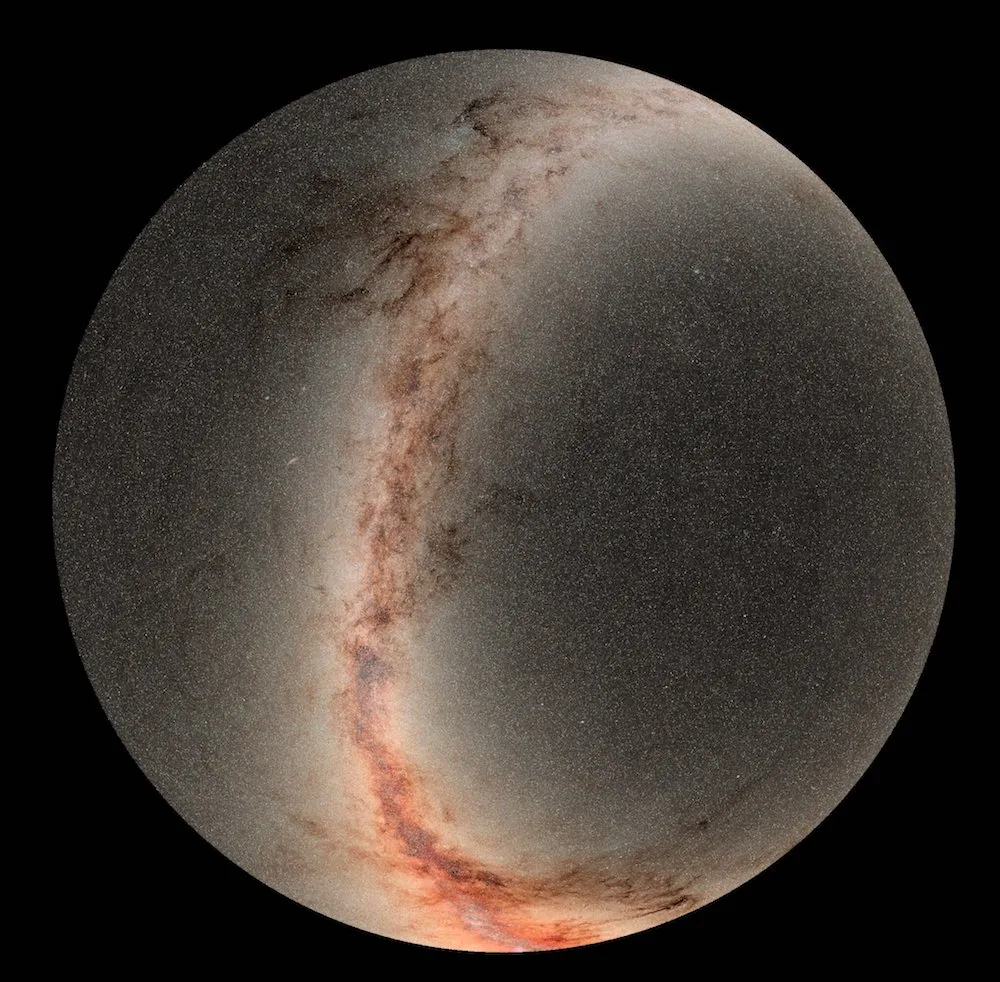
At first, it looks like a planet: dark, snow-speckled and slashed down the center by a deep red scar. But zoom in a little closer, and you realize you're looking at something much larger than a planet — larger even than 100 billion planets.
This is a new map of the cosmos, compiled from four years of observations by the Pan-STARRS observatory in Maui, Hawaii. Hidden within this mosaic image of the Milky Way (that's the big, red smear in the middle) and its near cosmic neighborhood are more than 800 million stars, galaxies and roving interstellar objects visible from the observatory's mountaintop vantage point. [11 Fascinating Facts About Our Milky Way Galaxy]
Soon, stargazers around the world will get a chance to study each of those objects (and millions of others) in detail, thanks to what scientists at the University of Hawai'i at Mānoa (UH) have called the biggest release of astronomical data of all time.
In partnership with the Space Telescope Science Institute in Baltimore, the UH is releasing 1.6 petabytes of data (1.6 million gigabytes) recorded by the Pan-STARRS telescope since 2010. This massive data dump is equivalent to about 2 billion selfies, or 30,000 times the total text content of Wikipedia, according to a statement from the UH.
"We put the universe in a box and everyone can take a peek," Conrad Holmberg, a database engineer on the project, said in the statement.
Of course, it's not the entire universe on display here — just the vast vault of sky visible over Hawaii, centered on the North Star, Polaris. A chunk of the Milky Way galaxy slices through the middle of the image, growing brighter near the bottom of the frame where the galaxy's black hole-powered center smolders in the night. Thick clouds of interstellar dust, which absorb blue light and appear to glow red, puddle along the galaxy's length.
The Pan-STARRS telescope recorded the many smaller shots that made this image possible using a 1.4-billion-pixel digital camera, which snapped the sky in visible and near-infrared light. Astronomers scanned the sky 12 times using five different telescope filters over the course of four years. The combined results of those scans are visible in this image, as well as the new data release.
Get the world’s most fascinating discoveries delivered straight to your inbox.
According to Ken Chambers, director of the Pan-STARRS observatories, this telescope's observations have already helped the astronomy community study a galaxy's worth of space phenomena over the past several years (partially thanks to a smaller data stockpile released in 2016).
"While searching for near-Earth objects, Pan-STARRS has made many discoveries, from 'Oumuamua passing through our solar system to lonely planets between the stars," Chambers said in the statement. "We hope people will discover all kinds of things we missed in this incredibly large and rich data set."
Editor's Note: This story was corrected on March 12 at 6:00 p.m. EDT. The all-sky map was created using 1.6 million gigabytes of data, which is 1.6 petabytes, not 1.6 billion petabytes.
- Spaced Out! 101 Astronomy Images That Will Blow Your Mind
- Earth Pictures: Iconic Images of Earth from Space
- Interstellar Space Travel: 7 Futuristic Spacecraft to Explore the ...
Originally published on Live Science.

Brandon is the space / physics editor at Live Science. With more than 20 years of editorial experience, his writing has appeared in The Washington Post, Reader's Digest, CBS.com, the Richard Dawkins Foundation website and other outlets. He holds a bachelor's degree in creative writing from the University of Arizona, with minors in journalism and media arts. His interests include black holes, asteroids and comets, and the search for extraterrestrial life.