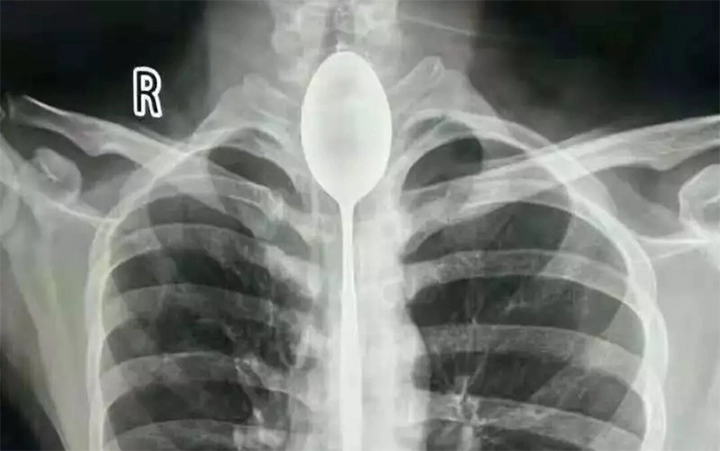
A man in China had a steel spoon lodged in his esophagus for a year, but surprisingly, the half-swallowed utensil didn't cause too much discomfort.
The man — identified only as "Mr. Zhang" — swallowed the spoon on a dare in 2017, and it promptly got stuck in the narrow tube connecting his mouth and stomach, representatives at Xinjiang Meikuang General Hospital said in a statement. Months passed, but the irritation wasn't serious enough to prompt the man to seek medical attention. That all changed last week, however, when he began experiencing chest pains and having difficulty breathing after being punched in the chest.
Three doctors performed the procedure to remove the spoon on Oct. 22. Two hours later, the spoon — which measured about 8 inches (20 centimeters) long — saw the light of day for the first time in a year, hospital officials reported. [11 Weird Things People Have Swallowed]
When Zhang visited the hospital, he was holding his chest and seemed to be in a lot of pain, Dr. Yu Xiwu, director of the hospital's Department of Otolaryngology [ear, nose and throat speciality], said in the statement. Examination revealed a metal foreign body "in the upper part of the pharynx to the esophagus," and when doctors peered down Zhang's throat with an endoscope (a long, thin tube with a camera attached), they spotted the mucus-coated spoon.
The spoon was retrieved after a procedure that lasted more than two hours.
(Image credit: Xinjiang Meikuang General Hospital)
"I was very surprised. I have never encountered a similar patient," Dr. Xiwu said.
Doctors determined that the object could be life-threatening unless it were removed immediately, and they extracted the spoon through Zhang's mouth using a pair of forceps, according to hospital representatives.
People often swallow things that they shouldn't, such as lighters, dentures and garden slugs. Examples such as these — along with the wayward spoon — may represent accidents or temporary lapses of judgment. However, sometimes people repeatedly gulp down objects that could harm them. In 2016, a 42-year-old man deliberately swallowed 40 knives — some folded and some unfolded — over a period of two months, claiming that he did so because he liked the way they tasted.
Sign up for the Live Science daily newsletter now
Get the world’s most fascinating discoveries delivered straight to your inbox.
Following his surgery, Zhang was resting comfortably; doctors expected him to be discharged within two days — hopefully, a little wiser after his ordeal, according to the statement.
Mindy Weisberger is a science journalist and author of "Rise of the Zombie Bugs: The Surprising Science of Parasitic Mind-Control" (Hopkins Press). She formerly edited for Scholastic and was a channel editor and senior writer for Live Science. She has reported on general science, covering climate change, paleontology, biology and space. Mindy studied film at Columbia University; prior to LS, she produced, wrote and directed media for the American Museum of Natural History in NYC. Her videos about dinosaurs, astrophysics, biodiversity and evolution appear in museums and science centers worldwide, earning awards such as the CINE Golden Eagle and the Communicator Award of Excellence. Her writing has also appeared in Scientific American, The Washington Post, How It Works Magazine and CNN.