Live Science Plus





You are now subscribed
Your newsletter sign-up was successful
Want to add more newsletters?

Delivered Daily
Daily Newsletter
Sign up for the latest discoveries, groundbreaking research and fascinating breakthroughs that impact you and the wider world direct to your inbox.

Once a week
Life's Little Mysteries
Feed your curiosity with an exclusive mystery every week, solved with science and delivered direct to your inbox before it's seen anywhere else.

Once a week
How It Works
Sign up to our free science & technology newsletter for your weekly fix of fascinating articles, quick quizzes, amazing images, and more

Delivered daily
Space.com Newsletter
Breaking space news, the latest updates on rocket launches, skywatching events and more!
Once a month
Watch This Space
Sign up to our monthly entertainment newsletter to keep up with all our coverage of the latest sci-fi and space movies, tv shows, games and books.

Once a week
Night Sky This Week
Discover this week's must-see night sky events, moon phases, and stunning astrophotos. Sign up for our skywatching newsletter and explore the universe with us!
Join the club
Get full access to premium articles, exclusive features and a growing list of member rewards.
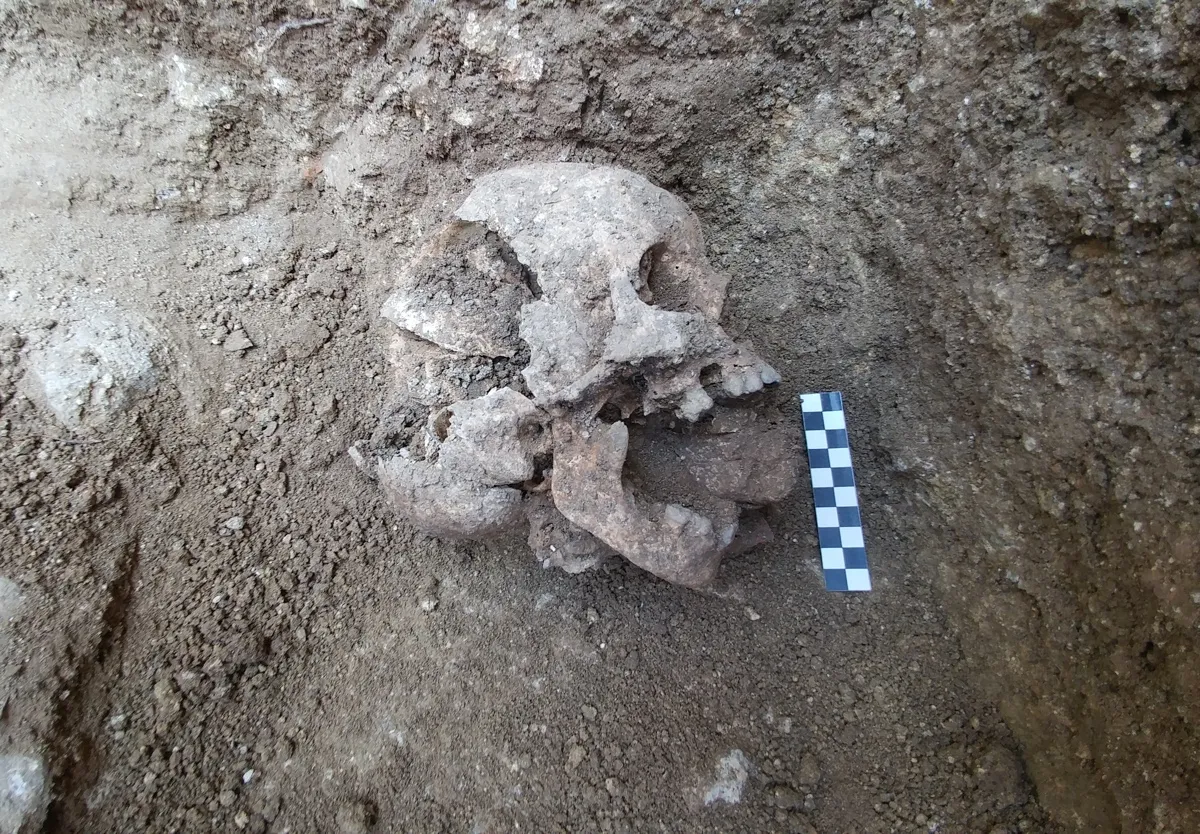
A 1,550-year-old "vampire burial" of a child with a rock stuffed into his or her mouth has been discovered in an ancient cemetery in Lugnano, Italy.
Those who buried the child, who possibly died of malaria, may have used the rock to prevent him or her (the child's sex isn't known) from rising from the grave and spreading disease to other people, said a team of researchers in a statement released Oct. 12 by the University of Arizona.
"I've never seen anything like it. It's extremely eerie and weird," said David Soren, an anthropology professor at the University of Arizona, who has overseen archaeological excavations at the cemetery since 1987. "Locally, they're calling it the 'Vampire of Lugnano.'" [7 Strange Ways Humans Act Like Vampires]
Other bizarre remains have been discovered at this cemetery, called La Necropoli dei Bambini, or the Cemetery of the Babies,including the skeletons of babies and toddlers found buried beside raven talons, toad bones and bronze cauldrons filled with the remains of sacrificed puppies. In one case, the skeleton of a 3-year-old girl at the cemetery was found with stones holding down her hands and feet, the researchers said.

In fact, until now, the oldest person found buried at the cemetery was the 3-year-old, and archaeologists assumed the grounds had been reserved for infants and toddlers.
"There are still sections of the cemetery that we haven't excavated yet, so we don't know if we'll find other older kids," bioarcheologist Jordan Wilson, a doctoral student in anthropology at the University of Arizona who analyzed the bones in Italy, said in the statement.
The cemetery was erected during the fifth century, within a first-century Roman villa. During the fifth century, a deadly malaria outbreak swept through the area, the archaeologists noted.
Rising from the dead?
The researchers said they suspect the child died of malaria, even though DNA testing hasn't been conducted on the child's remains. Other children buried in the cemetery are known to have died of malaria, and this child has an abscessed tooth, which is a side effect of malaria, the researchers said.

"We know that the Romans were very much concerned with this [the spread of disease] and would even go to the extent of employing witchcraft to keep the evil — whatever is contaminating the body — from coming out," Soren said, adding that in this case the "evil" may have been malaria.
The researchers will continue excavations at Lugnano next summer.
Other vampire burials have been discovered in the past in Italy and in Poland. An 18th-century example of one such possible burial was discovered recently at the Church of the Holy Trinity in Byszewo, Poland, reported Sebastian Nowak, a researcher at Nicolaus Copernicus University in Torun, Poland. Nowak described the finding at the European Association of Archaeologists annual meeting held in September in Barcelona, Spain.
Originally published on Live Science.