













Astronomers Just Caught the Tiniest Cannibal Galaxy in the Universe

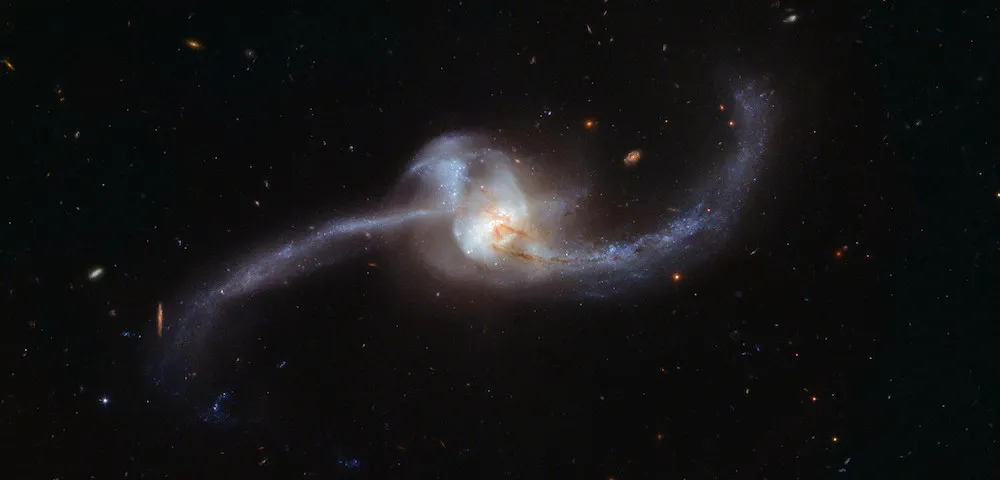
The sky is full of cannibals. Astronomers have long suspected that massive galaxies like the Milky Way become so big over time by swallowing up stars from their smaller cosmic neighbors. However, new research suggests that little galaxies also have big appetites.
According to a new paper published today (Oct. 11) in the journal Monthly Notices of the Royal Astronomical Society, a pair of astronomers from Spain's Instituto de Astrofísica de Canarias and the University of Laguna may have detected the smallest known case of galactic cannibalism ever observed — and it may have happened right down the cosmic street in one of the Milky Way's teensy satellite galaxies known as the Sextans dwarf spheroidal. [The 18 Biggest Unsolved Mysteries in Physics]
This neighborhood dwarf is old (about 12 billion years) and small, carrying about 100,000 times less solar mass than the Milky Way. And according to the study authors, it may've only gotten that way after eating an even smaller neighbor.
In their new study, the researchers analyzed data from several previous sky surveys to compare the different colors, brightness and orbital speeds of the Sextans stars. They saw some interesting patterns emerge. For starters, Sextans appeared to be split between blue, metal-poor stars and red, metal-rich stars — and those two groups of stars were behaving differently. While the blue stars appeared organized into a somewhat orderly, round cluster, the red stars were scattered into a more irregular, elliptical orbit.
"The most reasonable explanation of this phenomenon is that two galaxies merged, and had different metallicities," lead study author Luis Cicuéndez said in a statement.
The team turned up other oddities, too. Velocity data revealed what the researchers called a "ring-like substructure" of low-metal stars crammed into the belly of the galaxy. All the stars forming this ring appear to have significantly lower metallicity than their neighbors and orbit at a much higher velocity.
It's possible, the researchers wrote in the study, that this ring of low-metal stars formed when the Sextans galaxy swallowed up a more metal-poor neighbor billions of years ago. Whether these stars are the living remnants of that ancient, unlucky galaxy, or whether they formed fresh in the middle of the merger, requires further study, the researchers wrote. In any case, the Sextans galaxy's former appetite represents the smallest case of intergalactic cannibalism ever observed.
Get the world’s most fascinating discoveries delivered straight to your inbox.
"This finding appears to show that the hierarchical theory of galaxy formation, in which small galaxies merge to form larger ones, can explain the formation of even the smallest known galaxies," study co-author Giuseppina Battaglia, a physicist at the Instituto de Astrofísica de Canarias, said in the statement.
Originally published on Live Science.

Brandon is the space / physics editor at Live Science. With more than 20 years of editorial experience, his writing has appeared in The Washington Post, Reader's Digest, CBS.com, the Richard Dawkins Foundation website and other outlets. He holds a bachelor's degree in creative writing from the University of Arizona, with minors in journalism and media arts. His interests include black holes, asteroids and comets, and the search for extraterrestrial life.