















Poachers Tried to Kill Rhinos in South African Reserve. Instead, a Pride of Lions Killed Them.
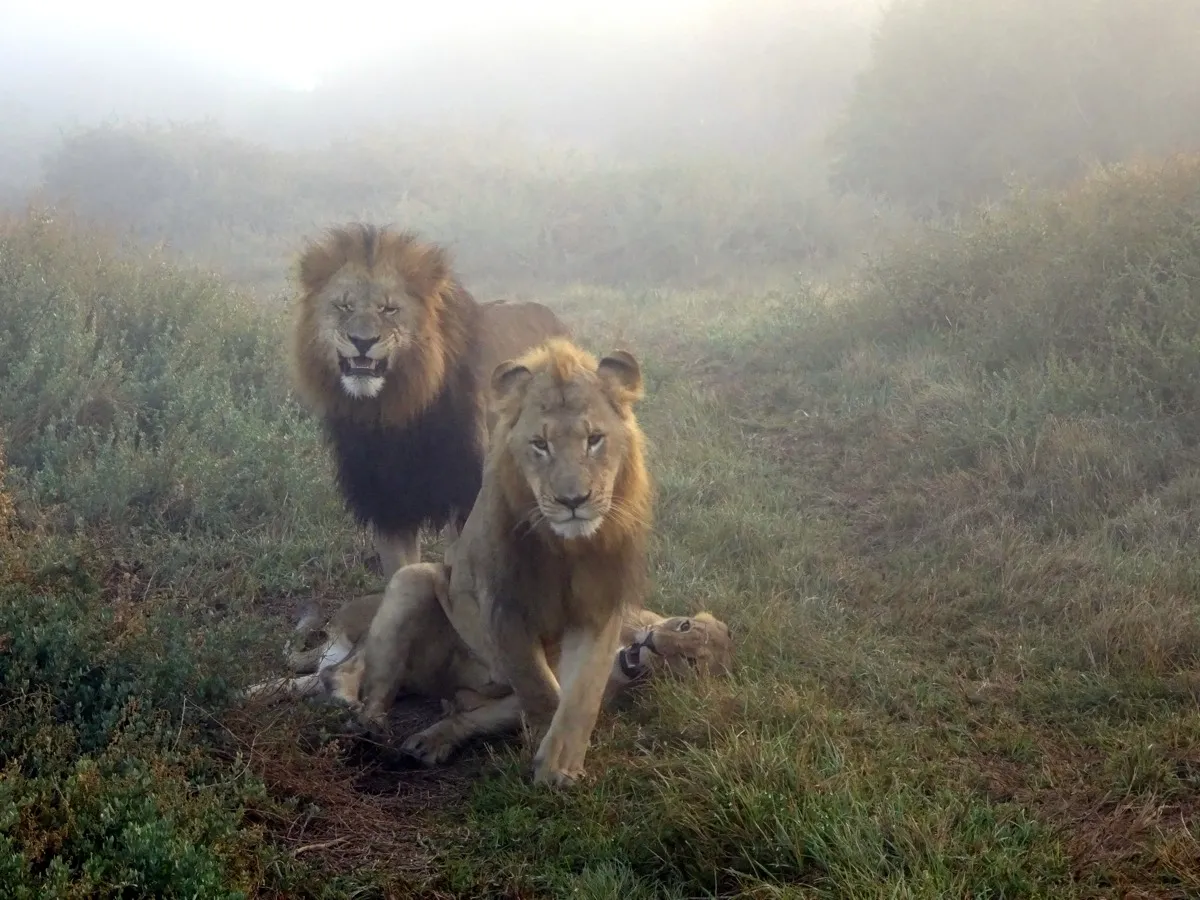
A pride of hungry lions in a South African reserve just saved the day, at least for a herd of rhinos. The poachers, who had illegally entered that reserve with a gun and axe to kill those rhinos, were not so lucky.
The big cats mauled and killed at least two — possibly three — poachers, leaving behind just their bloodied and partly-eaten body parts, according to news reports.
The illegal entrance and subsequent mauling attack happened at the Sibuya Game Reserve sometime between Sunday night (July 1) and Monday morning (July 2), according to a statement by the reserve.
"They were armed with, amongst other things, a high-powered rifle with a silencer, an axe, wire cutters and had food supplies for a number of days — all the hallmarks of a gang intent on killing rhino and removing their horns," Nick Fox, owner of the reserve, said in the statement. [In Photos: The Last 5 Northern White Rhinos]
The horns are prized for their medicinal value and used in traditional Chinese medicines, though there is no science to back up their touted "cure-all" powers. In addition, the horns are now seen as a status symbol, according to Save the Rhino, a U.K.-based conservation charity. And South Africa is home to the most rhinos in the world — both the critically endangered black rhino and the near threatened white rhino — making them a target for poachers, who are often armed with guns and other equipment. Some will even tranquilize a rhino before sawing off its horn, "leaving the rhino to wake up and bleed to death very painfully and slowly," according to Save the Rhino. In 2017, poachers killed 1,028 rhinos in South Africa, compared with 13 in 2007.
In this case, at 4:30 a.m. local time Monday, one of the anti-poaching dogs on the reserve alerted her "handler" that there was a problem nearby. "At the same time, the handler heard a loud commotion coming from the lions, so he suspected that this was what had alerted her and was not concerned," Fox said. Because lion activity at night is not uncommon, the handler didn't think much of it.
Then, on Tuesday afternoon, one of the field guides found what appeared to be human remains near the lions' range. "Clearly, the poachers had walked into a pride of six lions, and some, if not all, had been killed," Fox said.
Get the world’s most fascinating discoveries delivered straight to your inbox.
A forensic team from the local police is now investigating the crime. Currently, Fox said, it's not certain how many poachers were killed.
Original article on Live Science.
Jeanna Bryner is managing editor of Scientific American. Previously she was editor in chief of Live Science and, prior to that, an editor at Scholastic's Science World magazine. Bryner has an English degree from Salisbury University, a master's degree in biogeochemistry and environmental sciences from the University of Maryland and a graduate science journalism degree from New York University. She has worked as a biologist in Florida, where she monitored wetlands and did field surveys for endangered species, including the gorgeous Florida Scrub Jay. She also received an ocean sciences journalism fellowship from the Woods Hole Oceanographic Institution. She is a firm believer that science is for everyone and that just about everything can be viewed through the lens of science.