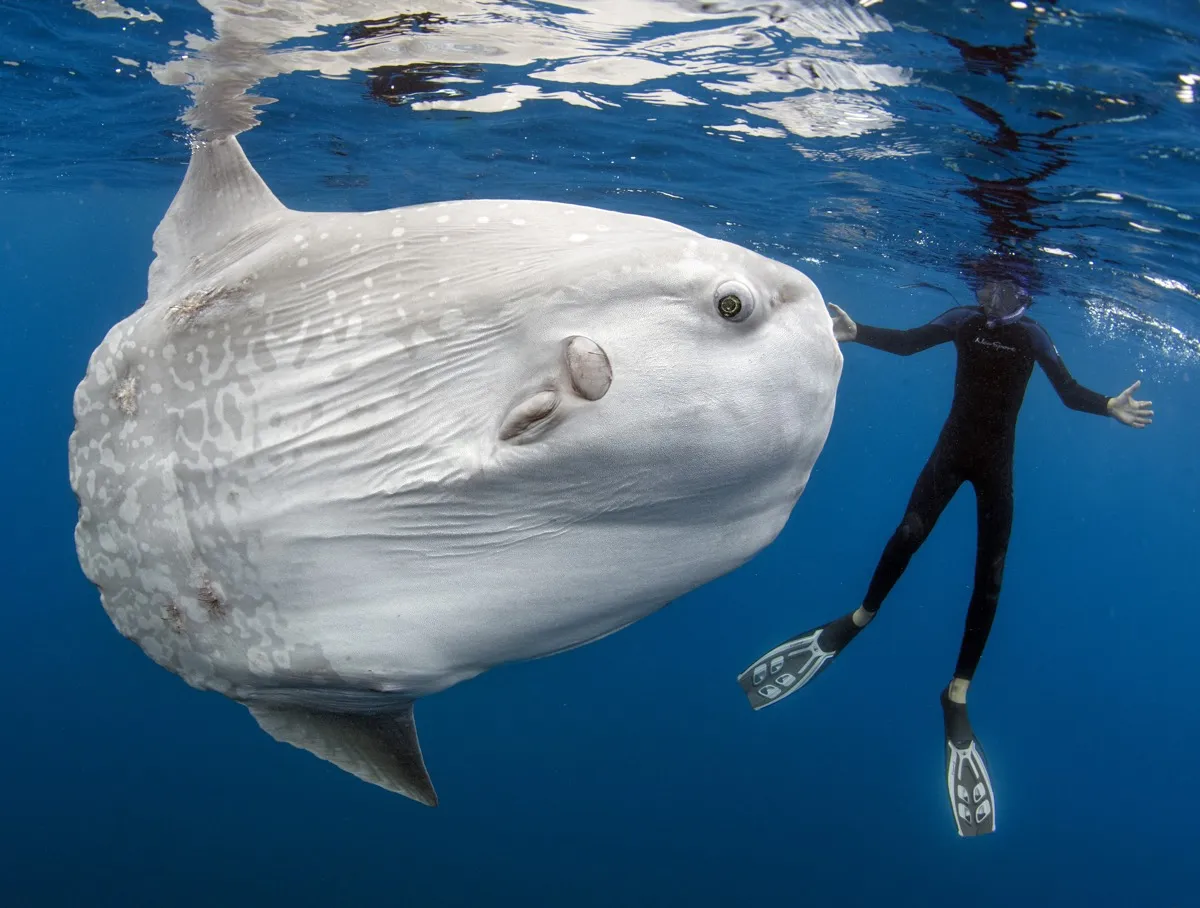
The heaviest bony fish ever caught weighs in at a staggering 5,070 lbs. (2,300 kilograms). Now, scientists know its name.
The fish is a Mola alexandrini ocean sunfish, researchers reported Dec. 5 in the journal Ichthyological Research. Originally, the fish, which was caught in 1996, was misidentified as a Mola mola, a better-known species of sunfish. But recent research has upended the whole Mola genus and led to the reidentification of some species. M. alexandrini is recognizable by its prominent head shape, lending it the common name the "bump-headed sunfish."
"For the same reason, we adopt the already proposed Japanese common name Ushi-manbo," said study leader Etsuro Sawai, a sunfish expert at Hiroshima University. "'Ushi' means 'cow,' and refers to the head profile of the fish." [In Photos: The World's Largest Bony Fish]
Big fish
Sunfish are the largest bony fish in the sea. Unlike sharks and rays, they have skeletons made of bone rather than cartilage. They're also very strange-looking. Their bodies are huge and round, shaped like wagon wheels or pancakes. They can grow up to about 10 feet (3 meters) long.
The Mola genus wasn't well understood until in recent years, because studying such enormous specimens isn't easy. They're difficult to collect and even harder to transport for thorough anatomical examinations. Genetic studies cracked open the case, revealing that fish once classified as Mola mola were in fact very different from one another, and that some gene sequences didn't fit nicely into pre-existing species categories. In July 2017, researchers named a new species of sunfish with those sequences, Mola tecta, after finding a handful of specimens washed ashore on a New Zealand beach.
M. tecta has a round snout and a distinctive stripe that divides its body from the rudder-type fin on the fish, which is known as the clavus.
Redefining the sunfish
In the new study, researchers studied 30 specimens of Mola that did not belong to the M. tecta species. They also hunted through historical photographs, looking for anatomical features that would help to distinguish existing species from one another. Ultimately, they used this information to redescribe M. alexandrini and to differentiate it from M. tecta and M. mola.
The realization that M. alexandrini wins the heavyweight prize for bony fish grew out of this newly clarified classification. Guinness World Records lists M. mola as the world's heaviest bony fish, but Sawai and his team found that the largest catch on record was actually a M. alexandrini caught in 1996 off Kamogawa, Japan. That fish was 8.9 feet (2.72 m) long, raising the question of whether some individuals of this species are even heavier. In 2004, fishers recorded the catch of a 10.9-foot-long (3.32 m) M. alexandrini near Aji Island, Japan, but they didn't weigh that behemoth.
Original article on Live Science.

