















Photos: Analyzing an Amazing, Amphibious Dinosaur
Swimming dinosaur

About 75 million years ago, an odd dinosaur walked from land into the water, where it used its flipper-like arms to swim in the ocean. This amazing feat was rare, as most dinosaurs of its kind could not swim that well, with the exception of Spinosaurus. A fossilized specimen of this enigmatic species was uncovered and sold on the black market for years before researchers could study it. However, not everyone is convinced it's a genuine specimen, and say that it might be a fake. But the researches of a new study say it's real, and even put it in the European Synchrotron Radiation Facility to guarantee its validity.
[Read the full story about the swan-necked dinosaur]
Back to life
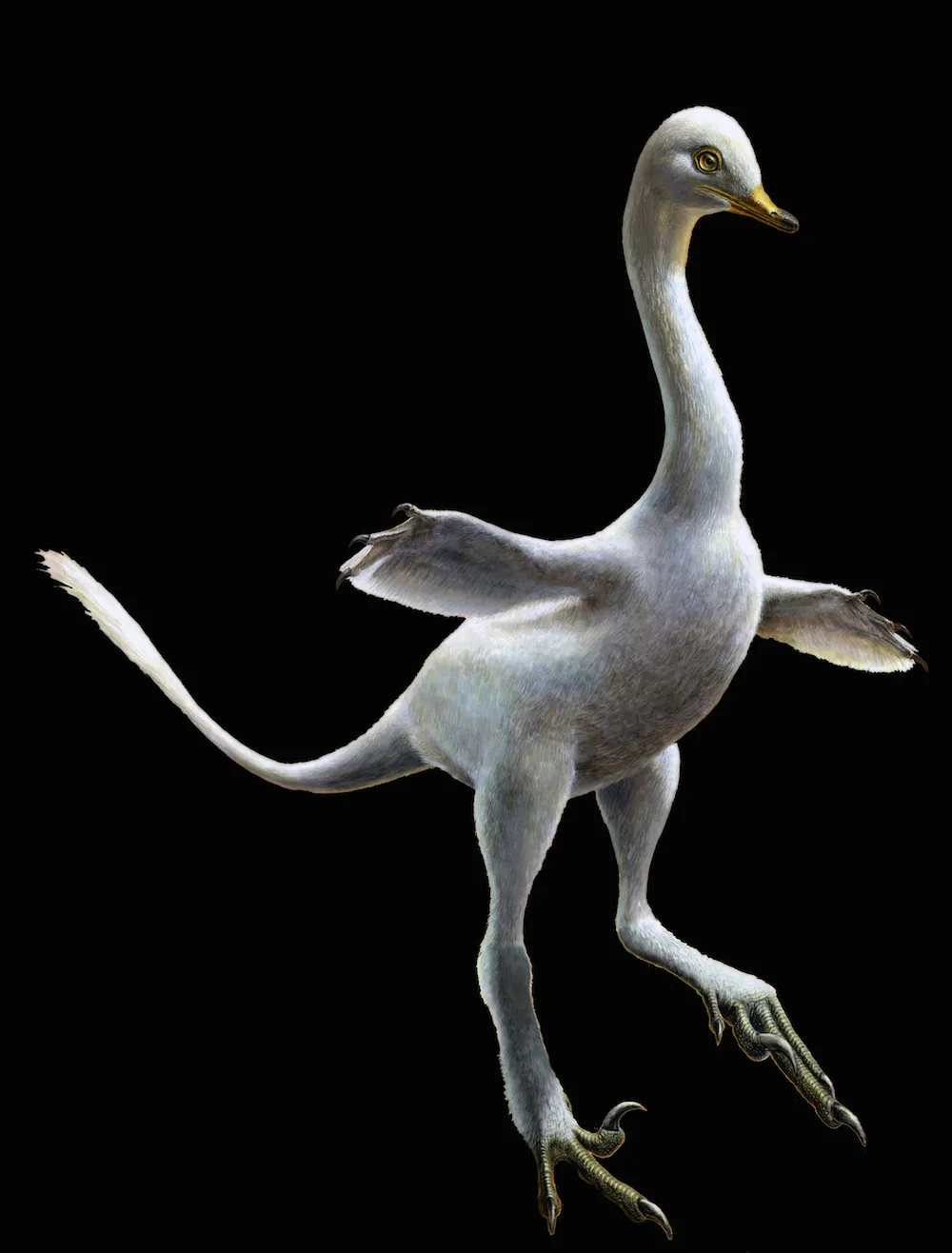
A reconstruction of the Halszkaraptor escuilliei, a small dinosaur related to the Velociraptor, exhibits how its body shape and inferred lifestyle make it more closely related to modern waterbirds like swans than to its predator cousins.
3D masterpiece

A 3D rendering of the H. escuilliei calculated from data gathered from the European Synchrotron Radiation Facility's (ESRF) BM05 beamline.
Work in progress

From left to right, paleontologists Pascal Godefroit, Andrea Cau and Paul Tafforeau set up the H. escuilliei fossil.
Getting ready

Part of the ESRF team that worked to research the H. escuilliei fossil helps to set it up for testing at the ESRF BM05 beamline.
Exquisite details

Paleontologists with the ESRF examine the H. escuilliei fossil before testing at the BM05 beamline.
Stellar team

The BM05 beamline team at the ESRF, made up of Pascal Godefroit, Vincent Beyrand, Dennis Voeten, Paul Tafforeau, Vincent Fernandez and Andrea Cau pose with the H. escuilliei fossil.
[Read the full story on Live Science]
Get the world’s most fascinating discoveries delivered straight to your inbox.
New knowledge
At the ESRF tomography beamline, the H. escuilliei fossil represents the first of a new group of semiaquatic predators.
Improved understanding

The H. escuilliei fossil sheds new light on the lifestyle of raptorial dinosaurs.
Mongolian find

The Halszkaraptor escuilliei fossil, which the team nicknamed Halska, was uncovered in Ukhaa Tolgod, in Mongolia.
Deep discussion

ESRF team members Vincent Fernandez and Dennis Voeten discuss the strength of the fossil as they view a 3D representation of the fossils.