













Here's Another Reason Bonobo 'Hippie Chimps' Are Awesome

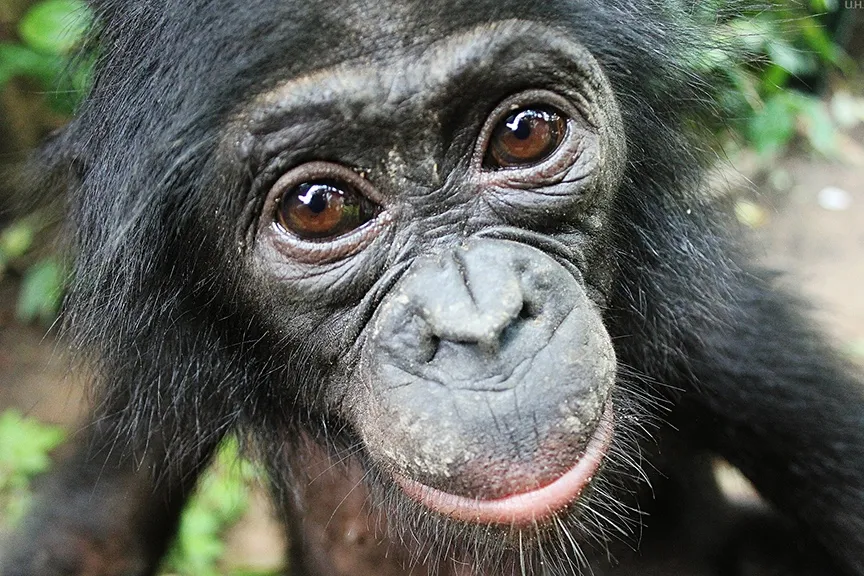
Bonobos, one of our closest primate relatives, could teach some humans a thing or two about helping others before being asked.
These predominantly peaceful primates — sometimes called "hippie chimps," as they are known to be less aggressive and more altruistic than chimpanzees — tend to look out for one another and even share their food.
But these courtesies aren't extended only between bonobos that are already acquainted with each other. Researchers recently found that bonobos would help unfamiliar bonobos reach a food reward, even when they didn't receive a reward themselves. And the helpful primates would lend a hand to assist the stranger whether or not the unknown bonobo asked them for help. [8 Humanlike Behaviors of Primates]
"Trust," the scientists wrote in a new study, "is fundamental to social life." Modern human societies are built on trust that we often extend to people who are unfamiliar to us, a behavior known as xenophilia. Evidence of this behavior in non-human primates suggests that xenophilia may have evolutionary origins that predate the modern human lineage, likely because such behavior improves the chances of a group's survival, the scientists reported.
Prior studies have shown that xenophilia is especially prevalent in bonobos. They move more easily between social groups than chimpanzees do, and when two groups interact, tensions rarely escalate into violence, the study authors wrote. In experiments, bonobos have unlocked one-way doors to share their food with unfamiliar bonobos, even when unlocking the entry would admit a group of strangers — something that chimpanzees would go out of their way to avoid, according to the study.
Hello, stranger
In the new study, researchers worked with wild bonobos at a sanctuary in the Democratic Republic of Congo, to further explore the primates' practice of connecting with bonobos that they didn't know.

The scientists suspended pieces of apple over an enclosure, securing the rope so that it was impossible for a bonobo in the room to reach the fruit. But the apple could be lowered to them if a second bonobo in an adjacent room climbed the fence and pulled a wooden pin to release the rope.
Get the world’s most fascinating discoveries delivered straight to your inbox.
Screens prevented the second bonobo from grabbing the apple for themselves. Yet, even when there was no reward for them — and when they had to put aside a toy and go out of their way to climb the fence — they released the fruit to their waiting neighbor.
In some of the tests, the waiting bonobos were visible to their benefactors and could use begging gestures to indicate that they wanted the fruit. But even in trials where the bonobos had limited visual contact with each other, the helpful bonobos released the fruit without receiving any beseeching signals at all, the study authors reported.
Sympathetic yawning
Another experiment tasked the bonobos' responses to yawning, an activity that is known to spread between individuals — humans as well as bonobos — triggered by a form of empathy.
But do you have to know someone, in order to empathize with them enough to "catch" their yawn? Not if you're a bonobo, according to the study.
The scientists discovered that the bonobos were just as likely to join in when confronted with an unfamiliar yawner — they yawned along with a stranger as often as they did when the yawner was part of their social group.
When female bonobos reach adulthood, they abandon the social group of their youth for another, unrelated group. Being able to quickly bond with strangers would therefore be a critical strategy for these highly social primates, Jingzhi Tan, a postdoctoral associate with the evolutionary anthropology department at Duke University in North Carolina, said in a statement.
"All relationships start between two strangers," Tan explained. "You meet a stranger, but you may meet them again, and this individual could become your future friend or ally. You want to be nice to someone who's going to be important for you."
The findings were published online Nov. 7 in the journal Nature: Scientific Reports.
Original article on Live Science.

Mindy Weisberger is a science journalist and author of "Rise of the Zombie Bugs: The Surprising Science of Parasitic Mind-Control" (Hopkins Press). She formerly edited for Scholastic and was a channel editor and senior writer for Live Science. She has reported on general science, covering climate change, paleontology, biology and space. Mindy studied film at Columbia University; prior to LS, she produced, wrote and directed media for the American Museum of Natural History in NYC. Her videos about dinosaurs, astrophysics, biodiversity and evolution appear in museums and science centers worldwide, earning awards such as the CINE Golden Eagle and the Communicator Award of Excellence. Her writing has also appeared in Scientific American, The Washington Post, How It Works Magazine and CNN.