













Franklin Becomes First Atlantic Hurricane of the Season

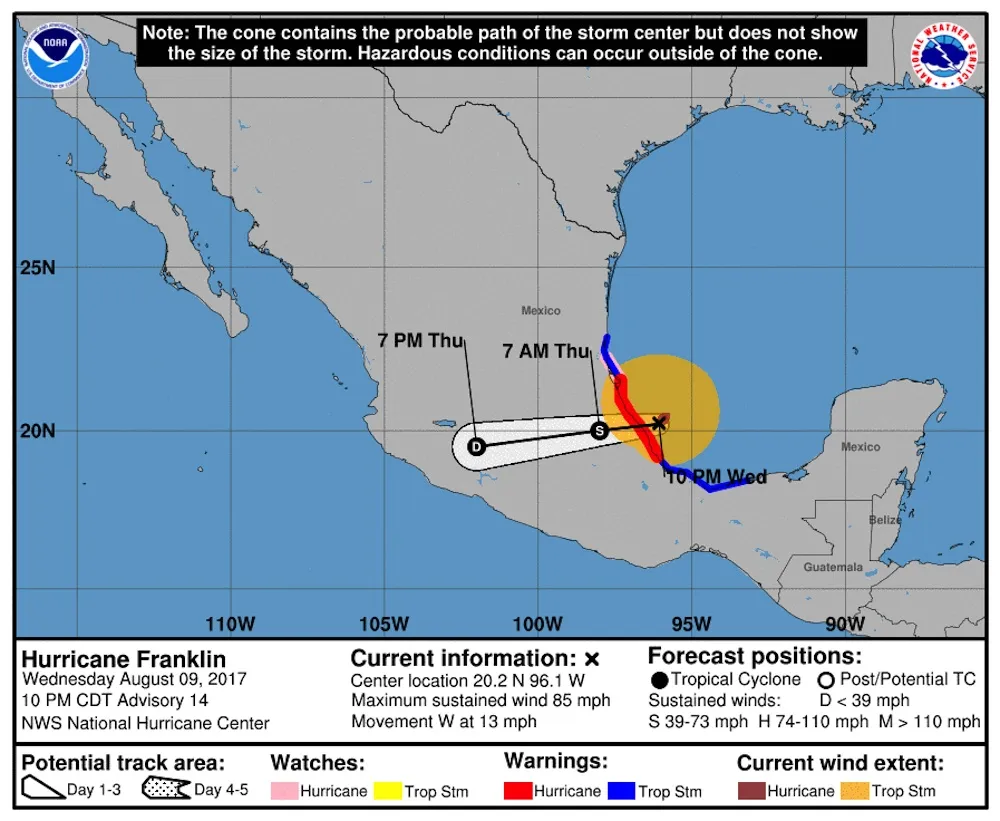
Franklin, a storm that has been churning off the southwest coast of Mexico, has become the Atlantic's first hurricane of the season and is expected to make landfall in the next several hours, battering Mexico's Gulf Coast with torrential rains, according to the National Hurricane Center.
Hurricane Franklin is located about 70 miles (113 kilometers) north of Veracruz, Mexico, and is moving west at approximately 13 mph (21 km/h), according to an advisory issued at 11 p.m. EDT (0300 GMT) by the National Hurricane Center (NHC). [50 Amazing Hurricane Facts]
"Data from an Air Force reconnaissance plane indicate that the maximum sustained winds are near 85 mph (140 km/h) with higher gusts," NHC officials said in the advisory.
The hurricane is expected to bring heavy rainfall to the region, with as much as 15 inches (38 centimeters) of precipitation soaking parts of eastern Mexico. "These rains will be capable of producing life-threatening flash floods and mudslides," the NHC said.
Earlier today, the National Oceanic and Atmospheric Administration's (NOAA) Climate Prediction Center released its updated hurricane season outlook. The report now forecasts that this year's hurricane season will likely be extra active, in part because of warmer-than-usual water temperatures in the Atlantic Ocean.
Though this is the first hurricane of the season, there have been six named tropical storms: Arlene, Bret, Cindy, Don, Emily, Franklin and Gert. A storm becomes a named tropical storm when winds reach 39 to 73 mph (62 to 117 km/h); they are considered hurricanes beyond that wind speed. Hurricane season typically lasts from June 1 to Nov. 30.
More information about Hurricane Franklin and the developing hurricane season can be found on the National Hurricane Center's website.
Get the world’s most fascinating discoveries delivered straight to your inbox.
Original article on Live Science.

Denise Chow was the assistant managing editor at Live Science before moving to NBC News as a science reporter, where she focuses on general science and climate change. Before joining the Live Science team in 2013, she spent two years as a staff writer for Space.com, writing about rocket launches and covering NASA's final three space shuttle missions. A Canadian transplant, Denise has a bachelor's degree from the University of Toronto, and a master's degree in journalism from New York University.