













In Photos: 'Faceless' Fish Rediscovered After More Than a Century

A Fish Without a Face

Australian researchers found a strange-looking, "faceless" fish that appeared to not have any eyes, or even a face, during an expedition off Australia's east coast.
Though scientists initially thought the deep-sea creature might be a new species, further research revealed that the fish is a species of cusk eel (Typhlonus nasus) that has not been seen in Australian waters since the late 1800s. [Read full story about the faceless fish]
Rediscovered Near Australia After More Than a Century

T. nasus, which the scientists now call the "faceless cusk," is rarely seen but widely distributed from the Arabian Sea to Hawaii. The cusk was first collected by the historic HMS Challenger, the first round-the-world oceanographic expedition.
No Discernable Eyes
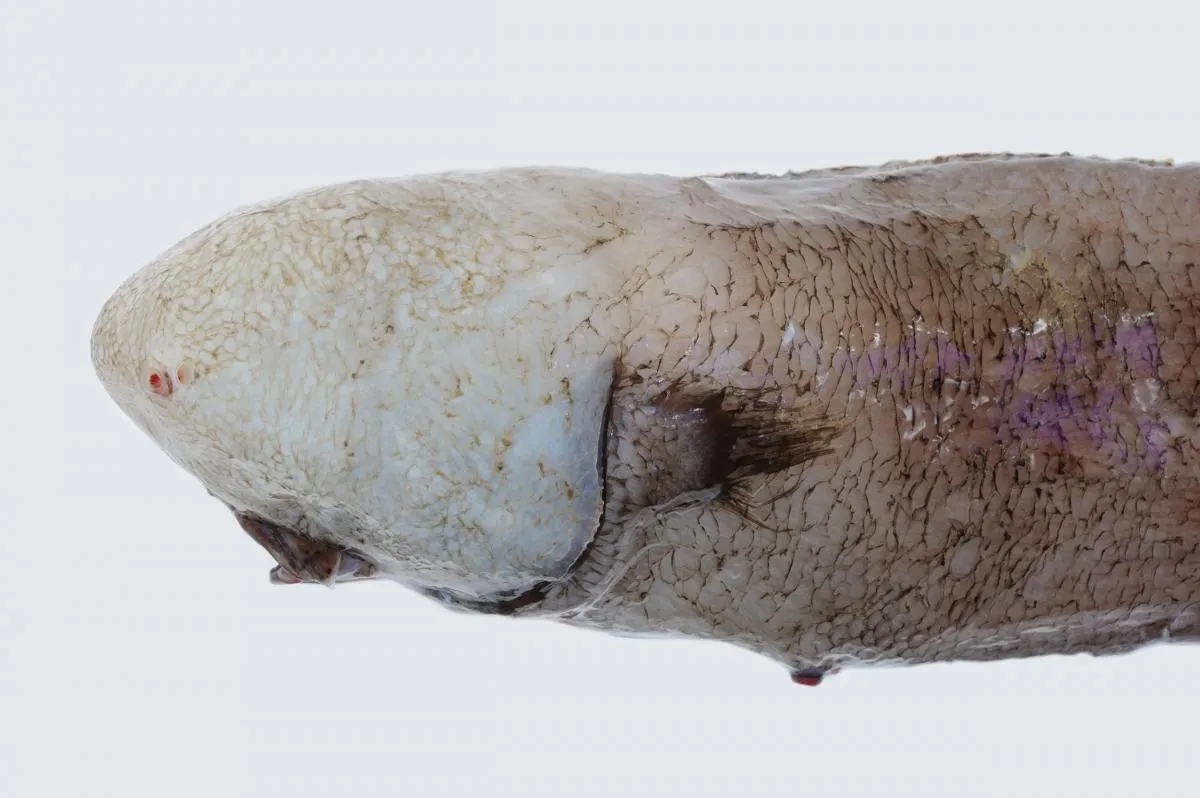
Lacking clearly defined eyes, and with a mouth located underneath its body, the researchers said the fish seemed to not have a face. However, the "faceless cusk" does have eyes — which are visible well beneath the skin in smaller specimens. The recent specimen did not have discernible eyes, and could be the largest T. nasus ever seen, according to the researchers.
Hidden Mouth

Under the fish's bulbous head and snout is a relatively small mouth filled with close-set teeth to dine on a variety of crustaceans, according to researchers.
Deep-Sea Living

This recent "faceless cusk" was discovered about 13,000 feet (4,000 meters) below the surface off Australia's east coast. It lives along a relatively barren seafloor in waters that are about 34 degrees Fahrenheit (1 degree Celsius).
More to Discover

The Australian researchers said they may find another faceless cusk as they move north of the site where the creature was most recently found. This is because a 1951 deep-water search off East Kalimantan, Borneo, resulted in the collection of five faceless cusk specimens.
Get the world’s most fascinating discoveries delivered straight to your inbox.
