













Puffin Couples Stay Close During 'Winter Break'

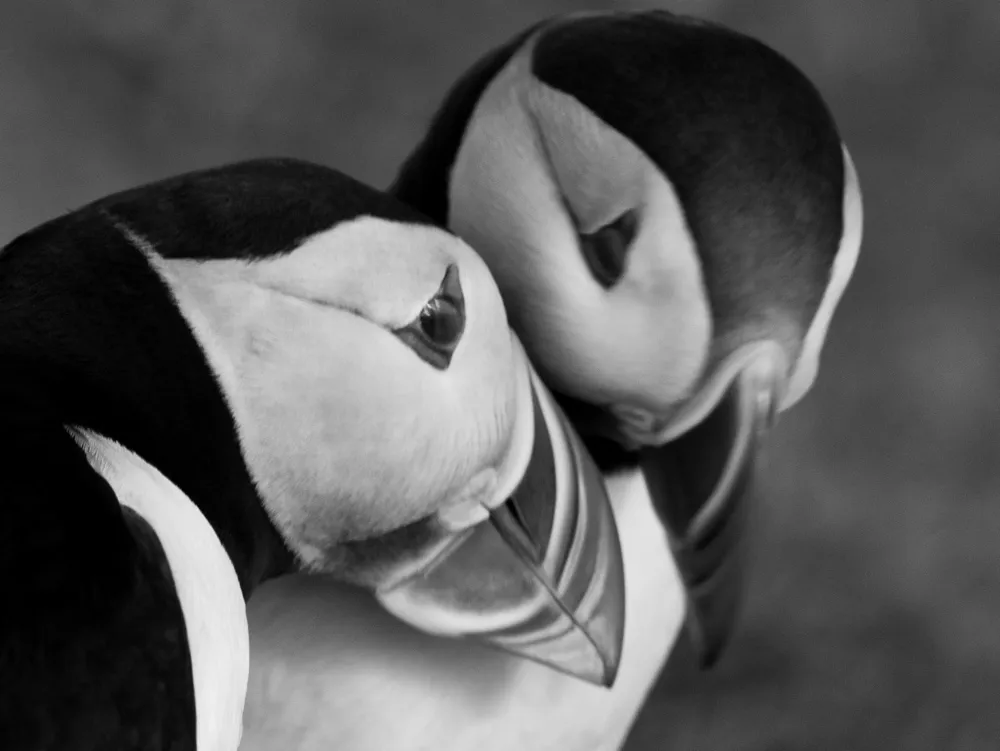
Puffin couples that roam together, raise babies together.
New research has found that pair-bonded puffins that travel similar migration routes are more successful breeders in the next season.
Orange-beaked puffins pair off in long-term, monogamous relationships, raising chicks year after year at the same breeding grounds. But in winter, they head for the open ocean, where they can spend eight months at a time.
University of Oxford zoologist Annette Fayet and her colleagues wanted to understand what happens to puffin relationships during these mysterious winter breaks. The researchers tracked 12 pairs of Atlantic puffins from Skomer Island, Pembrokeshire, in Wales, with geolocation devices.
Seasonal journeys
The researchers followed the puffin pairs' journeys for six years straight. After the breeding season ended, the puffins headed off for their winter respites separately, but followed similar paths at first, the researchers found. Their journeys diverged more and more as the winter wore on, but the puffins still managed to synchronize their return to the emerald nesting grounds on Skomer Island. [11 Strange Animal Courtship Rituals]
The details of these winter migrations made a difference, though, the researchers found. The more similar the migration between the male and female of a pair, the earlier they bred the next spring, and the more likely they were to rear their offspring successfully.
Proximity might help the puffins coordinate their return to the breeding colony, the researchers reported today (April 7) in the journal Marine Ecology Progress Series.
Get the world’s most fascinating discoveries delivered straight to your inbox.
Successful parenthood
Close migrations weren't the most important factor for puffins' parenthood success, though. Female puffins that foraged more over the winter were better poised to lay eggs and rear chicks to adulthood in the spring, the researchers found.

"A likely explanation for this finding is that female puffins which spend more time fueling up over winter return to the colony in better condition and are able to lay higher quality eggs, rearing stronger chicks," Fayet said in a statement.
Thus, focusing on self-care in the winter seems to be more important than sticking with your partner, at least if you're a puffin. But keeping to the same itinerary does help, if only because the paired-off puffins are both back and ready to breed at the same time.
Fayet and her colleagues have many more questions about what puffins do all winter, particularly how much time they spend flying and foraging while at sea and away from the curious eyes of scientists.
"Until recently, tracking devices were too big to use on small birds like puffins," Fayet said. "The recent miniaturization of tracking technology mean[s] we can now study the at-sea movement of puffins and other small migratory seabirds over months and even years."
Original article on Live Science.

Stephanie Pappas is a contributing writer for Live Science, covering topics ranging from geoscience to archaeology to the human brain and behavior. She was previously a senior writer for Live Science but is now a freelancer based in Denver, Colorado, and regularly contributes to Scientific American and The Monitor, the monthly magazine of the American Psychological Association. Stephanie received a bachelor's degree in psychology from the University of South Carolina and a graduate certificate in science communication from the University of California, Santa Cruz.