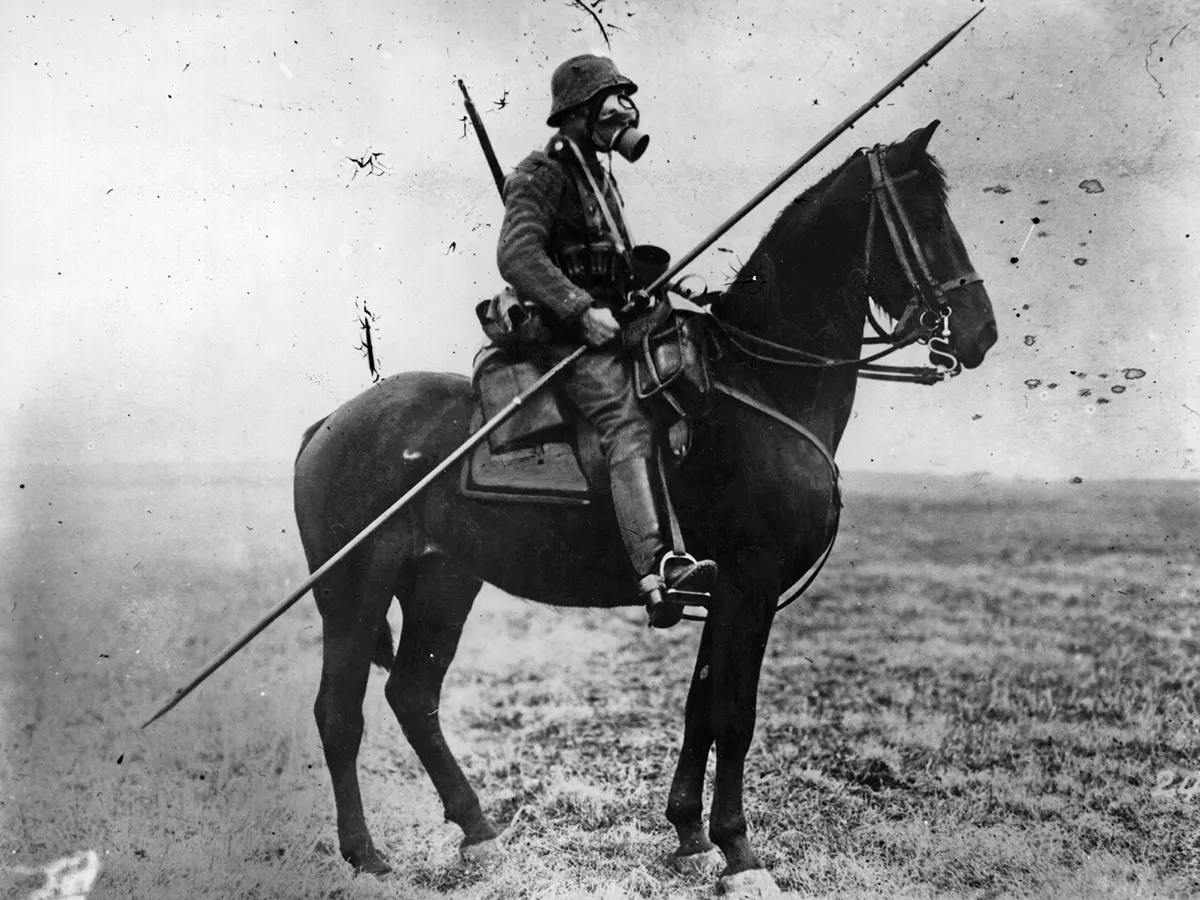
One hundred years ago today (April 6), the United States declared war on Germany and entered into World War I (WWI), the global conflict that initiated the first widespread use of chemical weapons in warfare.
The scope of WWI's chemical weaponry was unlike anything seen on the battlefield before. Over the course of the war — which lasted from July 28, 1914, to Nov. 11, 1918 — about 3,000 chemicals were investigated for military use, and 50 toxic agents were deployed on battlefields across Europe, killing an estimated 90,000 to 100,000 people and leaving 1.3 million people injured, reported Chemical & Engineering News (CEN), the magazine of the American Chemical Society.
Though chemical weapons were responsible for only about 1 percent of the Great War's dead, they provided the 20th century with a dangerous new weapon of mass destruction, according to experts. And the terror they inspired ensured that this new chapter in modern warfare would be an ugly one. [Killer Chemistry: The Chemical Weapons of World War I (Photos)]
The earliest physical evidence of chemical warfare is nearly 2,000 years old, preserved in the remains of 19 Roman soldiers who died in the ancient city of Dura-Europos in what is now Syria, researchers reported in a study published in January 2011 in the American Journal of Archaeology. The unlucky Romans met their deaths underground in a tunnel, where they likely suffocated from the toxic smoke and gas that their Persian opponents blew into the enclosed space, the study revealed.
Other historical accounts describe Athenian soldiers poisoning the water supply of a besieged city with toxic plants in 600 B.C., and Peloponnesian warriors subduing their enemies with sulfur clouds in 479 B.C., according to the Chemical Heritage Foundation (CHF).
Thousands of casualties
But chemical attacks during wartime were usually very localized, with limited range. That changed on April 22, 1915, when the German army released close to 170 metric tons of chlorine gas from nearly 6,000 cylinders buried in defensive trenches in Ypres, Belgium. Chlorine gas is yellow-green and smells like bleach; when it makes contact with moist body tissues, it produces an acid that can cause severe tissue damage, according to the Centers for Disease Control and Prevention (CDC).
Minutes after the gas was released, 1,000 French and Algerian soldiers were dead, and nearly 4,000 more were injured, Gerard J. Fitzgerald, a researcher in the Department of History and Art History at George Mason University in Virginia, wrote in a study published in April 2008 in the American Journal of Public Health.
Sign up for the Live Science daily newsletter now
Get the world’s most fascinating discoveries delivered straight to your inbox.
More chemical attacks followed, launched by the Germans and Allied forces. They used phosgene gas, which causes breathing difficulties and heart failure, and mustard gas, which damages the respiratory tract and causes severe eye irritation and skin blistering, according to the CDC.
A picture staged by the U.S. Army Corps of Engineers, to illustrate the effects of phosgene gas. The photo was taken in France, near the frontline trenches, in 1918.
(Image credit: Everett Historical/Shutterstock)
Witness accounts of chemical attacks and their aftermath were horrific. A British observer at Ypres described French soldiers stumbling off the battlefield "blinded, coughing, chests heaving, faces an ugly purple color, lips speechless with agony," Fitzgerald reported in his study.
In another distressing report, preserved in the United Kingdom's National Archives, a British soldier in the Royal Army Medical Corps described survivors of a poison gas attack:
"Complexion here was an ashed blueish grey, the expression most anxious and distressed with the eye-balls staring, and the lids half closed. Respiration was extremely laboured and noisy with frequent efforts to expel copious amounts of tenacious yellowish green frothy fluid which threatened to drown them, and through which they inhaled and exhaled air into and out of their lungs with a gurgling noise," Capt. Edward L. Reid recounted in a written report.
Banning chemical agents
The specter of poison gas inspired an international agreement after WWI ended — the 1925 Geneva Protocol — which banned chemical and biological weapons during war.
According to the treaty, "the use in war of asphyxiating, poisonous or other gases, and of all analogous liquids, materials or devices, has been justly condemned by the general opinion of the civilized world," and their prohibition "shall be universally accepted as a part of International Law, binding alike the conscience and the practice of nations."
An American soldier demonstrates gas masks for a man and a horse during World War I, around 1917 to 1918.
(Image credit: Everett Historical/Shutterstock)
Global leaders continue to condemn the use of chemical weapons. In 1993, the United Nations banned mustard gas and other toxic agents through the Chemical Weapons Convention, prohibiting "the development, production, acquisition, stockpiling, retention, transfer or use of chemical weapons," the Organisation for the Prohibition of Chemical Weapons (OPCW), reported.
And in 2013, the OPCW received the Nobel Peace Prize for its work as chemical weapons "watchdogs," — for mobilizing nations to cease producing and storing lethal chemical weapons, and targeting cached weapons for safe disposal, with the ultimate goal of eliminating them completely.
But poisonous agents still pose a silent and deadly threat. Just this Tuesday (April 4), a chemical bombing in Syria claimed the lives of at least 70 people, many of them children, following an air attack that dropped bombs in Idlib Province, the New York Times reported. While the composition of the lethal gas is still unknown, it is thought to be a type of nerve agent, which disrupts neuron signals and can interfere with involuntary muscle movements, such as respiration.
Mindy Weisberger is a science journalist and author of "Rise of the Zombie Bugs: The Surprising Science of Parasitic Mind-Control" (Hopkins Press). She formerly edited for Scholastic and was a channel editor and senior writer for Live Science. She has reported on general science, covering climate change, paleontology, biology and space. Mindy studied film at Columbia University; prior to LS, she produced, wrote and directed media for the American Museum of Natural History in NYC. Her videos about dinosaurs, astrophysics, biodiversity and evolution appear in museums and science centers worldwide, earning awards such as the CINE Golden Eagle and the Communicator Award of Excellence. Her writing has also appeared in Scientific American, The Washington Post, How It Works Magazine and CNN.