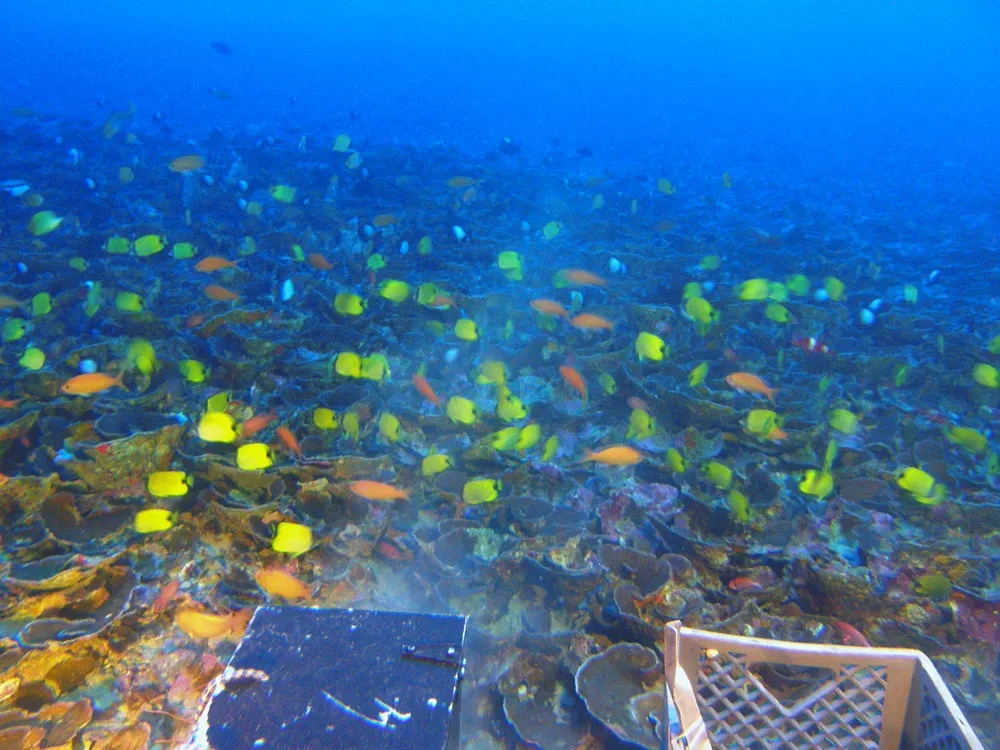
A new study of the deep coral reefs around the Hawaiian archipelago reveals that the deeper you go, the more one-of-a-kind the ecosystem. Nearly every fish in this image taken 300 feet (90 meters) deep near Maui is found only in Hawaii.
(Image credit: Hawai'i Undersea Research Laboratory. License: CC-BY)
A 20-year study of deep coral reefs off of the Hawaiian Islands has found "meadows" of algae nearly 300 feet (90 meters) beneath the surface and the highest rates of species found nowhere else on Earth.
Published today (Oct. 4) in the open-access journal PeerJ, the study focuses on a little-understood ecosystem called the mesophotic coral zone. These reef zones span the area between about 100 feet and 500 feet (30 m and 150 m) below the ocean's surface, according to the National Oceanic and Atmospheric Administration (NOAA). "Meso" means "middle" and "photic" means "light," indicating that these deep reefs are in a sort of perpetual twilight zone where sunlight just barely penetrates.
"These are some of the most extensive and densely populated coral reefs in Hawaii," study co-author Anthony Montgomery, a biologist with the U.S. Fish and Wildlife Service, said in a statement. "It's amazing to find such rich coral communities down so deep," added Montgomery, who previously represented the Hawaii Department of Land and Natural Resources. [Photos: The Freakiest-Looking Fish]
Exploring mesophotic coral ecosystems is a challenge because scuba divers can just barely reach their depths. Recreational divers don't get below 130 feet (40 m), and the reefs are too shallow for most submersible vehicles to operate there.
The research group overcame this challenge by combining strategies. They used remote-sensing technology such as multibeam bathymetry mapping, which maps the seabed with sonar. They towed camera systems beneath boats and sent remotely operated cameras on solo undersea adventures. They also had divers wearing mixed-gas closed-circuit rebreathers swim alongside submersibles.
Researcher Richard Pyle uses a closed-circuit rebreather to dive deep alongside a submersible in order to explore deep coral reefs off of the Hawaiian archipelago.
(Image credit: Robert K. Whitton. License: CC-BY)
"Submersibles can go much deeper and stay much longer, but divers can perform more complex tasks to conduct experiments and collect specimens," Richard Pyle, lead researcher on the project and a zoologist at the Bishop Museum in Honolulu, said in a statement. "Combining both [of these strategies] together on the same dives allowed us to achieve tasks that could not have been performed by either technology alone." [Images: Dazzling World of Coral, Unveiled]
The researchers surveyed the length of the Hawaiian Islands as well as the small atolls to the far northwest — a distance of about 1,600 miles (2,600 kilometers).
Sign up for the Live Science daily newsletter now
Get the world’s most fascinating discoveries delivered straight to your inbox.
Hidden worlds
The researchers documented the coral cover at a depth of around 300 feet off of Maui and Kauai. They discovered vast swaths of Leptoseris, a genus of flat, plate-like coral that looks a bit like colorful and misshapen pancakes. At this depth, there are also algal "meadows," where the seafloor is carpeted with green. Researchers identified more than 70 species of algae during the course of their research.
An "algal meadow" 210 feet (64 meters) below the surface near Pearl and Hermes Atoll in the Hawaiian Islands. This species, Microdictyon setchellianum, is one of around 70 identified in a 20-year exploration of these deep reefs.
(Image credit: Greg McFall)
"We found that the diversity of macroalgal species actually peaked at around 90 meters [300 feet] deep," study co-author Heather Spalding, of the Department of Botany at the University of Hawaii at Manoa, said in the statement. "These extensive algae meadows represent a major component of the deep-reef communities, and play a fundamentally important role in the overall ecology."
The deeper the researchers dove, the more they found that they were in a one-of-a-kind world. At greater depths, more of the fish species they found were species that live only around Hawaii. Species that live in only one place on Earth are called endemic. Around the Hawaiian Islands, 17 percent of the fish that live above 100 feet are endemic. But below 230 feet (70 m), more than half of the species are endemic. Around the small atolls of the northwestern Hawaiian Islands, which are scattered far in a line extending northwest from Kauai, the endemism rate at some deep reefs was 100 percent.
"We were able to document the highest rates of endemism of any marine environment on Earth," study co-author Randall Kosaki, NOAA's deputy superintendent of the Papahānaumokuākea Marine National Monument, said in the statement.
Researchers hope the findings will improve conservation attempts around the islands.
"With coral reefs facing a myriad of threats, the finding of extensive reefs off Maui provides managers with a unique opportunity to ensure that future activities in the region — such as cable laying, dredging dump sites and deep sewer outfalls — do not irreparably damage these reefs," Kimberly Puglise, an oceanographer with NOAA's National Centers for Coastal Ocean Science, said in the statement.
Stephanie Pappas is a contributing writer for Live Science, covering topics ranging from geoscience to archaeology to the human brain and behavior. She was previously a senior writer for Live Science but is now a freelancer based in Denver, Colorado, and regularly contributes to Scientific American and The Monitor, the monthly magazine of the American Psychological Association. Stephanie received a bachelor's degree in psychology from the University of South Carolina and a graduate certificate in science communication from the University of California, Santa Cruz.