













Zombie Ants Controlled by Fungus

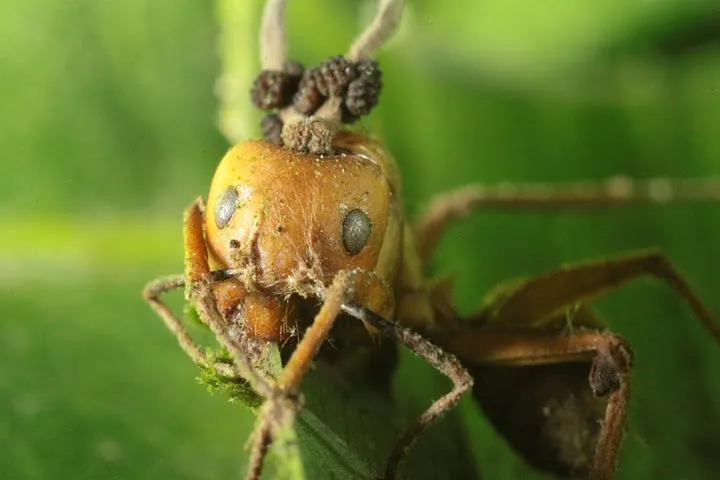
In a bizarre parasitic death sentence, a fungus turns carpenter ants into the walking dead and gets them to die in a spot that's perfect for the fungus to grow and reproduce.
Scientists have no clue how the fungus takes control of the brains of ants so effectively. But a new study in the September issue of the American Naturalist reveals an incredible set of strategies that ensue.
The carpenter ants nest high in the canopy of a forest in Thailand, and they trek to the forest floor to forage. The fungus, Ophiocordyceps unilateralis, prefers to end up on the undersides leaves sprouting from the northwest side of plants that grow on the forest floor, the new study showed. That's where temperature, humidity and sunlight are ideal for the fungus to grow and reproduce and infect more ants.
Once infected by the fungus, an ant is compelled to climb down from the canopy to the low leaves, where it clamps down with its mandibles just before it dies.
"The fungus accurately manipulates the infected ants into dying where the parasite prefers to be, by making the ants travel a long way during the last hours of their lives," said study leader David P. Hughes of Harvard University.
After the ant dies, the fungus continues to grow inside it. By dissecting victims, Hughes and colleagues found that the parasite converts the ant's innards into sugars that help the fungus grow. But it leaves the muscles controlling the mandibles intact to make sure the ant keeps its death grip on the leaf.
The fungus also preserves the ant's outer shell, growing into cracks and crevices to reinforce weak spots, thereby fashioning a protective coating that keeps microbes and other fungi out.
Get the world’s most fascinating discoveries delivered straight to your inbox.
"The fungus has evolved a suite of novel strategies to retain possession of its precious resource," Hughes said.
After a week or two, spores from the fungus fall to the forest floor, where other ants can be infected.
Making nests in the forest canopy might be an evolved ant strategy to avoid infection, Hughes figures. The ants also seem to avoid foraging under infected areas. This too might be an adaptive strategy to avoid infection, but more study is needed to confirm it, he said.
How the fungus controls ant behavior remains unknown. "That is another research area we are actively pursuing right now," Hughes said.
