













Moon Photobombs Earth in New NASA Video

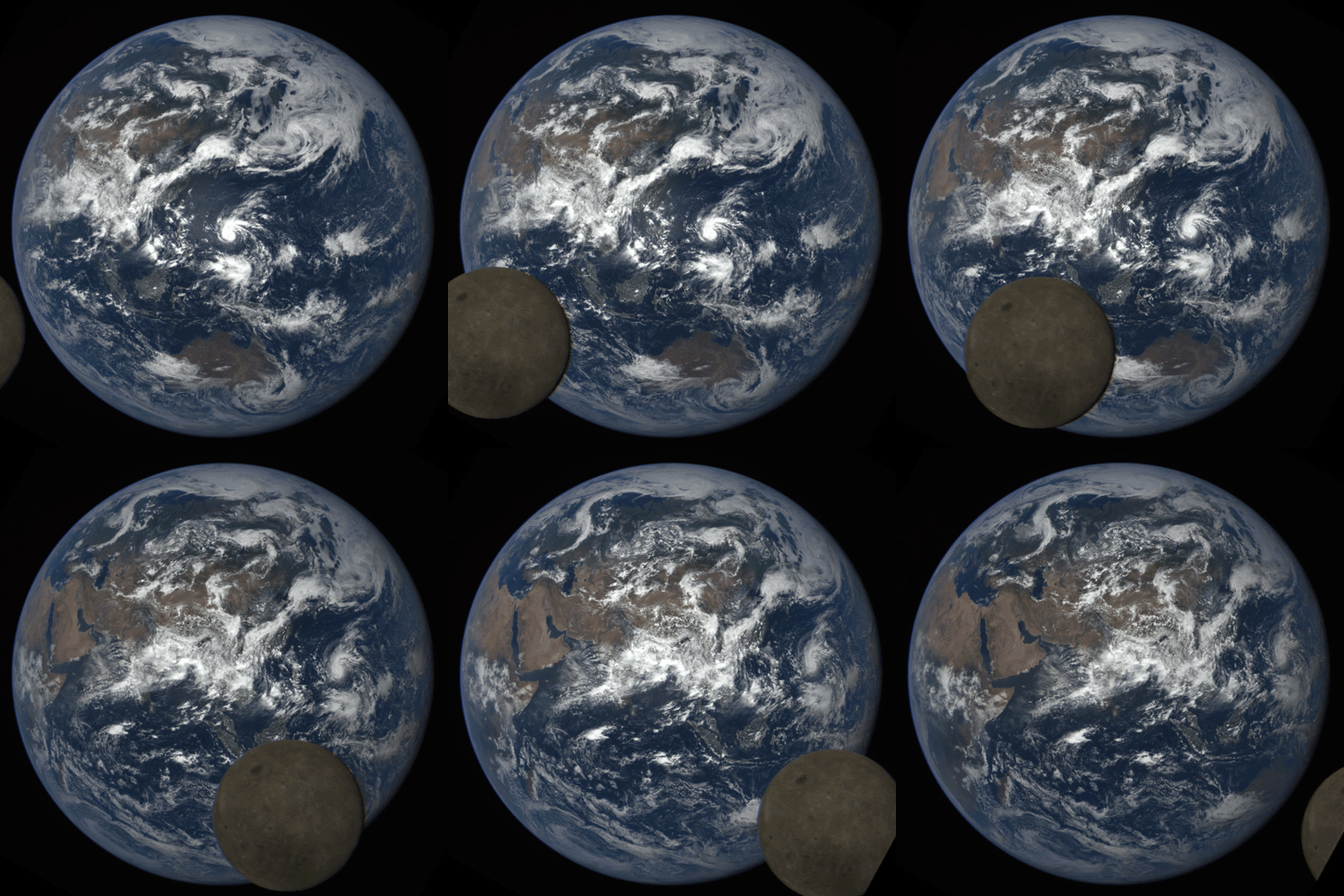
A NASA satellite in just the right position captured a spectacular celestial photobomb — a view of the moon moving in front of the sunlit side of Earth.
It is only the second time in a year that the NASA camera aboard the Deep Space Climate Observatory (DSCOVR) satellite, orbiting about 1 million miles (1,609,344 kilometers) away from Earth, captured the moon crossing Earth's face, resulting in a spectacular time-lapse video.
"For the second time in the life of DSCOVR, the moon moved between the spacecraft and Earth,” Adam Szabo, DSCOVR project scientist at NASA’s Goddard Space Flight Center, said in a statement. "The project recorded this event on July 5 with the same cadence and spatial resolution as the first ‘lunar photobomb’ of last year." [Earth from Above: 101 Stunning Images from Orbit]
Although DSCOVR's primary mission is to monitor solar wind in real time for the National Oceanic and Atmospheric Administration (NOAA), the satellite is also known for its stunning images of Earth, which are captured by NASA’s Earth Polychromatic Imaging Camera (EPIC) — a 4-megapixel CCD camera and telescope on the DSCOVR satellite.
Due to DSCOVR's position between the sun and Earth, EPIC maintains a constant view of the fully illuminated Earth as it rotates on its axis.
"It's surprising how much brighter Earth is than the moon," Szabo said in a statement about last year's moon images. "Our planet is a truly brilliant object in dark space compared to the lunar surface."
The moon is tidally locked to Earth, so the same face is always pointing toward the planet. DSCOVR offers a unique view of the moon's far side, which can be seen when the satellite's orbit intersects the lunar orbit. The two orbits intersect only four times a year, and the moon only appears between the spacecraft and Earth once or twice a year, depending on the relative orbital phases of the moon and DSCOVR, according to NASA.
Get the world’s most fascinating discoveries delivered straight to your inbox.
This latest crossing of paths was captured by combining three images taken about 30 seconds apart. EPIC uses three separate monochrome exposures — red, blue and green — to generate "natural color" images of Earth.
The images were taken between July 4 at 11:50 p.m. EDT and July 5 at 3:18 a.m. EDT. The moon can be seen moving over the Indian and Pacific oceans, with the North Pole at the top of the images.
Original article on Live Science.
