













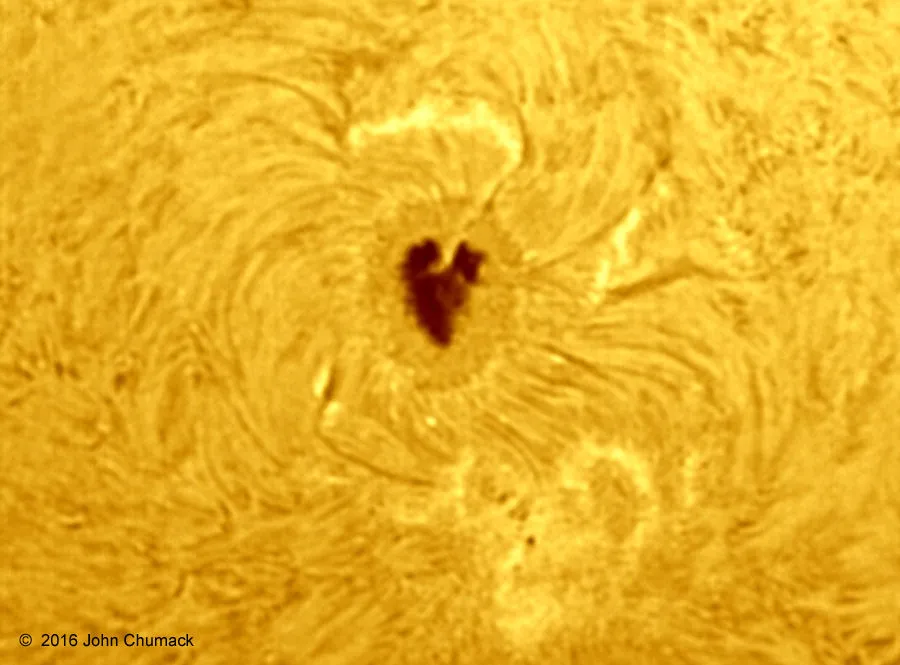
You can’t help falling in love with the recent sunspot AR2529 and that's exactly what happened to astrophotographer John Chumack.
Chumack captured the heart-shaped sunspot from his backyard Observatory in Dayton, Ohio on April 12.
"I caught sunspot AR2529 flaring at lunch time in this close-up view," he wrote in an email to Space.com. "[It] looks like a dachshund dog face with folded over ears or a heart."
The sunspot was large enough to hold two Earths as it crossed the face of the sun in April, making it a great target for amateur astronomers to safely observe.
Warning: NEVER look directly at or photograph the sun unless you have the proper protective equipment. Serious and permanent eye damage can result.
Sunspots are dark patches on the surface of the sun that are a bit cooler than surrounding areas. As the term "active region" suggests, sunspots serve as launchpads for solar flares and coronal mass ejections (CMEs) — huge eruptions that send clouds of solar plasma racing into space at millions of miles per hour.
To see more amazing night sky photos submitted by readers, visit our astrophotography archive.
Get the world’s most fascinating discoveries delivered straight to your inbox.
Editor's note: If you have an amazing night sky photo you'd like to share with Space.com and our news partners for a possible story or image gallery, send images and comments in to [email protected].
Follow us on Twitter @Spacedotcom. We're also on Facebook and Google+. Original story on Space.com.
