















Female Firsts: 7 Women Who Broke Barriers in Science and Tech

Female Firsts

Hillary Clinton made history on June 7 when she became the first woman to claim the presidential nomination of a major political party in the U.S.
To note this historic achievement, Live Science has rounded up some of the famous "firsts" for women in science, technology and medicine.
Read on to learn about seven other history-making women.
Valentina Tereshkova

Cosmonaut Valentina Tereshkova became the first woman in space when she piloted the Soviet mission Vostok 6 on June 16, 1963.
Tereshkova's mission lasted three days, during which she performed various tests on herself to collect data on how the female body reacted to spaceflight.
Sally Ride, who flew on the Challenger space shuttle in 1983, was the first American woman in space.
Marie Curie

Chemist and physicist Marie Curie claims several firsts: In 1903, Curie became the first woman to win a Nobel Prize, which was awarded to her for her physics research on radiation. Curie shared the prize with her husband, Pierre Curie, and French physicist Henri Becquerel.
Get the world’s most fascinating discoveries delivered straight to your inbox.
Then, in 1911, Curie won her second Nobel Prize — this time, for her work in chemistry. Curie had discovered two elements: radium and polonium.
Curie is the only woman to have ever won two Nobel Prizes, as well as the only person to have ever won the prize in two different fields. [Marie Curie: Facts & Biography]
Dr. Elizabeth Blackwell

Dr. Elizabeth Blackwell was the first woman to earn an M.D. from a medical school in the United States.
Before Blackwell applied to medical school, several physicians told her that such an education was not available to women. She applied to over a dozen schools, and was accepted to Geneva Medical College in New York after the faculty voted on it. Blackwell graduated in 1849 and went on to practice obstetrics and gynecology.
Blackwell's younger sister, Emily, followed in her footsteps, earning her M.D. from Western Reserve University's medical school in Ohio in 1854.
Jacqueline Cochran

In 1953, Jacqueline Cochran became the first woman to break the sound barrier when she piloted an F-86 Sabre jet to speeds that exceeded Mach 1 (the speed of sound, which is 761.2 mph, or 1,225 km/h). Eleven years later, Cochran doubled her speed, flying a jet at Mach 2 in 1964.
Cochran learned to fly planes while she was working as a cosmetics saleswoman.
In addition to flying faster than the speed of sound, Cochran set a number of other records in her lifetime, including altitude and distance records. [Image Gallery: Breaking the Sound Barrier]
Ellen Swallow Richards

Ellen Swallow Richards was the first woman admitted to the Massachusetts Institute of Technology (MIT). In 1870, when Richards was admitted, the school noted that "her admission did not establish a precedent for the general admission of females," according to MIT's library archives.
Richards studied chemistry and graduated with a Bachelor of Science degree in 1873.
Two years after graduating, Richards helped to establish a laboratory at the school dedicated to educating women in chemistry. The Women's Laboratory was opened in 1876, and Richards held the position of instructor in chemistry and mineralogy.
Dana Ulery

Dana Ulery became the first female engineer at NASA when she started working at the agency's Jet Propulsion Laboratory (JPL) in Pasadena, California, in 1961.
Ulery studied computer science, and worked to develop algorithms for NASA's Deep Space Network while at JPL. The Deep Space Network uses antennas around the world to communicate with spacecraft.
Later, she went on to work at the U.S. Army Research Laboratory, where she was one of the first female managers.
Amelia Earhart
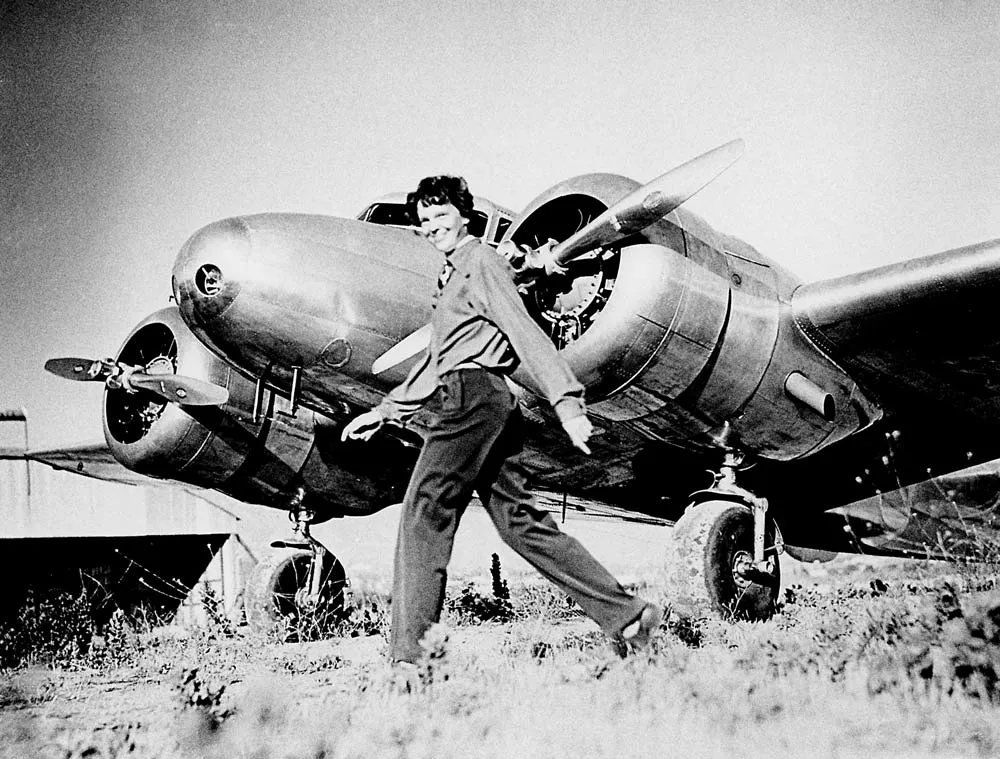
Amelia Earhart was the first woman, and second person overall, to fly solo across the Atlantic Ocean. She took off on May 20, 1932, from Newfoundland and landed 15 hours later, in Ireland. (She originally planned to fly to Paris, but due to bad weather, she decided to cut the flight short.)
Earhart went on to set seven women's speed and distance aviation records.
Earhart disappeared in 1937 during an attempt to fly around the world. The unsolved mystery of her disappearance continues to intrigue people today.
Originally published on Live Science.
