













Toad-Eating Spider Named for Famed Physicist
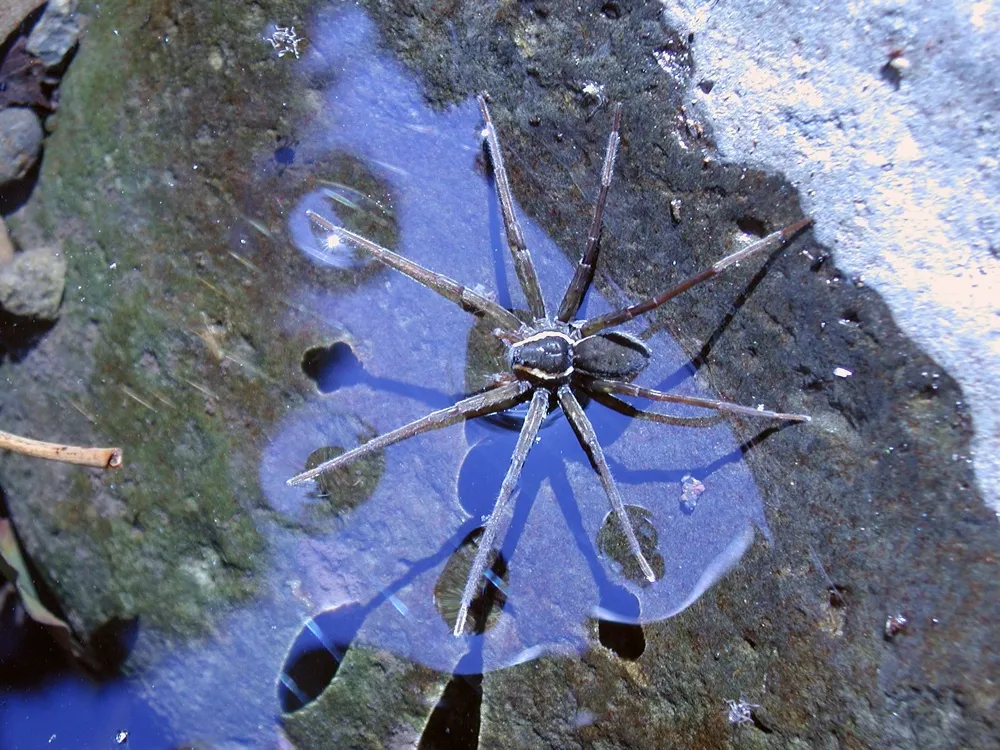
A spindly toad-eating spider that creates vibrational waves on the water's surface in order to navigate and capture prey has been discovered in Brisbane, Australia, scientists announced at the World Science Festival last week.
They named the fish-eating spider Dolomedes briangreenei after theoretical physicist Brian Greene, who is also co-founder of the World Science Festival where the spider was described.
"It's wonderful that this beautiful native spider, which relies on waves for its very survival, has found a namesake in a man who is one of the world's leading experts in exploring and explaining the effects of waves in our universe," Queensland Premier Annastacia Palaszczuk said in an emailed statement, referring to gravitational waves, or ripples in the very fabric of space-time. [See Photos of Fish-Eating Spiders from Around the World]
Greene said he is "honored to be so closely associated with a spider that has its own deep affinity for waves." (Physicists announced last month they had detected for the first time such gravitational waves.)
Dolomedes briangreenei males sport bold white stripes along the sides of the head, while females have a narrower, fawn-colored stripe on either side of the head, according to the statement. The dark, leggy spider snacks on fish, frogs and tadpoles; the spider also makes a meal of the invasive cane toad, Rhinella marina, whose females can weigh up to 3.3 pounds (1.5 kilograms), according to the U.S. Geological Survey.

When asked to comment on the newfound Dolomedes spider, Martin Nyffeler, a senior lecturer of zoology at the University of Basel in Switzerland, who was not involved in this new research, told Live Science: "The spiders in the genus Dolomedes are spiders of fairly large size, which often reach a live weight of up to 2 grams. These spiders are known to kill fish, frogs, toads, lizards and even small snakes."
Dolomedes spiders can take down such large prey — up to 4.5 times their own weight, according to Nyffeler — by first using their long legs to lunge at a victim, biting the prey with its chelicerae, or the spider's mouthparts, Nyffeler said. "Many other spiders’ chelicerae are not that strong," he added in an email. The Dolomedes spider then injects powerful neurotoxins into its prey.
Get the world’s most fascinating discoveries delivered straight to your inbox.
Spiders in the Dolomedes genus are members of the Pisauridae family, which is related to another spider family with a big appetite: Lycosidae. Two Australian wolf spiders in the Lycosidae family (Lycosa lapidosa and Lycosa obscuroides) are known to take down cane toads, he said.
"Both families belong to the superfamily Lycosoidea, which does contain numerous powerful species capable of devouring frogs and toads. I assume that the cane toads killed by such spiders might be rather smaller-sized juveniles, but I don't know this," Nyffeler wrote.
Not only do they go big for dinner, the water spiders are also strong swimmers and can even propel themselves across the surface of the water with their two middle leg pairs.
"When disturbed or hauling in captured fish, they will plunge through the surface of the water and swim quickly to hide on the bottom," Robert Raven, Queensland Museum arachnologist, said in the statement.
The World Science Festival Brisbane, where big thinkers and artists from around the world celebrate "the beauty and complexity of science," according to the WSF, ran from March 9–13; the festival in New York City will kick off on June 1.
Follow us @livescience, Facebook & Google+. Original article on Live Science.
Jeanna Bryner is managing editor of Scientific American. Previously she was editor in chief of Live Science and, prior to that, an editor at Scholastic's Science World magazine. Bryner has an English degree from Salisbury University, a master's degree in biogeochemistry and environmental sciences from the University of Maryland and a graduate science journalism degree from New York University. She has worked as a biologist in Florida, where she monitored wetlands and did field surveys for endangered species, including the gorgeous Florida Scrub Jay. She also received an ocean sciences journalism fellowship from the Woods Hole Oceanographic Institution. She is a firm believer that science is for everyone and that just about everything can be viewed through the lens of science.