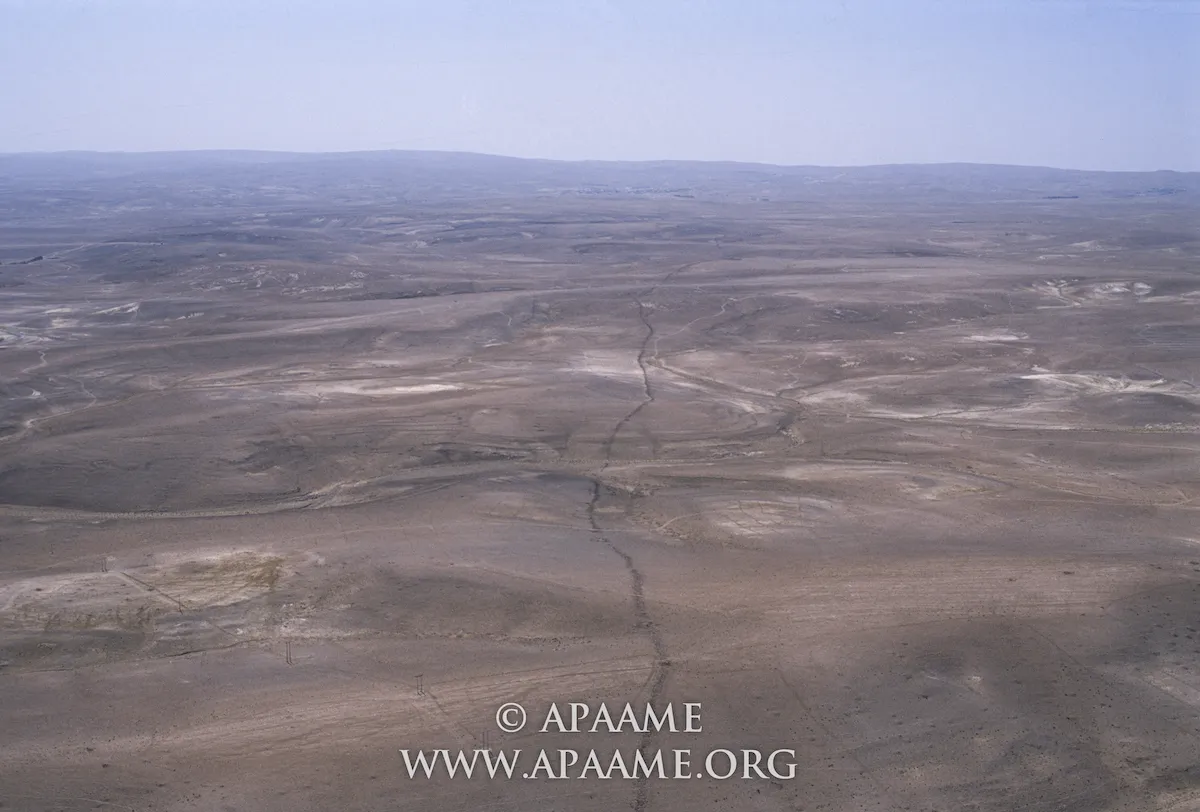
A new map of an ancient wall that extended 93 miles (150 kilometers) in Jordan has left archaeologists with a series of mysteries, including questions over when the wall was built, who built it and what its purpose was.
Known today as the "Khatt Shebib," the wall's existence was first reported in 1948, by Sir Alec Kirkbride, a British diplomat in Jordan. While traveling by airplane in Jordan, he saw a "stone wall running, for no obvious purpose, across country."
Archaeologists with the Aerial Archaeology in Jordan (AAJ) project have been investigating the remains of the wall using aerial photography. The researchers found that the wall runs north-northeast to south-southwest over a distance of 66 miles (106 km). The structure, they found, contains sections where two walls run side by side and other sections where the wall branches off. [See Photos of the Mysterious Ancient Wall in Jordan]
"If we add the spurs and stretches of parallel wall, the total [wall length] may be about 150 km (93 miles)," wrote David Kennedy, a professor at the University of Western Australia, and Rebecca Banks, a research assistant at Oxford University, in a paper published recently in the journal Zeitschrift für Orient-Archäologie.
Today, the wall is in ruins. However, "even in its original state, it cannot have been much more than a meter [3.3 feet] high and perhaps half a meter [1.6 feet] wide," wrote Kennedy and Banks.
Along the Khatt Shebib, the archaeologists also found the remains of an estimated 100 so-called towers, measuring 2 to 4 meters in diameter. Some of the towers were constructed after the wall was built, the researchers said.
One of the towers from the Khatt Shebib wall can be seen here.
The towers likely had a variety of uses. "Some may have been places of refuge — a secure place to overnight. Others may have been [used] as watch posts. Some, perhaps, [were] places in which hunters could hide until browsing fauna was close enough to try and bring down," Kennedy told Live Science.
Sign up for the Live Science daily newsletter now
Get the world’s most fascinating discoveries delivered straight to your inbox.
Ancient mystery
The research leaves archaeologists with a series of mysteries: When was the wall built? Who built it and why?
So far, the only dating information the scientists have comes from pottery found in the towers and other sites along the wall, Kennedy said. Based on the pottery found to date, the wall was likely built sometime between the Nabataean period (312 B.C.–A.D. 106) and the Umayyad period (A.D. 661–750), Kennedy said.
Though one of the kingdoms or empires that ruled Jordan in that long stretch of time could have built the wall, the structure might not have been constructed by a large state. "It is possible that local communities, seeing what neighbors have done and persuaded of its usefulness, simply copied the practice," Kennedy and Banks wrote.
The purpose of the wall is also a mystery. Its low height and narrowness indicate that it wasn't constructed for defensive reasons, said Kennedy and Banks. Traces of ancient agriculture are more visible to the west of the wall than to the east, suggesting the structure marked a boundary between ancient farmers and nomadic pastoralists, the researchers said. Or it may have marked a different type of boundary.
Ultimately, more on-the-ground fieldwork is needed to solve these mysteries. "Aerial archaeology will never resolve these key questions of purpose and date. For that, we require systematic fieldwork," Kennedy and Banks wrote.
Owen Jarus is a regular contributor to Live Science who writes about archaeology and humans' past. He has also written for The Independent (UK), The Canadian Press (CP) and The Associated Press (AP), among others. Owen has a bachelor of arts degree from the University of Toronto and a journalism degree from Ryerson University.