













Dark Pion Particles May Explain Universe's Invisible Matter

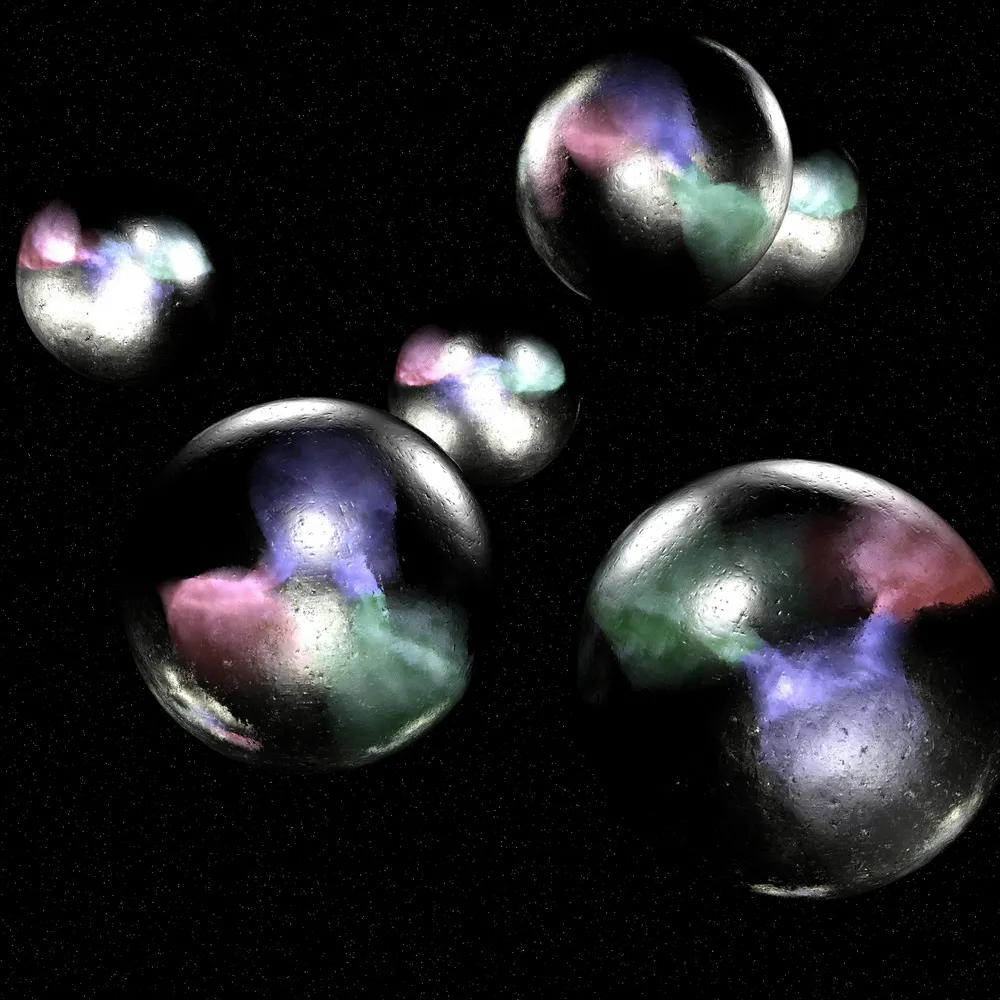
Dark matter is the mysterious stuff that cosmologists think makes up some 85 percent of all the matter in the universe. A new theory says dark matter might resemble a known particle. If true, that would open up a window onto an invisible, dark matter version of physics.
The only way dark matter interacts with anything else is via gravity. If you poured dark matter into a bucket, it would go right through it because it doesn't react to electromagnetism (one reason you can stand on the ground is because the atoms in your feet are repelled by the atoms in the Earth). Nor does dark matter reflect or absorb light. It's therefore invisible and intangible.
Scientists were clued into its existence by the way galaxies behaved. The mass of the galaxies calculated from the visible stuff they contained wasn't enough to keep them bound to each other. Later, observations of gravitational lensing, in which light bends in the presence of gravity fields, showed there was something that made galaxy clusters more massive that couldn't be seen. [The 9 Biggest Unsolved Mysteries in Physics]
Invisible pions
Now, a team of five physicists has proposed that dark matter might be a kind of invisible, intangible version of a pion, a particle that was originally discovered in the 1930s. A pion is a type of meson — a category of particles made up of quarks and antiquarks; neutral pions travel between protons and neutrons and bind them together into atomic nuclei.
Most proposals about dark matter assume it is made up of particles that don't interact with each other much — they pass through each other, only gently touching. The name for such particles is weakly interacting massive particles, or WIMPs. Another idea is that dark matter is made up of axions, hypothetical particles that could solve some unanswered questions about the Standard Model of particle physics. Axions wouldn't interact strongly with each other, either.
The new proposal assumes that the dark matter pions interact much more strongly with each other. When the particles touch, they partially annihilate and turn into normal matter. "It's a SIMP [strongly interacting massive particle]," said Yonit Hochberg, a postdoctoral researcher at Berkeley and lead author on the study. "Strongly interacting with itself."
Get the world’s most fascinating discoveries delivered straight to your inbox.
To annihilate into normal matter, the particles must collide in a "three-to-two" pattern, in which three dark matter particles meet. Some of the dark matter "quarks" that make up the particlesannihilate and turn into normal matter, leaving some dark matter behind. With this ratio, the result would leave the right proportion of dark matter to normal matter in the current universe.
This new explanation suggests that in the early universe the dark pions would have collided with each other, reducing the amount of dark matter. But as the universe expanded the particles would collide less and less often, until now, when they are spread so thinly they hardly ever meet at all.
The interaction bears a close resemblance to what happens to charged pions in nature. These particles consist of an up quark and an anti-down quark. (Quarks come in six flavors, or types: up, down, top, bottom, charm and strange.) When three pions meet, they partially annihilate and become two pions. [7 Strange Facts About Quarks]
"[The theory] is based on something similar — something that already happens in nature," said Eric Kuflik, a postdoctoral researcher at Cornell University in New York and a co-author of the study.
Different kind of pion
For the new explanation to work, the dark matter pions would have to be made of something different from normal matter. That's because anything made of normal quarks simply wouldn't behave the way dark matter does, at least not in the group's calculations. (There are theories that strange quarks could make up dark matter).
Charged pions are made up of an up quark and an anti-down quark, or a down and anti-up quark, while neutral pions are made of an up quark plus an anti-up or a down quark plus an anti-down.
In the new hypothesis, dark matter pions are made up of dark matter quarks that are held together by dark matter gluons. (Ordinary quarks are held together by normal gluons.) The dark quarks wouldn't be like the familiar six types, and the dark gluon would, unlike ordinary gluons, have mass, according to the mathematics.
Dark pions and dwarf galaxies
Another co-author on the paper, Hitoshi Murayama, professor of physics at the University of California, Berkeley, said the new hypothesis would help explain the density of certain kinds of dwarf galaxies. Computer simulations show dwarf galaxies with very dense center regions, but that isn't what astronomers see in the sky. "If SIMPs are spread out, the distribution is flatter — it works better," he said. [Gallery: Dark Matter Throughout the Universe]
Dan Hooper, a staff scientist at Fermi National Accelerator Laboratory in Illinois, said he isn't quite convinced that this model of dark matter is necessary to explain the dwarf galaxy conundrum. "There's a handful of people who say dwarfs don't look like we expect," he said. "But do you need some other property to solve that? People have showed it could be the heating of gas." That is, gas heated at the center of a dwarf galaxy would be less dense.
The Large Hadron Collider might soon offer some insight into which camp is correct; that strange new "dark pions" are dark matter or that they aren't and there's something else. Particle accelerators work by taking atomic nuclei -- usually hydrogen but sometimes heavier elements like lead —and smashing them together at nearly the speed of light. The resulting explosion scatters new particles, born of the energy of the collision. In that sense the particles are the "shrapnel."
Kuflik said that if there's "missing" mass (more precisely, mass-energy) from the collision of particles that's a strong pointer to the kind of dark matter that the researchers are looking for. This is because mass and energy are conserved; if the products of a collision don't tally up to the same amount of mass and energy you started with, that means there might be a previously unknown particle that escaped detection somewhere.
Such measurements are hard to do, though, so it will take a lot of sifting through data to see if that happens and what the explanation is.
Another way to track down dark matter particles might be in a detector made with liquid xenon or germanium, in which electrons would occasionally get knocked off an atom by a passing dark matter particle. There's already an experiment like that, though, the Large Underground Xenon (LUX) project in South Dakota. It didn't find anything yet, but it was focused on WIMPs (though it was able to rule out some types). A newer version of the experiment is planned; it might detect other kinds of dark matter particle.
The team is currently working on a paper outlining the kinds of observations that would detect this kind of dark matter. "We're currently working on writing up explicit ways these dark pions can interact with ordinary matter," Hochberg said.
The study appears in the July 10 issue of the journal Physical Review Letters.
Follow us @livescience, Facebook & Google+. Original article on Live Science.
